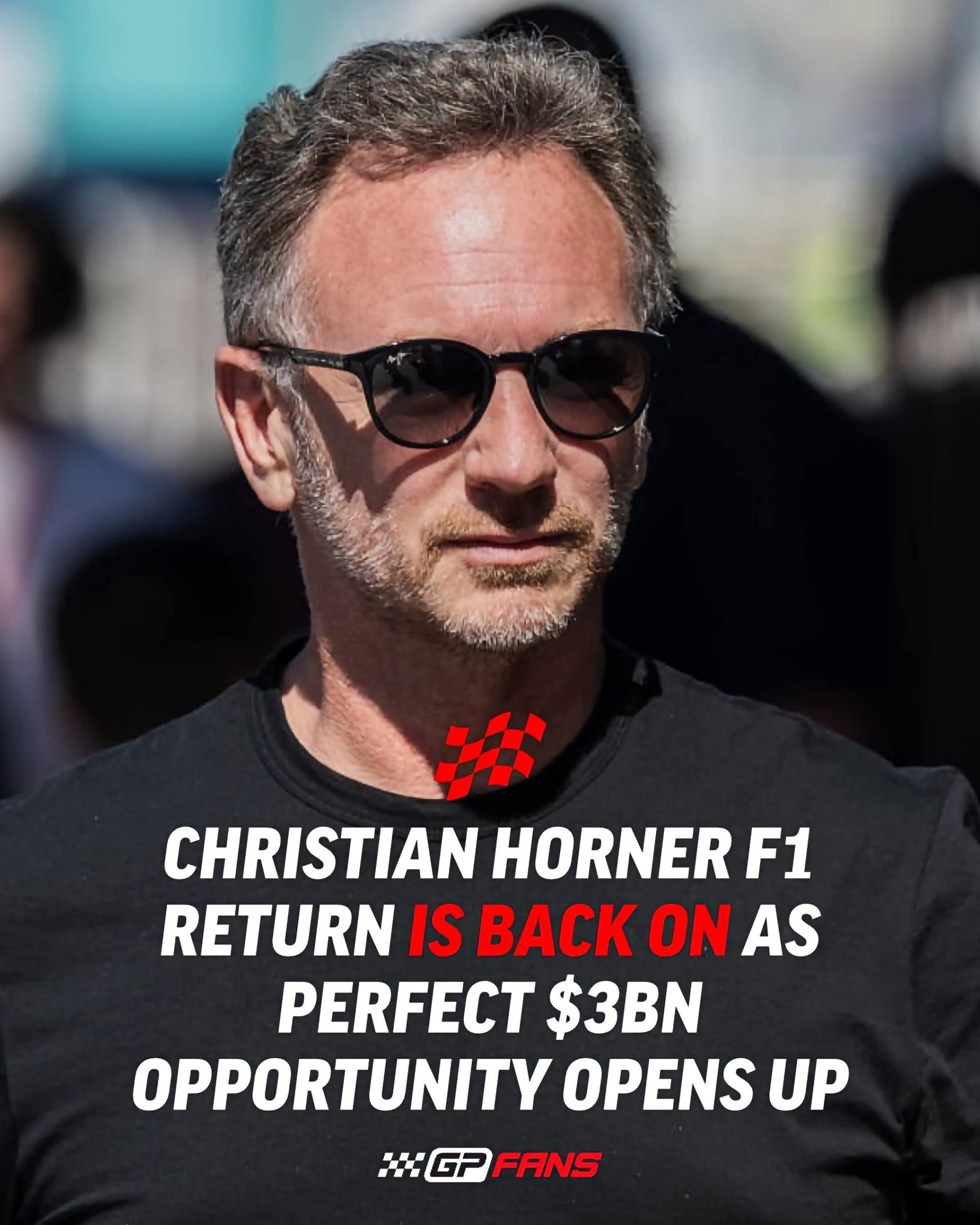
Christian Horner’s Formula 1 comeback could be closer than previously expected, with a potentially extraordinary ownership opportunity emerging that could transform his future in the sport. After months of uncertainty surrounding his next move following his departure from Red Bull, the former team principal is reportedly facing a situation that could finally deliver everything he has been demanding: ownership, influence and the opportunity to build another championship-winning organisation.
The 52-year-old has remained away from Formula 1 since being dismissed by Red Bull following the 2025 British Grand Prix. Despite continued speculation surrounding potential destinations, Horner has repeatedly made it clear that returning merely as a team principal would not satisfy his ambitions. He wants a meaningful stake in a team and greater control over its direction.
Now, reports surrounding Cadillac’s ownership have introduced a potentially game-changing possibility. TWG Global owner Mark Walter is reportedly considering selling the American Formula 1 operation for approximately $3 billion, creating an opportunity that could attract Horner and a consortium of investors.
If the development leads to a serious takeover attempt, Horner could return to Formula 1 in a position far more powerful than the one he occupied during his final years at Red Bull.
CHRISTIAN HORNER’S CADILLAC OPPORTUNITY COULD CHANGE EVERYTHING
The reported Cadillac sale possibility represents a significant development in Horner’s long-running search for a Formula 1 comeback.
According to GPFans, Mark Walter, the owner of TWG Global, is reportedly considering selling the Cadillac operation less than a year after the American team made its Formula 1 debut.
The reported asking price is approximately £3 billion, equivalent to around $4 billion, although the exact valuation and sale arrangements have not been independently confirmed.
Such a figure would place the operation among the most valuable assets in Formula 1, reflecting the extraordinary financial growth experienced by the championship in recent years.
For Horner, however, the appeal would extend beyond the financial value of the team.
Cadillac offers something that few established Formula 1 organisations can provide: the opportunity to influence a project from its earliest competitive stages and potentially reshape its entire operational structure.
Rather than inheriting an established team with entrenched leadership and processes, Horner could become part of an ownership group with the authority to determine how Cadillac develops.
That possibility makes the reported opportunity particularly attractive for someone who has openly prioritised ownership over a conventional management position.
WHY CADILLAC COULD BE THE PERFECT PROJECT FOR CHRISTIAN HORNER
Cadillac’s current position presents an enormous challenge, but it also creates an opportunity for someone with Horner’s experience.
The American outfit has entered Formula 1 with considerable financial backing and ambitious long-term objectives. However, building a competitive team from scratch is an entirely different task from purchasing an established championship-winning operation.
Cadillac must develop its technical structures, recruit experienced personnel, establish efficient decision-making processes and create a culture capable of competing against Formula 1’s strongest organisations.
These challenges are precisely where Horner’s previous experience could become valuable.
His arrival at Red Bull in 2005 came when the team had inherited an underperforming Jaguar operation that struggled to translate financial investment into consistent results.
Jaguar had spent several seasons attempting to establish itself as a competitive midfield team, but organisational inefficiencies and disappointing performances prevented it from becoming a serious championship contender.
Horner subsequently helped transform Red Bull into one of Formula 1’s most successful organisations.
The process was not immediate, but the team eventually developed into a championship-winning operation, securing multiple titles with Sebastian Vettel before repeating its success with Max Verstappen.
Cadillac would represent another opportunity for Horner to demonstrate that his management philosophy can produce results in a completely different environment.
RED BULL’S CHAMPIONSHIP SUCCESS COULD MAKE HORNER A SERIOUS CADILLAC ASSET
Horner’s reputation remains closely connected to the extraordinary achievements of Red Bull Racing.
Under his leadership, the team developed from a midfield operation into a championship-winning powerhouse, attracting some of the sport’s most influential technical and sporting personnel.
The recruitment of Adrian Newey proved particularly important, helping establish the technical foundation that eventually delivered multiple championship-winning cars.
Red Bull’s success demonstrated that building a Formula 1 team requires more than money.
It demands a clear competitive direction, effective leadership, strong technical recruitment and the ability to make decisions quickly when circumstances change.
Those qualities could be particularly important for Cadillac, which must establish itself against organisations with decades of experience and deeply developed technical structures.
Horner would not necessarily be expected to reproduce Red Bull’s success within four years. Cadillac’s challenges are different, and Formula 1’s competitive environment continues to evolve.
However, his experience could help accelerate the process of turning a new operation into a functioning and increasingly competitive team.
That is arguably the strongest argument in favour of his potential involvement.
CHRISTIAN HORNER COULD FINALLY GET THE OWNERSHIP HE WANTS
One of the biggest obstacles to Horner’s return has been his insistence that he does not want to work as a team principal without ownership involvement.
His ambitions have reportedly influenced several discussions involving possible Formula 1 destinations.
A potential acquisition of an Alpine stake associated with Otro reportedly failed to progress after Renault rejected the proposed arrangement.
Horner’s interest in Williams also attracted attention, although no agreement emerged.
There were additionally discussions surrounding a possible Formula 1 project involving BYD, but those prospects reportedly cooled.
The Cadillac situation could be different because a reported sale would create an opportunity to acquire an entire team rather than negotiate for a limited ownership position within an existing organisation.
A consortium involving Horner could potentially provide the financial resources required to pursue such a deal while allowing him to become a central figure in the team’s future.
That arrangement would align directly with his stated ambitions.
Instead of answering to an ownership group with limited influence over strategic decisions, Horner could potentially participate in shaping the organisation’s direction at the highest level.
For someone who previously controlled many aspects of Red Bull’s sporting operation, the prospect of greater ownership influence could be particularly appealing.
SEVEN POTENTIAL BUYERS REPORTEDLY CIRCLE CADILLAC
The reported Cadillac sale has also introduced an additional layer of uncertainty.
GPFans indicated that seven bidders were reportedly interested in purchasing the operation, suggesting that any potential acquisition could attract substantial competition.
If the reports are accurate, Horner would not necessarily have a straightforward route to securing the team.
A successful bid would likely require considerable financial backing, an attractive long-term development strategy and confidence that the prospective ownership group could support Cadillac’s ambitions.
The reported valuation also makes the transaction exceptionally significant.
A Formula 1 team is not simply a racing organisation. It represents a valuable commercial asset with sponsorship opportunities, global exposure, technological partnerships and potentially substantial long-term returns.
For investors, Cadillac’s American identity could offer additional advantages, particularly as Formula 1 continues expanding its presence in the United States.
However, the financial commitment required to compete successfully should not be underestimated.
The team still needs substantial investment in infrastructure, personnel and technical development before it can realistically challenge established championship contenders.
Any prospective owner would therefore be purchasing both an opportunity and a major long-term responsibility.
CADILLAC’S AMERICAN PROJECT COULD BECOME HORNER’S NEXT RED BULL
The possibility of Horner joining Cadillac raises an intriguing question about whether he could recreate the success he achieved at Red Bull.
The American team has a potentially valuable foundation.
Its entry into Formula 1 provides access to a rapidly expanding market, while its association with Cadillac offers significant commercial opportunities.
The challenge is converting those advantages into competitive performance.
Formula 1’s established teams possess sophisticated engineering departments, experienced personnel and extensive knowledge of the championship’s technical demands.
Cadillac must gradually develop comparable capabilities if it intends to challenge for victories and championships.
Horner’s experience in managing a championship-winning operation could help identify the personnel and organisational changes required to accelerate that process.
His ability to attract experienced engineers, establish clear responsibilities and maintain competitive pressure could become particularly important.
Nevertheless, the project would require patience.
Even with substantial investment and an experienced leadership structure, Cadillac would likely need several seasons to develop into a genuine championship contender.
The potential attraction for Horner is that he could help shape that journey rather than inherit a finished product.
CHRISTIAN HORNER’S RETURN COULD SHAKE UP THE F1 PADDOCK
A Horner comeback would immediately attract attention across the Formula 1 paddock.
His departure from Red Bull marked the end of one of the most influential leadership periods in the team’s history, but it did not necessarily mean his involvement in the sport was permanently finished.
A return through Cadillac ownership could create an entirely different dynamic.
Horner would potentially be operating outside the traditional structure of an established team, with the authority to develop a new organisation and recruit personnel according to his own vision.
That could eventually create another major competitive force in Formula 1.
It would also place him back into direct competition with familiar rivals, including Mercedes team principal Toto Wolff, whose leadership has shaped another of the championship’s dominant organisations.
The prospect of Horner rebuilding a team while Wolff continues leading Mercedes could reignite one of Formula 1’s most intense management rivalries.
However, the competitive implications would depend entirely on whether a deal materialises and what responsibilities Horner would ultimately assume.
At present, the Cadillac ownership story remains a reported opportunity rather than a confirmed agreement.
THE $3 BILLION QUESTION: WILL CHRISTIAN HORNER FINALLY RETURN?
Christian Horner’s Formula 1 future has remained uncertain since his departure from Red Bull, but the reported Cadillac sale could represent the most compelling opportunity to emerge so far.
The potential acquisition would satisfy several of his long-standing ambitions, including ownership, influence and the chance to build another successful team.
It would also present an enormous challenge.
Cadillac is still developing its competitive identity, and transforming a new Formula 1 operation into a championship-winning organisation requires years of investment, recruitment and technical progress.
Horner’s Red Bull experience provides a compelling reason for investors to consider his involvement, but past success does not guarantee another championship-winning project.
The reported interest from multiple bidders could also complicate any potential takeover.
For now, there is no confirmed announcement that Horner has submitted a bid, joined a consortium or agreed to return to Cadillac.
Nevertheless, the possibility is significant enough to reshape discussions surrounding his future.
If Christian Horner really wants to return to Formula 1 with ownership and complete influence over a team’s direction, Cadillac could finally offer him the opportunity he has been waiting for.
And if he succeeds in turning America’s newest F1 operation into a championship contender, his next chapter could become just as remarkable as the Red Bull dynasty he helped create.