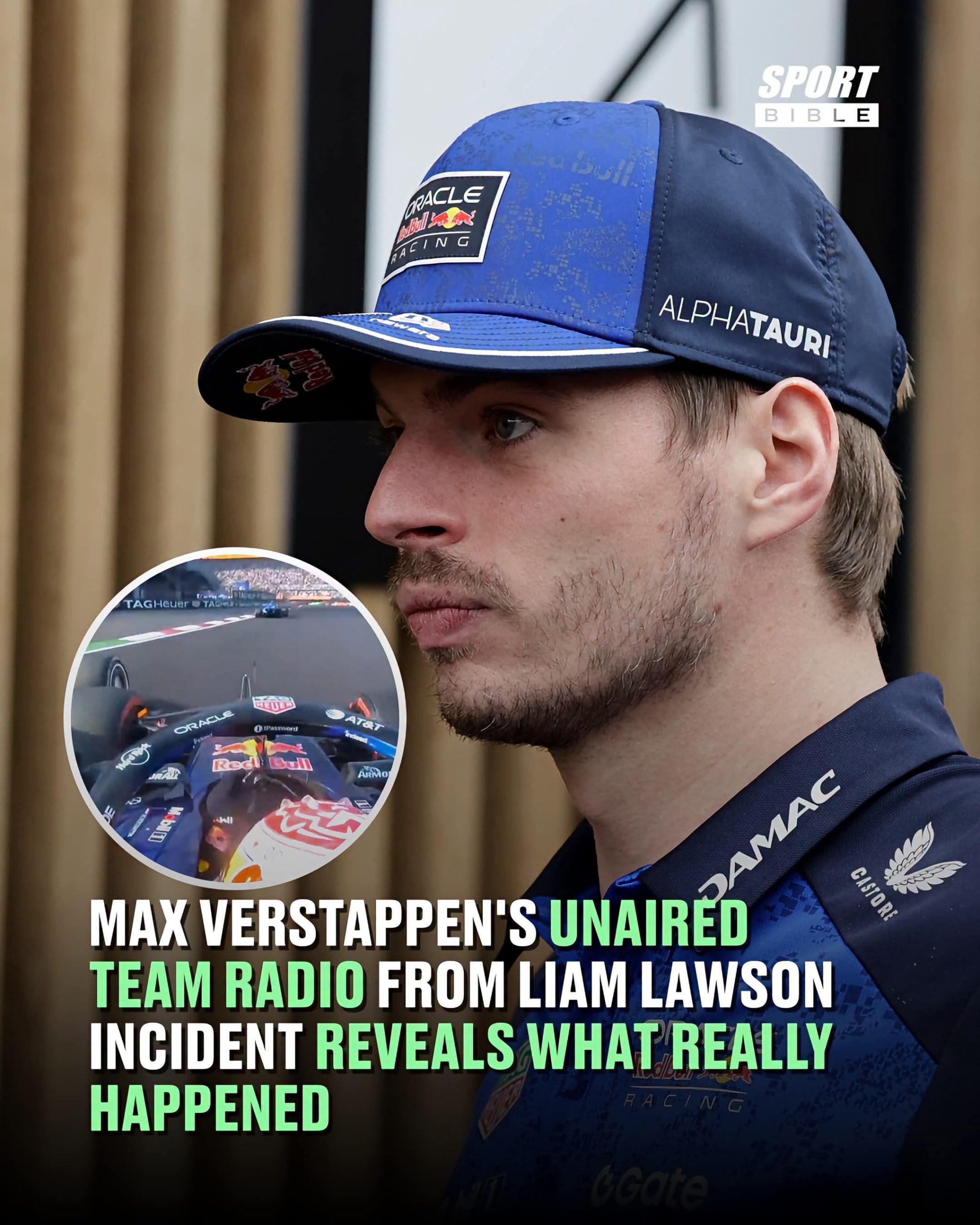
Max Verstappen’s collision with Liam Lawson during second practice at the Mexican Grand Prix has taken another interesting turn after previously unaired team radio revealed what both drivers were told before the incident.
The Red Bull champion and Racing Bulls driver were each handed a one-place grid penalty and a penalty point following their controversial encounter at Turn 12. However, the newly revealed radio exchanges provide important context about how the situation developed and why the stewards considered both drivers responsible.
The incident happened when Verstappen attempted to overtake Lawson into Turns 12 and 13. Lawson defended his position, forcing Verstappen off the circuit. The Dutchman rejoined at Turn 14, where the two cars made contact.
VERSTAPPEN WAS EXPLICITLY TOLD TO TARGET LAWSON
The newly revealed radio exchanges show that Lawson had been informed that Verstappen was approaching on an out-lap.
His race engineer, Alexandre Iliopoulos, told him:
“Not pushing, his out lap.”
Lawson acknowledged the information before being told that Carlos Sainz had aborted his lap and that Verstappen was behind.
However, the situation became more interesting when Verstappen’s race engineer, Gianpiero Lambiase, gave the four-time world champion a different instruction.
“So, Lawson and Sainz… let’s try to get track position on Lawson. Let’s go, Max.”
That message suggests Red Bull was actively looking to secure track position rather than simply allowing Verstappen to continue behind Lawson.
The radio exchange does not establish that either driver deliberately caused the collision, but it helps explain why the two cars ended up fighting for position during practice.
LAWSON’S RADIO REACTION SHOWS HOW FRUSTRATED HE WAS
During the incident, Lawson made his frustration clear over the team radio.
“If I back out every single time, what the f— do I do? He actually came off the track into the side of me,” the New Zealander said.
Lawson’s argument was that he could not continually surrender his position whenever a faster driver approached.
From his perspective, Verstappen had attempted an overtake and then made contact after leaving the circuit. But the FIA stewards did not accept that only one driver was responsible for the incident.
VERSTAPPEN QUESTIONS LAWSON’S JUDGEMENT
Verstappen was equally unhappy with how Lawson handled the situation.
The Red Bull driver suggested that Lawson accelerated when he saw him approaching and questioned why the Racing Bulls driver would risk such an encounter while his future in Formula 1 remained uncertain.
“When he saw me coming, he suddenly started to accelerate,” Verstappen explained.
He also delivered a pointed warning, saying that fighting for a seat made Lawson’s behaviour particularly questionable.
The comments added another layer to the controversy because Lawson has yet to secure confirmation of his place on the 2027 grid.
FIA PUNISHES BOTH DRIVERS AFTER MEXICO COLLISION
The stewards ultimately handed both drivers a one-place grid penalty and one penalty point on their Super Licences.
Their explanation was particularly revealing. The FIA stated that Verstappen was on a preparation lap while Lawson was on a cool-down lap ahead of another push lap.
The stewards also noted that both drivers behaved in a manner considered unacceptable, particularly because teams had already received a warning during the earlier team managers’ meeting.
Both drivers admitted that their moves were unnecessary and clumsy.
THE INCIDENT RAISES QUESTIONS ABOUT LAWSON’S FUTURE
For Lawson, the collision arrived at a particularly sensitive moment. His future at Racing Bulls remains uncertain, with Red Bull junior Nikola Tsolov reportedly among the contenders for a 2027 opportunity.
Every remaining race could influence how the Red Bull management evaluates its driver options.
Verstappen, meanwhile, has little reason to welcome unnecessary incidents during a championship campaign. The Dutchman was clearly frustrated that a practice session had turned into a damaging confrontation.
The previously unaired radio messages reveal that both teams were aware of the other driver’s position before the collision. However, they do not completely settle the argument over who was most responsible.
One thing is clear: the Mexico incident was not simply an ordinary practice-session misunderstanding. It exposed the fine line between defending track position and taking unnecessary risks, particularly when a driver’s future is under pressure.