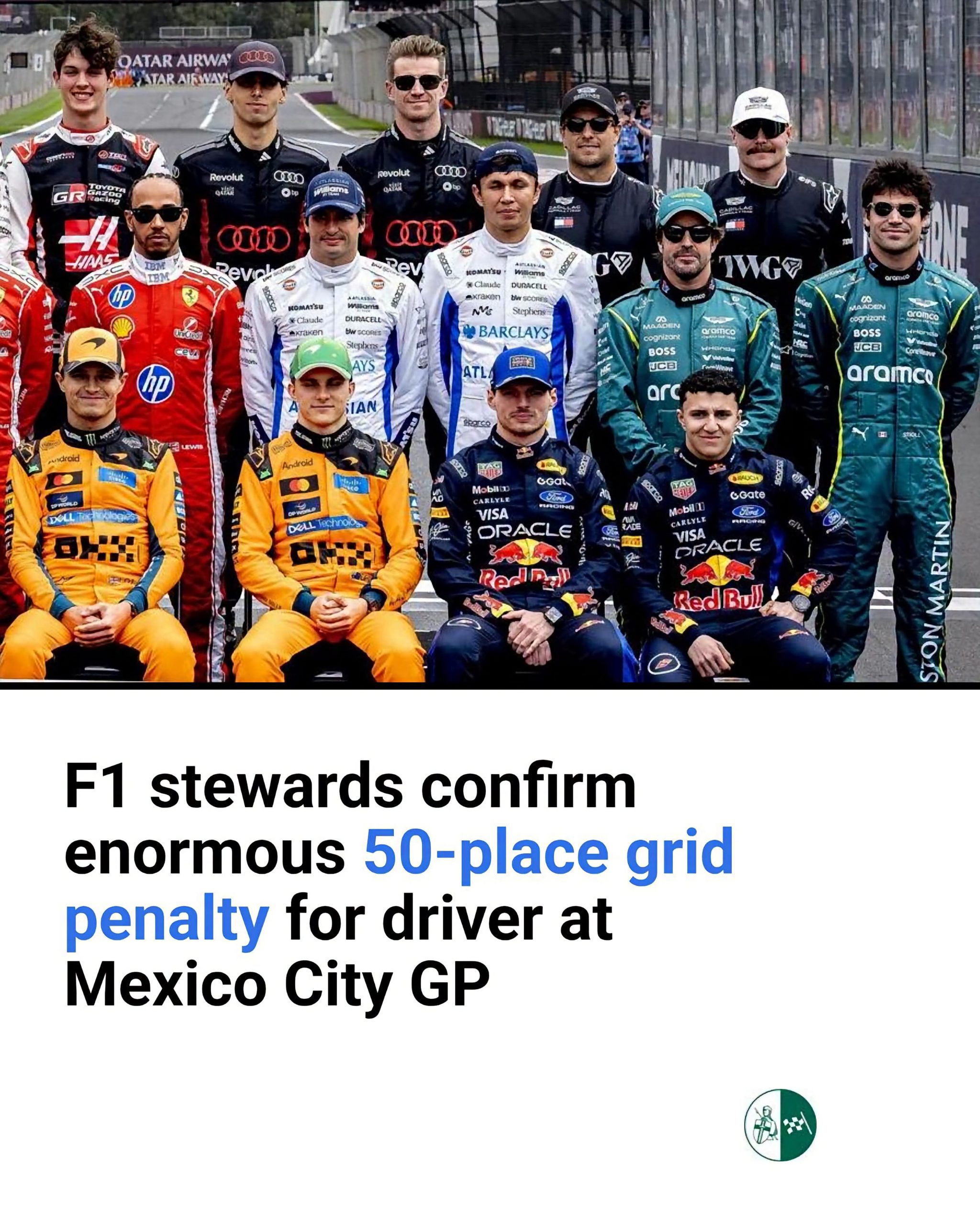
Valtteri Bottas has been handed a staggering 50-place grid penalty for the Mexico City Grand Prix after Cadillac introduced five new power-unit components that exceeded his permitted allocation for the 2026 Formula 1 season.
The penalty effectively guarantees that the Finnish driver will start Sunday’s race from the back of the grid, regardless of where he finishes in qualifying. It is another frustrating setback for Bottas, whose season has already been affected by repeated reliability problems and an uncertain future with the American manufacturer.
The decision comes at a particularly difficult moment. Cadillac is still evaluating its driver line-up for 2027, with Colton Herta increasingly linked to the available race seat. Meanwhile, team principal Marcin Budkowski has made it clear that Bottas must deliver stronger performances consistently if he wants to remain part of the project.
FIVE NEW POWER-UNIT COMPONENTS TRIGGER 50-PLACE PENALTY
The FIA confirmed that Cadillac had introduced five new components into Bottas’ power-unit pool ahead of the Mexico City Grand Prix.
The components include:
– Internal combustion engine (ICE).
– Turbocharger.
– Energy store.
– Control electronics unit.
– Motor generator unit-kinetic (MGU-K).
Each component exceeded Bottas’ permitted seasonal allocation, and each represented a first offence for that particular component.
Under Formula 1’s power-unit regulations, the first use of an additional component beyond the allocation normally carries a 10-place grid penalty. With five separate components involved, Bottas accumulated a total of 50 places’ worth of penalties.
However, Formula 1 regulations do not allow drivers to serve an unlimited number of grid positions. When the accumulated penalty exceeds 15 places, the driver is automatically required to start from the back of the grid.
That means Bottas faces a difficult Sunday before the race has even begun.
Even a surprisingly strong qualifying performance would not change his starting position. His focus will instead be on preparing for a race in which overtaking, tyre management and avoiding further reliability problems could become especially important.
CADILLAC’S RELIABILITY PROBLEMS CONTINUE
The latest penalty is another reminder of the technical difficulties Cadillac has experienced during its debut Formula 1 campaign.
The team entered the championship with considerable expectations, but establishing a competitive operation in Formula 1 has proved challenging. Reliability has been one of the biggest obstacles, with Bottas suffering nine retirements during the season, eight of which were attributed to technical problems.
His latest retirement came at the United States Grand Prix in Austin, where he was forced to pull over with only a handful of laps remaining. A suspected power-unit issue was identified as the reason behind the problem.
The decision to introduce several new components in Mexico suggests Cadillac is attempting to address the reliability concerns rather than risk another failure.
However, the consequence is a major sporting disadvantage for Bottas.
There is also a wider issue for the team. Every additional power-unit component comes with financial and operational consequences, particularly under Formula 1’s cost-control environment. Cadillac needs to improve reliability without allowing technical setbacks to undermine its ability to develop the car.
For a new manufacturer-backed team, solving these problems is essential to building credibility and competing more consistently against established rivals.
COLTON HERTA GETS A CHANCE IN BOTTAS’ CADILLAC
One of the most interesting details surrounding the weekend is that Bottas was not the first driver to use the car fitted with the new power-unit components.
That opportunity went to Colton Herta during Friday’s first practice session.
The American participated in FP1 as part of his Formula 1 preparation, with the session helping him secure the final Super Licence point required to become eligible to compete in F1 next season.
Herta’s involvement is significant because he is widely considered a leading candidate for Cadillac’s second race seat alongside Sergio Perez in 2027.
His move from IndyCar to Formula 2 has not been straightforward, but his experience in American open-wheel racing and his connection to Cadillac make him an attractive option for the organisation.
Mercedes reserve driver Frederik Vesti also participated in FP1 in Mexico and remains another potential candidate.
Cadillac therefore has several options to consider as it evaluates the best combination of experience, development ability and long-term potential.
BUDKOWSKI SENDS BOTTAS A CLEAR MESSAGE
While Bottas continues to fight for his future, Cadillac team principal Marcin Budkowski has made it clear that strong performances must become a regular occurrence.
Speaking after the Mexico FP1 session, Budkowski acknowledged that Bottas delivered a positive performance in Austin.
“Valtteri did a really good race in Austin: he was strong in qualifying and he was strong in the race as well, and that’s what he needs to do, race in, race out,” he explained.
He also recognised that Bottas has demonstrated competitive pace alongside Perez on several occasions.
“We’ve seen weekends where he was on it, on pace with Checo [Sergio Perez] and sometimes even a bit quicker. We need more of that.”
Those comments are important because they suggest Cadillac has not completely dismissed Bottas’ contribution.
The team recognises his experience and ability, but it wants greater consistency. Occasional strong weekends are unlikely to be enough when a driver is competing against younger alternatives for a long-term position.
Bottas must therefore make the most of the remaining races, even when technical problems and grid penalties complicate his chances.
CAN BOTTAS STILL SAVE HIS CADILLAC SEAT?
The biggest question surrounding Bottas is whether his experience will be enough to convince Cadillac that he remains the right driver for its future.
At 37, the Finnish driver brings considerable knowledge from his years at Mercedes and other Formula 1 teams. He understands how to develop a car, work with engineers and manage the demands of a championship campaign.
Those qualities could be valuable to Cadillac as it continues building its operation.
However, Herta offers something different. His American racing background could strengthen Cadillac’s connection with the United States market, while his potential gives the team an opportunity to invest in a younger driver.
Vesti also represents an alternative with experience inside the Mercedes development programme.
For Cadillac, the decision is not simply about choosing the fastest driver available. It must consider commercial interests, technical feedback, development potential and the balance between its two drivers.
Perez already provides substantial Formula 1 experience, meaning the team could decide that a younger second driver offers a more attractive long-term combination.
Nevertheless, replacing Bottas would mean losing a driver who understands the demands of competing at the highest level and has experienced championship-winning machinery.
MEXICO GP COULD BECOME ANOTHER TEST OF BOTTA’S RESILIENCE
The 50-place penalty makes Bottas’ Mexico City weekend considerably more complicated, but it does not remove the importance of his performance.
Starting from the back means he will need to manage traffic carefully, identify overtaking opportunities and avoid getting caught in incidents during the opening laps.
The high-altitude conditions at the Autódromo Hermanos Rodríguez also create additional challenges for power-unit performance, cooling and aerodynamic efficiency.
If Cadillac can provide Bottas with a reliable car, he will have an opportunity to demonstrate his racecraft despite the grid disadvantage.
More importantly, he needs to show the team that he can consistently deliver the kind of performances Budkowski praised in Austin.
The penalty itself is a consequence of Cadillac’s technical situation, not necessarily a reflection of Bottas’ driving ability. But with his 2027 future unresolved, every remaining opportunity to make a positive impression matters.
For now, Cadillac must focus on getting its reliability under control, while Bottas faces the difficult task of proving that experience still has a place in the team’s long-term plans.