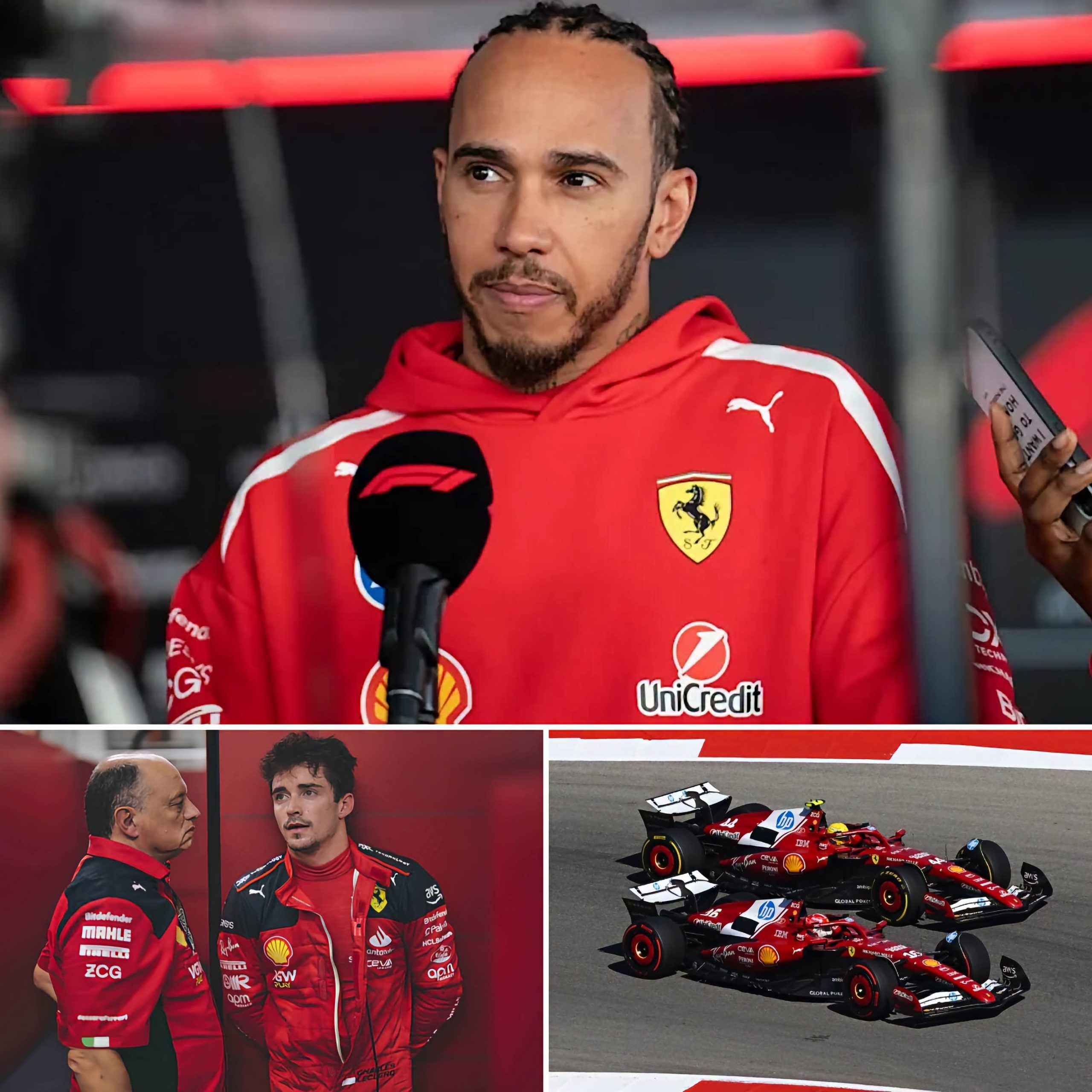
Lewis Hamilton’s competitive instincts remain as strong as ever, and a reported disagreement with Ferrari over team orders at the Mexican Grand Prix has reignited the debate about how the Scuderia should manage its two star drivers.
The controversy centres on an alleged instruction from Ferrari’s pit wall asking Hamilton to surrender his track position to Charles Leclerc. The seven-time world champion reportedly questioned the reasoning behind the request, unwilling to sacrifice his own race result without being convinced that the move was justified.
Although the dramatic account has attracted attention, the specific radio exchanges and Leclerc’s alleged ten-word response have not been independently verified. They should therefore be treated cautiously rather than presented as confirmed verbatim conversations.
Nevertheless, the situation raises an important question for Ferrari: how does a team balance the ambitions of two highly competitive drivers while protecting its own championship objectives?
WHY FERRARI’S TEAM ORDERS COULD BECOME A MAJOR PROBLEM
Team orders are among the most difficult decisions in Formula 1. A team may have two drivers competing for individual results, but its ultimate responsibility is to maximise the combined points scored across both cars.
There are circumstances in which asking one driver to move aside makes strategic sense. If one car is significantly faster, has a better tyre advantage or is fighting for a more important position, allowing the drivers to exchange places could improve the team’s overall result.
However, the decision becomes much harder when both drivers believe they have earned their positions.
Hamilton’s reported resistance reflects a familiar problem in elite motorsport. Drivers spend an entire race fighting for every position, managing their tyres and taking risks to gain an advantage. Being asked to surrender that advantage without a clear explanation can create frustration, particularly when the driver believes his own pace is competitive.
Ferrari must therefore ensure that any team-order instruction is supported by clear strategic reasoning. Otherwise, the pit wall risks turning a tactical decision into a much bigger internal dispute.
HAMILTON HAS NO REASON TO ACCEPT A SECONDARY ROLE
Hamilton arrived at Ferrari with an extraordinary record and the ambition to add another championship to his achievements. His experience and reputation naturally make him one of the most influential figures in the garage.
But Formula 1 does not award positions based on past championships. Every driver must prove his performance on the current circuit, and Hamilton will expect to be judged by the same standards as his teammate.
That is why a request to surrender position could become particularly sensitive if Hamilton believes he has the pace and tyre condition to finish ahead.
His competitive identity has always been built around challenging for the best possible result. Even during difficult periods, he has continued to demand more from himself and his machinery.
Ferrari must recognise that signing a seven-time champion means managing a driver who expects to compete, not simply follow instructions without understanding their purpose.
LECLERC ALSO HAS A STRONG CASE TO FIGHT FOR HIS POSITION
Charles Leclerc is not a driver who can be expected to accept a secondary role automatically either.
The Monegasque has spent years building his position within Ferrari, developing relationships with the engineers and carrying the expectations of a team that has invested heavily in his future.
He has experienced difficult seasons, strategic mistakes and disappointing championship campaigns, yet his commitment to Ferrari has remained central to his career.
If Leclerc believes he is faster or has a genuine strategic advantage, he will naturally expect the team to consider his position seriously.
The challenge is ensuring that neither driver feels the team is favouring the other. A perceived imbalance could damage trust inside the garage and make future strategic decisions even more complicated.
The alleged exchange in Mexico, particularly the reported response from Leclerc, would fit into the wider narrative of two ambitious drivers fighting to establish their position. However, without verified radio recordings or official confirmation, the exact wording should not be treated as fact.
FERRARI MUST AVOID REPEATING FORMULA 1’S BIGGEST TEAM-RIVALRY MISTAKES
Formula 1 history is filled with examples of teams struggling to control two drivers with championship ambitions.
The rivalry between Ayrton Senna and Alain Prost at McLaren remains one of the sport’s most famous examples. Their competition became so intense that it eventually overshadowed the team’s wider achievements.
Lewis Hamilton’s relationship with Nico Rosberg at Mercedes provides another warning. Despite delivering enormous success for the team, their battle for supremacy became increasingly hostile, culminating in several controversial moments on track.
Red Bull also experienced internal tension during the Sebastian Vettel and Mark Webber era, most famously during the 2013 Malaysian Grand Prix, when Vettel ignored team instructions and overtook Webber despite an apparent agreement to hold positions.
These examples demonstrate that having two outstanding drivers can be both an advantage and a serious management challenge.
Ferrari must avoid allowing individual competition to become more important than the team’s overall objectives.
WHAT THE INCIDENT COULD MEAN FOR FERRARI’S CHAMPIONSHIP AMBITIONS
Every point matters in Formula 1, particularly when the fight for the Constructors’ Championship is close.
A driver refusing to follow an instruction could potentially cost the team valuable points. Equally, forcing a driver to surrender a position unnecessarily could damage confidence and create resentment that affects future races.
Ferrari’s management must therefore make decisions based on performance data, tyre conditions, race pace and the championship situation rather than reputation or internal politics.
There is also a long-term consideration. Hamilton and Leclerc need to maintain a working relationship if Ferrari hopes to build a successful development programme. Both drivers provide valuable technical feedback, and internal hostility could make that process more difficult.
The team cannot afford to turn every close racing situation into a public argument.
FERRARI’S BIGGEST CHALLENGE MAY BE INSIDE ITS OWN GARAGE
The reported Mexico controversy highlights the difficult balance Ferrari faces with two ambitious drivers.
Hamilton wants to demonstrate that he remains capable of fighting at the front, while Leclerc has his own ambitions and a long-standing connection with the team. Neither can be expected to surrender opportunities simply because of their reputation or position within the organisation.
For Ferrari, the solution must be consistency. Drivers need to understand when team orders will be used, why they are necessary and what circumstances justify changing positions.
If the team fails to establish that clarity, similar disagreements could become a recurring feature of its race weekends.
The most important question is not whether Hamilton or Leclerc deserves preferential treatment. It is whether Ferrari can create a system that allows both drivers to compete while ensuring the team’s interests come first.
That balance could prove just as important as the performance of the car in determining Ferrari’s future success.