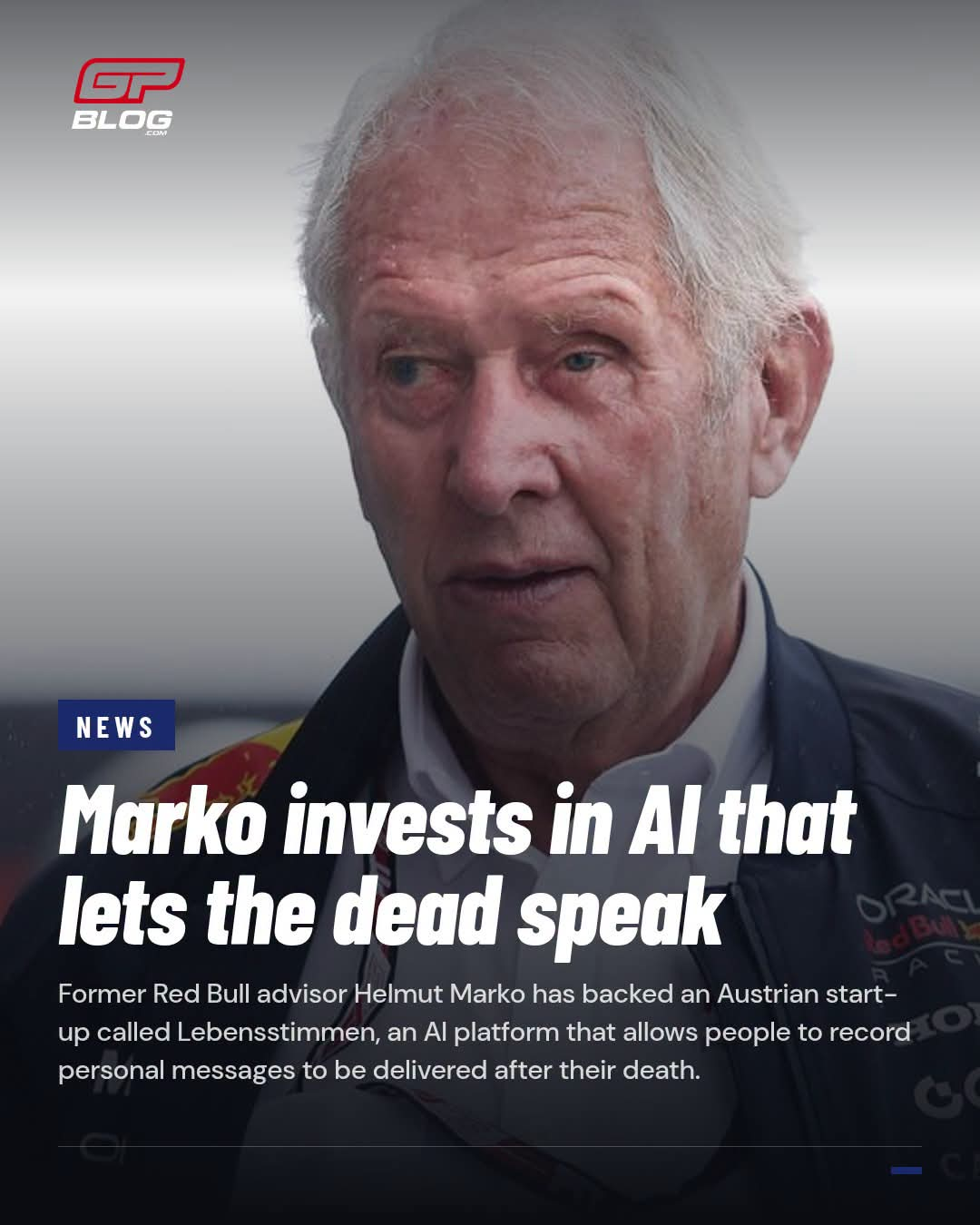
Helmut Marko has spent decades shaping Formula 1 through talent, ruthlessness, and an unblinking eye for potential. After two decades as Red Bull’s motorsport adviser and the driving force behind its junior programme, the Austrian left the sport at the end of 2025. Now the 83-year-old has attached his name to a project that feels completely alien to the paddock: an artificial-intelligence platform designed to let people speak after they die.
The startup is called Lebensstimmen in German and Words That Remain internationally. Unveiled at a press conference in Vienna, it creates AI-based avatars that can deliver personal messages prepared during a user’s lifetime. Recipients and conditions can be chosen in advance. In the most striking use case, the deceased can address mourners at their own funeral.
Marko appeared alongside the company’s founders and Austrian cathedral pastor Toni Faber. He framed the technology in language familiar to anyone who has followed his career. “This project is using very new technology, mainly AI. So it offers a very unique opportunity for the last will, and also the possibility that the one who died speaks personally at his funeral,” he said.
FROM LE MANS WINNER TO RED BULL KINGMAKER TO AI INVESTOR
Marko’s path to this point is well known inside Formula 1. A former driver who won the 1971 24 Hours of Le Mans, his racing career ended after a 1972 accident left him blind in one eye. He reinvented himself as a talent scout and team manager, founding what became the Red Bull Junior Team. From 2005 until the end of 2025 he advised Red Bull Racing and its sister team, helping produce champions Sebastian Vettel and Max Verstappen along with a long list of other Formula 1 graduates.
His methods were often blunt and polarising. Drivers who failed to meet the standard were moved on quickly. Those who succeeded, most notably Verstappen, gained a powerful ally. After more than 20 years and multiple world titles, Marko stepped away following the 2025 season, citing the emotional weight of missing another drivers’ championship among other factors. He later ruled out a return to Formula 1, saying success with Red Bull should stand alone.
The move into AI therefore marks a clean break. Instead of evaluating young drivers under pressure, Marko is now backing technology that preserves voices and presence after death. The contrast is stark: a man whose public image was built on decisive, sometimes harsh judgments about living talent is investing in a tool meant to give the dead a final say.
WHY THIS PROJECT MATTERS BEYOND THE HEADLINES
Digital afterlife technology is no longer pure science fiction. Startups and larger tech companies have experimented with chatbots trained on personal data, voice cloning, and interactive memorials. Lebensstimmen appears focused on controlled, intentional messages rather than open-ended conversation. Users prepare content while alive; the system then delivers it under specified conditions. The funeral-address feature is the element most likely to generate both fascination and discomfort.
Marko’s involvement gives the project visibility it might not otherwise achieve. His name still carries weight among motorsport audiences and Austrian media. Pairing him with a high-profile religious figure such as Faber also signals an attempt to address ethical and pastoral questions early. Death, memory, and technology sit at the intersection of practical need, emotional comfort, and cultural taboo. An AI that lets someone “speak” at their own funeral forces those questions into the open.
For Formula 1, the story is a reminder that the sport’s larger-than-life personalities do not disappear when they leave the paddock. Marko remains a public commentator on current events, offering sharp opinions on drivers, engines, and team performance. Investing in Lebensstimmen shows a different side: curiosity about technology that has little to do with lap times or championship points.
THE BROADER IMPLICATIONS FOR ATHLETES, TEAMS, AND SOCIETY
High-profile athletes and executives already think carefully about legacy. Contracts, foundations, and carefully managed public images are common. An AI platform that allows pre-recorded or generative personal messages adds another layer. Families of deceased drivers or team principals could one day receive messages timed for specific anniversaries or milestones. Teams might explore digital archives that preserve institutional knowledge in more personal forms. Whether any of that becomes mainstream remains uncertain, but the technology is being built now.
Critics will raise valid concerns about consent, data security, emotional manipulation, and the risk of commercialising grief. Supporters will point to the value of intentional final communication, especially for people who want to leave specific words for children, partners, or colleagues. Marko’s comparison to motorsport technology is instructive. Formula 1 has long embraced new tools when they deliver a competitive edge. Here the edge is emotional and personal rather than on-track.
WHAT COMES NEXT FOR MARKO AND THE TECHNOLOGY
Marko has described his post-Red Bull life as more relaxed while still staying informed. This investment fits a pattern of selective engagement rather than full retirement. Whether Lebensstimmen gains commercial traction will depend on user adoption, regulatory treatment of AI-generated content involving the deceased, and public acceptance of the concept. Early coverage has already labelled the venture “bizarre,” which is both a marketing challenge and a sign that it has captured attention.
For Formula 1 fans, the story offers a rare glimpse of a familiar figure operating far outside the usual ecosystem of teams, drivers, and regulations. Marko helped build one of the most successful driver development systems in the sport’s history. Now he is helping fund a system designed to keep voices present after the final chequered flag has fallen. The technology may never appear in a garage or on a timing screen, yet it reflects the same instinct that defined his career: identifying something new, backing it, and letting the results speak for themselves.
The project is unlike anything previously associated with Marko or with Formula 1. That is precisely why it stands out.