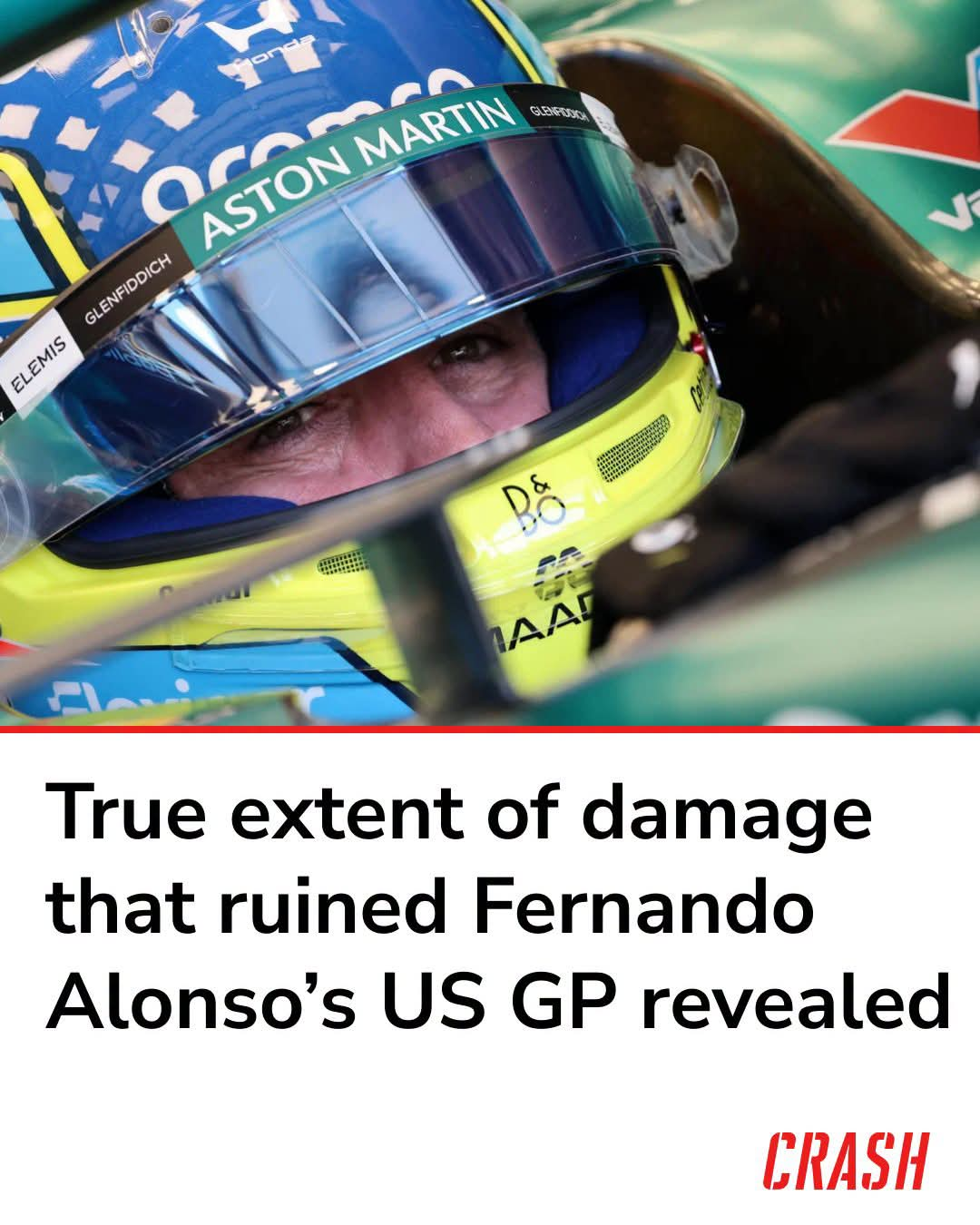
Fernando Alonso’s disappointing United States Grand Prix has taken another frustrating turn after the full extent of the damage to his Aston Martin AMR26 was revealed. The two-time Formula 1 world champion suffered a major setback on the opening lap at the Circuit of The Americas, with contact involving Alex Albon leaving his car severely damaged and potentially costing him a valuable points finish.
Alonso started the race from 12th on the grid but quickly found himself caught in a battle with Albon’s Williams at Turn 11. The two drivers made contact, with Albon’s front-right wheel striking the left-hand side of Alonso’s Aston Martin. The impact damaged several aerodynamic components, including the floor edge, bargeboards and deflectors, compromising the car’s performance for the remainder of the race.
ALONSO REVEALS THE EXTENT OF ASTON MARTIN’S DAMAGE
The damage proved far more serious than an ordinary first-lap collision. Alonso revealed after the race that approximately half of his car’s floor was missing, forcing him to continue with a machine that had lost a significant amount of its aerodynamic performance.
According to the Spaniard, the damage cost him approximately half a second per lap or potentially more. He also explained that the car became increasingly difficult to control, particularly through left-hand corners, as additional pieces of the floor were lost during the race.
Alonso admitted that he had considered retiring the car because of the condition it was in. However, Aston Martin fitted a replacement front wing, allowing him to continue and gather additional data. Despite his determination to reach the finish, he could only manage 16th place, missing out on the points.
PEDRO DE LA ROSA REACTS TO ALONSO’S SURPRISING PACE
Images shared after the race by Aston Martin ambassador and former F1 driver Pedro de la Rosa provided a clearer picture of the damage. The photographs showed how extensively the car’s aerodynamic components had been affected by the collision.
De la Rosa described Alonso’s pace as surprising given that the Aston Martin was missing a substantial section of its floor, alongside multiple deflectors and bargeboards. His reaction highlighted the challenge Alonso faced in keeping the car competitive despite the significant loss of aerodynamic efficiency.
In modern Formula 1, the floor is one of the most important elements of a car’s aerodynamic package. It helps generate downforce, allowing drivers to maintain grip through corners and control the car at high speed. Damage to this area can dramatically alter the balance of the car, making it more difficult to turn, brake consistently and manage tyre performance.
ALONSO QUESTIONS THE QUALITY OF DRIVERS FURTHER DOWN THE GRID
The incident also reignited Alonso’s frustration with the level of driving he believes is being demonstrated towards the back of the grid. Following the collision, the Aston Martin driver criticised what he described as the low quality of drivers in the lower third of the field, pointing to the contact with Albon as an example.
Alonso argued that starting further down the grid exposes drivers to greater risks during the opening laps, when several cars are fighting for position in limited space. He suggested Aston Martin must improve its performance so that he can begin races closer to the front and reduce the likelihood of becoming involved in such incidents.
His remarks are likely to generate debate throughout the paddock. While experienced drivers often face difficult decisions in crowded first-lap battles, contact can happen even when neither competitor intends to cause damage. The incident involving Alonso and Albon was not investigated by the stewards at the United States Grand Prix, meaning no official penalty was issued in relation to the clash.
COULD ALONSO HAVE SCORED POINTS WITHOUT THE DAMAGE?
Alonso believes a points finish was a realistic possibility had his Aston Martin remained intact. He explained that he was running around 12th position despite effectively driving with a severely compromised car, suggesting that the team may have had an opportunity to fight for a better result.
However, a points finish cannot be guaranteed simply by calculating the time lost to damage. Race strategy, tyre degradation, traffic and the performance of rival cars all influence the final classification. What the damage does establish is that Alonso was unable to demonstrate the Aston Martin’s full potential throughout the race.
For the team, the incident also creates an important technical learning opportunity. Engineers will need to examine the damaged components and compare the car’s behaviour before and after the collision to better understand how the aerodynamic losses affected performance.
ASTON MARTIN MUST TURN FRUSTRATION INTO PROGRESS
The Austin setback underlines the fine margins that can determine a Formula 1 weekend. A single collision can destroy a team’s race plan, compromise valuable data and leave a driver fighting simply to reach the finish. For Alonso, the frustration is particularly understandable given his belief that the car could have delivered a stronger result without the damage.
Aston Martin’s longer-term challenge remains improving the AMR26’s overall competitiveness while ensuring it can consistently fight for better grid positions. Starting higher up would not eliminate the possibility of contact, but it could reduce exposure to some of the congestion that often makes the opening laps unpredictable.
Alonso’s pace despite the damage may offer a small reason for encouragement, but the result itself was another missed opportunity. As the team analyses the evidence from Austin, the priority will be understanding the car’s underlying performance and finding a way to give the Spaniard a more competitive package at the next race.
For now, the images of Alonso’s damaged Aston Martin serve as a reminder of how quickly a promising Grand Prix can unravel—and how much performance can disappear when a crucial part of a modern F1 car is destroyed.