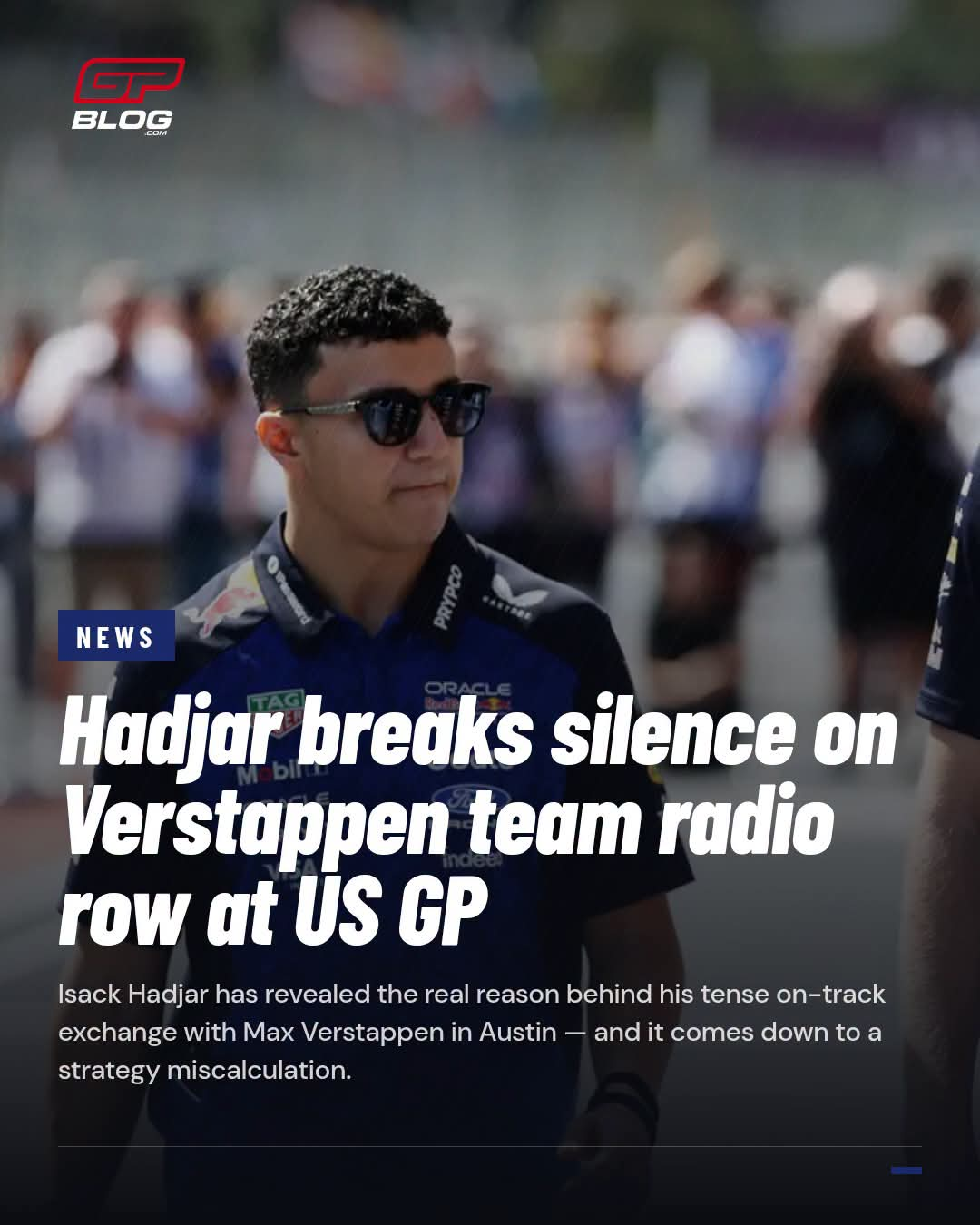
Isack Hadjar has revealed the strategic confusion behind his tense team radio exchange with Max Verstappen at the 2026 United States Grand Prix, explaining how a misjudgment by Red Bull left both drivers losing valuable time in Austin.
The incident unfolded during the second stint of the race when Verstappen caught his younger teammate after making an early pit stop. Running on fresher tyres, the four-time world champion was pursuing a two-stop strategy, while Hadjar was increasingly convinced that the race could be completed with just one stop.
When Red Bull instructed Hadjar to let Verstappen through, the Frenchman initially resisted because he believed moving aside could compromise his own race. He eventually complied, but the delay frustrated Verstappen, who was already fighting to recover time against his rivals.
The exchange added to Red Bull’s difficult afternoon, with Verstappen finishing third behind race winner Kimi Antonelli and Charles Leclerc, while Hadjar secured sixth place.
HADJAR EXPLAINS WHY HE INITIALLY RESISTED RED BULL’S ORDER
Hadjar’s hesitation was not simply a matter of refusing to help his teammate. According to the Frenchman, the team had failed to recognise early enough how manageable a one-stop strategy would be at the Circuit of the Americas.
As the race developed, Hadjar began to realise that he could potentially reach the chequered flag without making another pit stop. Verstappen, however, had already committed to a different strategy, leaving the pair with competing priorities.
Hadjar explained that the strategic picture became clearer only after Verstappen had already pitted. By then, the Dutchman was approaching rapidly, and Red Bull had to decide how to manage the situation between its two drivers.
The Frenchman said Verstappen was coming towards him at tremendous speed, creating a confusing situation for both of them. Although he ultimately moved aside, the manoeuvre cost time for each driver.
Hadjar lost time by allowing his teammate through, while Verstappen lost time running in the dirty air behind the Racing Bulls of the Frenchman’s car before the position was surrendered.
The episode exposed a potential weakness in Red Bull’s race management: the team had not fully anticipated how easily the race could develop into a one-stop contest.
MAX VERSTAPPEN’S FRUSTRATION GROWS OVER RED BULL’S STRATEGY
Verstappen’s frustration was evident over the team radio as he questioned why he had been left behind his teammate while attempting to make progress through the field.
For a driver fighting for the best possible result, losing time behind a teammate on a different strategy can be particularly frustrating. Dirty air reduces aerodynamic performance and can make it more difficult to follow another car closely, potentially affecting tyre management and the ability to attack.
Verstappen was already dealing with a challenging race, and the delay added another complication to his afternoon. The Dutchman eventually finished third, but the result came amid wider concerns about Red Bull’s strategy and the performance of his car.
His frustration was not limited to the Hadjar incident. Following the race, Verstappen also questioned the team’s handling of his strategy, making it clear that he wanted an explanation for decisions that did not match his expectations.
The combination of strategic uncertainty, time lost in traffic and other performance concerns meant that Red Bull had several issues to review after Austin.
RED BULL’S STRATEGIC MISJUDGMENT COST BOTH DRIVERS
Hadjar’s explanation points towards a problem that extended beyond the disagreement between teammates. If Red Bull had recognised earlier that a one-stop strategy was achievable, the team might have avoided putting its drivers in a situation where their race plans conflicted.
The difference between a one-stop and two-stop strategy can significantly affect a driver’s position on track. A driver who pits early gains the advantage of fresher tyres but may need to recover ground later. A driver who stays out longer can benefit from track position, provided the tyres remain competitive enough to maintain a reasonable pace.
In Austin, Hadjar believed the one-stop approach was viable, while Verstappen had already committed to a strategy that required him to make progress on fresher rubber. That difference created the difficult decision over whether Hadjar should defend his position or move aside.
The situation also demonstrates why communication between drivers and engineers is crucial. Teams must continually reassess tyre degradation, race pace and the likely effectiveness of alternative strategies as new information becomes available.
Red Bull’s mistake, as described by Hadjar, was failing to anticipate how straightforward the one-stop option would prove to be. The resulting confusion left neither driver in an ideal position.
HADJAR’S SIXTH PLACE OFFERS A POSITIVE TAKEAWAY
Despite the controversy, Hadjar’s sixth-place finish represented a respectable result in a race shaped by strategic decisions and intense competition.
The Frenchman has been working to establish himself within Red Bull’s wider driver programme, where performances are closely scrutinised. Managing a race while balancing his own result against the team’s instructions is another challenge he must navigate as he gains experience at the highest level.
His explanation also suggests that he was thinking carefully about the long-term consequences of his strategy rather than simply refusing to follow an instruction. From his perspective, giving up track position without a clear understanding of the team’s plan could have compromised his own chances.
However, team orders remain an important part of Formula 1, particularly when teammates are pursuing different objectives or when one driver has a realistic opportunity to achieve a stronger result. The challenge is ensuring those instructions are based on a clear and well-communicated strategy.
Hadjar eventually moved aside, but the delay was enough to become a talking point after the race.
WHAT THE INCIDENT MEANS FOR RED BULL’S NEXT RACE
Red Bull now faces the task of reviewing the strategic decisions that contributed to the confusion in Austin. With Verstappen finishing third and Hadjar sixth, the team still secured two strong results, but the circumstances suggest there was room for improvement.
For Verstappen, the priority will be understanding why the race unfolded differently from what he expected and whether the team can make better decisions in similar situations. With the championship battle still underway, every lost second can matter.
For Hadjar, the incident offers a reminder of the complexity of racing for a team whose drivers may be pursuing different strategies. He must protect his own result while remaining responsive to instructions from the pit wall, particularly when a teammate is attempting to recover time.
Ultimately, the Austin disagreement appears to have been driven less by personal conflict than by a strategic miscalculation. Hadjar’s account suggests that Red Bull’s failure to anticipate the strength of the one-stop strategy put both drivers in a difficult position.
The team will hope the lessons from the United States Grand Prix lead to clearer communication and better decisions in the remaining races of the 2026 season.