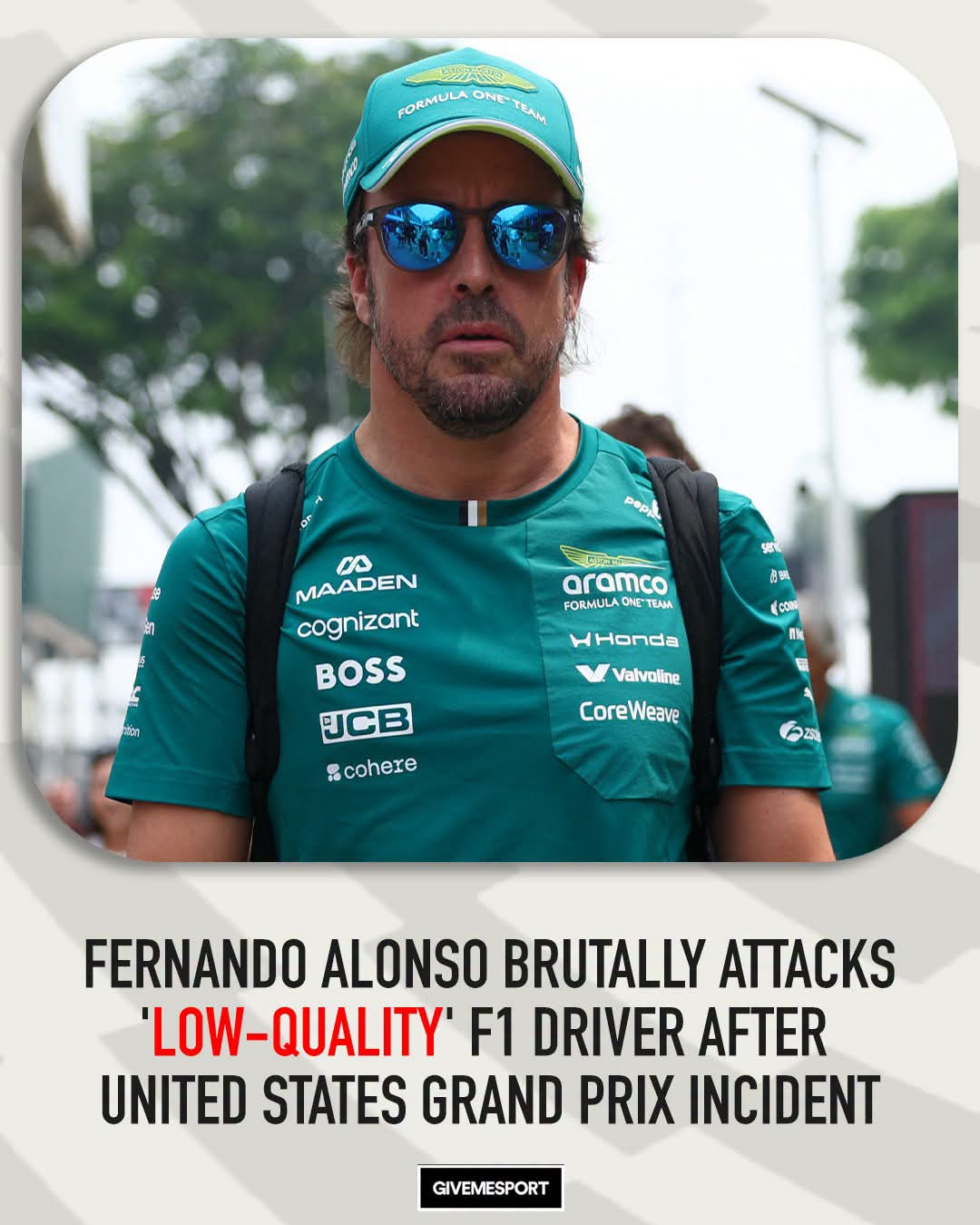
Fernando Alonso has reignited the debate over driving standards in Formula 1 after launching a scathing attack on Alex Albon following their first-lap collision at the 2026 United States Grand Prix. The Aston Martin veteran questioned the quality of drivers competing towards the back of the grid after contact with the Williams racer left his car badly damaged and potentially cost him a valuable points finish.
The incident added another frustrating chapter to Alonso’s difficult 2026 campaign. Despite believing Aston Martin had the pace to compete for points in Austin, the two-time world champion was left fighting with a compromised car after the opening-lap clash. His criticism also revived memories of Lando Norris’ earlier comments about Franco Colapinto, suggesting that frustration over on-track incidents involving drivers outside the leading positions could be becoming a wider talking point in the paddock.
ALONSO CLAIMS ALBON DESTROYED ASTON MARTIN’S POINTS CHANCES
Alonso was battling Albon during the opening stages of the race when their cars made contact. The collision inflicted significant damage on the Aston Martin, with Alonso later revealing that a substantial portion of his car’s floor was missing.
The damage was particularly costly because the floor plays a crucial role in generating aerodynamic performance. Losing a significant section can reduce downforce, compromise cornering speed and make it harder for a driver to remain competitive over a race distance.
Despite the setback, Alonso believed Aston Martin had demonstrated enough pace to challenge for a points-paying position. He explained that he had been running 12th despite effectively driving a damaged car, making the collision even more frustrating.
The Spaniard ultimately finished 16th according to the original race report, while GiveMeSport’s version places him 15th behind teammate Lance Stroll. Albon crossed the line in 17th after continuing with damage to his own car.
Alonso also suggested that Aston Martin had missed an opportunity to reduce the gap to Williams in the constructors’ championship. With both teams competing for valuable positions, losing a potential points finish because of an early collision represented a significant disappointment.
FERNANDO ALONSO DELIVERS HARSH VERDICT ON BACKMARKER DRIVERS
Alonso did not hide his frustration when discussing the incident after the race. While acknowledging the risks associated with starting towards the back of the grid, he delivered a particularly sharp assessment of the drivers competing in that part of the field.
The Spaniard argued that the quality of drivers in the lower third of the grid was very low, pointing to his collision with Albon as an example. He also suggested that Aston Martin needed to improve its car and qualify further up the order to avoid repeatedly exposing itself to such risks.
His remarks are especially striking given Alonso’s reputation as one of the most experienced and outspoken competitors in Formula 1. A two-time world champion who has raced through multiple eras of the sport, he has seen the championship evolve significantly in terms of car performance, racecraft and competitive pressure.
However, his criticism is unlikely to be universally accepted. Albon is an established Formula 1 driver, and a collision during a crowded opening lap does not automatically demonstrate a lack of ability. Drivers must make split-second decisions while judging braking points, available space and the movements of their rivals.
The stewards did not penalise Albon for the incident, meaning there was no official sporting sanction against him. Alonso’s comments therefore reflect his personal interpretation of what happened rather than a formal finding that the Williams driver was at fault.
ALEX ALBON RESPONDS AFTER THE CONTROVERSIAL COLLISION
Albon offered a noticeably calmer assessment of the incident, describing racing against Alonso as enjoyable while acknowledging that the battle had not gone as planned.
The Williams driver explained that he was on the inside of Alonso when the space became tight. He said he attempted to avoid the Aston Martin by moving towards the kerb but failed to prevent contact.
Albon also confirmed that he had suffered damage during the incident, forcing him to continue with a broken front wing. That compromise affected his own race and contributed to a disappointing result.
His response was notably different from Alonso’s. Rather than questioning the Spaniard’s ability or escalating the disagreement, Albon spoke positively about racing against the veteran, while recognising that Alonso might have viewed the manoeuvre differently.
The contrasting reactions underline how easily one racing incident can produce two very different interpretations. Alonso saw the collision as a preventable mistake that destroyed a promising afternoon, while Albon described a tight battle in which both drivers suffered consequences.
Without a penalty or a more definitive assessment of the available evidence, the incident remains a point of disagreement rather than proof that either driver lacks the ability to compete at Formula 1 level.
LANDO NORRIS’ COLAPINTO COMMENTS ADD ANOTHER LAYER TO THE DEBATE
Alonso’s outburst has also brought renewed attention to comments made by Lando Norris following his collision with Franco Colapinto in Baku earlier in the season.
Norris expressed anger after the incident, saying that some drivers should not be in Formula 1. His remarks attracted attention and were followed by an apology in the days afterwards.
The similarities between the two situations are difficult to ignore. Both incidents involved drivers expressing frustration after contact on track, and both raised questions about whether emotional reactions immediately after a race can lead to criticism that goes beyond the incident itself.
Formula 1 drivers operate under enormous pressure. A collision can destroy a race strategy, damage expensive machinery and cost a team crucial championship points. For drivers competing near the front, an incident involving a car further down the order can be particularly costly when championship battles are tight.
Nevertheless, the competitive nature of the sport means that drivers must accept a degree of risk when fighting for position. The challenge is distinguishing between an avoidable mistake, an ambitious but legitimate move and an incident in which neither competitor has enough room to escape contact.
Norris’ earlier apology also demonstrates why comments made immediately after a race can have consequences beyond the circuit. Alonso’s latest remarks could similarly prompt discussion about the line between legitimate criticism and publicly questioning a fellow driver’s place in Formula 1.
IS FRUSTRATION GROWING OVER THE STANDARD OF F1 RACING?
The incidents involving Alonso, Albon, Norris and Colapinto have highlighted a recurring tension within modern Formula 1: the balance between aggressive racing and responsible decision-making.
Drivers are expected to seize opportunities, particularly when their cars are not competitive enough to challenge for podiums. For teams fighting in the midfield or towards the back, every position matters, and an opening-lap overtake can be an opportunity to gain ground before the race settles down.
But aggressive moves also carry risks. A small misjudgment can damage two cars, force drivers into recovery drives and eliminate points-scoring opportunities. The financial and competitive consequences can be substantial, especially for teams operating under strict cost controls.
That does not necessarily mean the overall quality of the grid is declining. A single collision, or even several controversial incidents, cannot establish that drivers towards the back of the field are unworthy of their positions. A fair assessment would require a broader look at driving standards, incident patterns and the circumstances surrounding each case.
Alonso’s frustration is understandable given the damage he described and the points he believed Aston Martin could have scored. However, the stewards’ decision not to penalise Albon also serves as a reminder that a driver’s anger does not, by itself, establish responsibility.
WHAT ALONSO’S OUTBURST MEANS FOR THE REST OF THE SEASON
For Aston Martin, the immediate priority will be improving its performance and ensuring that promising race pace translates into results. Alonso’s suggestion that starting further up the grid would reduce exposure to incidents reflects a practical concern, even if qualifying position cannot eliminate the risk of contact entirely.
Albon, meanwhile, will want to move beyond the controversy and focus on delivering stronger results for Williams. His race was also compromised by damage, meaning neither driver left Austin with the outcome they wanted.
The wider debate is likely to continue as teams fight for positions and drivers face increasing pressure to maximise every opportunity. Alonso’s comments have made the disagreement more personal, while Norris’ earlier remarks demonstrate that frustration over racing incidents can quickly become a larger discussion about driver standards.
Ultimately, Formula 1’s competitive intensity depends on drivers being willing to fight for position without crossing the line into avoidable contact. Whether Alonso’s criticism reflects a genuine wider concern or simply the anger of a driver who believes a valuable result was taken away, the United States Grand Prix has given the paddock another controversial incident to examine.