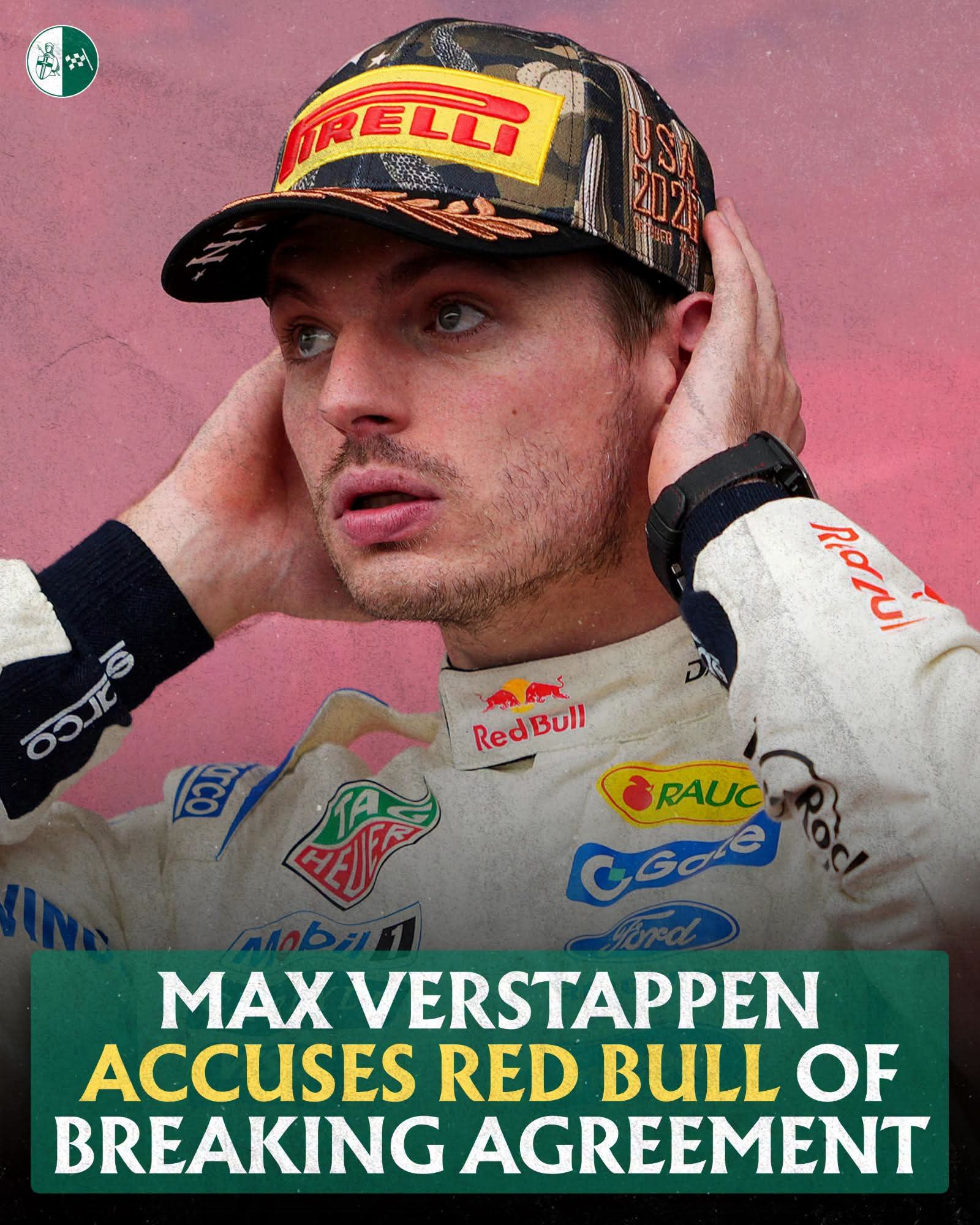
Max Verstappen has openly questioned Red Bull’s race strategy after a frustrating United States Grand Prix, making it clear that the team’s decisions were not what he had agreed to before the race. Despite securing another podium finish in Austin, the four-time world champion left the circuit unhappy after a combination of strategic mistakes, technical problems and inconsistent car performance prevented him from mounting a serious challenge for victory.
The Dutchman started second on the grid with one clear objective: stop Kimi Antonelli from claiming another victory in his impressive 2026 campaign. However, a poor getaway immediately put Verstappen on the back foot, allowing Charles Leclerc to move ahead. Verstappen recovered quickly and demonstrated strong pace, briefly gaining a strategic advantage after switching to soft tyres while Mercedes kept Antonelli out on the track. For a moment, the Red Bull driver appeared capable of turning the race in his favour, but the team’s subsequent decisions changed the picture.
VERSTAPPEN QUESTIONS RED BULL’S TWO-STOP STRATEGY
The biggest source of Verstappen’s frustration was Red Bull’s decision to use soft tyres for his first two stints before switching to medium tyres later in the race. Because he had started on softs, using another set of the same compound at his first stop effectively committed him to a two-stop strategy under the dry-race tyre rules.
That decision also made Red Bull’s intentions relatively easy for its rivals to anticipate. Mercedes could afford to keep Antonelli out longer before switching him to hard tyres, giving the Italian a strategy designed to reach the finish without another stop.
Verstappen was particularly unhappy because he said the approach had not been agreed upon beforehand.
“I’ve had more enjoyable races,” he said after the Grand Prix, expressing disappointment with his start, tyre selection and the team’s execution.
He questioned why Red Bull had chosen the soft-soft-medium sequence, arguing that the decision immediately revealed its two-stop plan to competing teams. His comments suggested that the disagreement was not simply about the final result but also about communication and decision-making within the team.
For a driver competing at the highest level, strategic discussions are crucial. Verstappen needs to trust that the choices made on the pit wall align with the race plan, especially when a championship rival is capable of capitalising on the smallest opportunity.
KIMI ANTONELLI CAPITALISES AS RED BULL FALLS SHORT
While Verstappen struggled to make his strategy work, Antonelli delivered another controlled performance for Mercedes. The young Italian managed his tyres effectively and took advantage of the team’s decision to keep him on track before making the switch to hard tyres.
Antonelli eventually crossed the finish line 13 seconds ahead of the field, with Leclerc taking second place and Verstappen finishing third, another 4.4 seconds behind the Ferrari driver.
The result extended Antonelli’s remarkable winning run to nine victories in the 2026 season, further strengthening his position in the championship battle. His latest success also demonstrated the importance of combining outright speed with a strategy that allows a driver to control the race.
Verstappen, meanwhile, secured his sixth consecutive top-three finish but was clearly dissatisfied. The podium maintained his recent consistency, yet the gap to Antonelli showed how much Red Bull had missed an opportunity in Austin.
The difference between the two teams was not necessarily a complete lack of speed from Red Bull. Instead, Mercedes appeared to execute its plan more effectively while avoiding the collection of problems that complicated Verstappen’s afternoon.
ENGINE BRAKING PROBLEMS MADE THE RACE EVEN WORSE
Red Bull’s strategic difficulties were compounded by technical issues affecting Verstappen’s RB22. The Dutchman had already experienced concerns during qualifying, and those problems continued into the Grand Prix.
During the race, Verstappen reported that the car had become extremely difficult to control. At one point, he described it as “undriveable” over the team radio, highlighting the extent of his frustration.
The main concern involved inconsistent engine braking. In some corners, the car failed to slow as expected, while in others the braking effect became unexpectedly aggressive. Verstappen also reported shifting problems, leaving him unable to predict how the car would respond from one corner to the next.
He explained that the inconsistency made it difficult to drive at a reliable pace throughout the race. Even when the car appeared competitive, the changing behaviour undermined his confidence and prevented him from extracting its full potential.
These problems were especially costly because Verstappen needed a clean second stint to make Red Bull’s two-stop strategy effective. A slow tyre change and the technical difficulties cost him valuable time, reducing his chances of challenging the leaders in the closing stages.
His criticism also extended beyond the race itself. Verstappen indicated that the car’s balance had not been optimal from the beginning of the weekend, suggesting that Red Bull had entered Austin without the consistency required to challenge Mercedes over the full distance.
LAURENT MEKIES ADMITS RED BULL MADE MISTAKES
Red Bull team principal Laurent Mekies acknowledged that the team had not executed the race as well as it should have. Rather than blaming a single incident, he pointed to several smaller problems that combined to make Verstappen’s afternoon more difficult.
Mekies admitted that Red Bull had been less sharp in Austin, with the accumulation of minor issues affecting its pace and increasing tyre wear. Those weaknesses made the race more complicated and prevented the team from getting everything possible out of the car.
His assessment broadly reflected Verstappen’s complaints, although the driver’s comments placed particular emphasis on the tyre strategy and the lack of prior agreement.
The acknowledgement is significant because Red Bull cannot afford repeated operational errors if it wants to challenge Mercedes consistently. When a rival team is delivering strong performances, even relatively small mistakes can determine the outcome of a Grand Prix.
The challenge for Mekies and his engineers will be to identify which problems came from strategic decisions, which were caused by technical limitations and which can be corrected before the next race.
WHAT VERSTAPPEN’S OUTBURST MEANS FOR RED BULL
Verstappen’s reaction highlights a growing pressure point for Red Bull: the team must deliver both a competitive car and the operational precision needed to convert strong pace into victories.
His frustration should not automatically be interpreted as evidence of a major internal breakdown. Drivers frequently challenge strategy decisions after difficult races, particularly when they believe a different approach could have produced a better result. However, Verstappen’s insistence that the tyre sequence had not been agreed upon beforehand makes this criticism more significant than a routine complaint about lost time.
Trust between the driver, race engineer and strategy department is essential. When everyone understands the plan before the race, the team can respond more confidently to changing conditions. If decisions differ from what the driver expects, communication becomes even more important.
Red Bull must now review the strategy, investigate the engine-braking and shifting problems, and ensure that its race plans are clearly communicated before the next Grand Prix.
For Verstappen, the priority will be turning his recent podium consistency into victories. Finishing third is a respectable result, but it will offer little comfort if Mercedes continues to execute its races more effectively.
Austin has therefore delivered an uncomfortable reminder for Red Bull: having a fast driver is not enough. Strategy, reliability, communication and execution must all work together. Verstappen’s frustration has made it clear that he expects the team to address those weaknesses quickly.