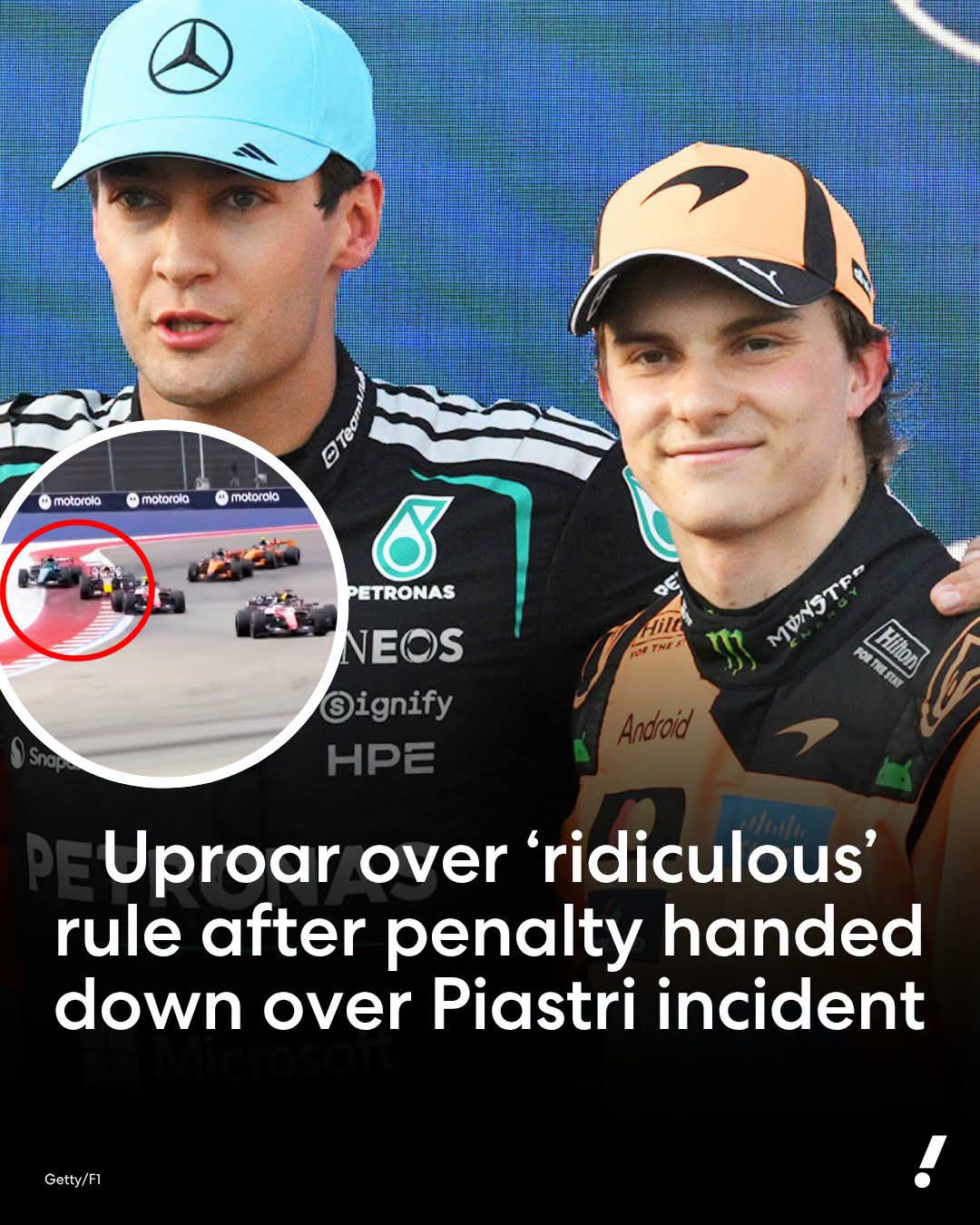
Formula 1 fans have questioned the stewards’ decision to penalise George Russell following an opening-lap incident with Oscar Piastri at the 2026 United States Grand Prix, arguing that the Mercedes driver did not gain a meaningful advantage from leaving the track.
Russell received a five-second time penalty after defending against Piastri at Circuit of the Americas. Although the punishment was reduced from the standard 10 seconds, the decision triggered criticism from fans who believed the circumstances did not justify a penalty of that severity.
The incident also had consequences for Russell’s race result, as he eventually finished eighth while his Mercedes teammate Kimi Antonelli secured another victory in his impressive 2026 campaign.
WHY GEORGE RUSSELL WAS PENALISED
The incident occurred during the opening lap as Russell defended his position against Piastri, who was attempting to make a move on the Mercedes driver.
According to the stewards’ report, Russell left the track while defending through Turn 12 before rejoining ahead of Piastri before Turn 13. He subsequently retained his position, prompting the officials to determine that he had gained a lasting advantage.
The stewards reviewed positioning and marshalling system data, video footage, onboard camera recordings and submissions from the teams involved before reaching their decision.
Their reasoning centred on the fact that Russell remained ahead of Piastri after leaving the circuit. Under Formula 1 regulations, drivers are not permitted to leave the track and retain an advantage without an appropriate consequence.
However, the stewards acknowledged that the incident occurred in unusual circumstances. Russell had been putting Isack Hadjar under pressure, which helped create the opportunity for Piastri to attack. They also considered the fact that the incident happened on the opening lap.
Those mitigating circumstances led the officials to reduce the penalty from the usual 10 seconds to five seconds.
FANS QUESTION THE SEVERITY OF THE DECISION
Despite the explanation, the ruling did not sit well with a section of the Formula 1 community.
Several fans argued that Russell had not gained a significant advantage because he did not overtake Piastri during the incident. Others questioned whether the penalty was proportionate to what happened on track.
One fan criticised the regulations, arguing that the rules had made racing less enjoyable. Another insisted that Russell had gained no advantage, while a supporter who admitted not being a fan of the Mercedes driver also described the decision as ridiculous.
The reaction highlights a recurring debate in modern Formula 1: how consistently should stewards punish drivers when they leave the circuit during close racing?
For some spectators, the priority should be preventing drivers from gaining positions or time by going off track. Others believe officials must consider whether a driver genuinely benefits, particularly when an incident happens during an intense opening-lap battle.
The distinction is important because leaving the track does not automatically mean a driver has gained an unfair advantage in every situation. The circumstances surrounding the move, the position retained and the effect on other competitors all influence the stewards’ assessment.
In Russell’s case, the officials concluded that retaining his position ahead of Piastri constituted a lasting advantage, even though the move did not result in an overtake.
THE PENALTY ADDS TO RUSSELL’S DIFFICULT AFTERNOON
The five-second penalty contributed to a difficult afternoon for Russell, who finished eighth after the early incident.
That result was particularly significant for the championship battle involving Antonelli. The young Italian arrived at the United States Grand Prix with another opportunity to strengthen his position in the title fight, and his victory further underlined Mercedes’ competitive form.
Antonelli finished ahead of Charles Leclerc and Max Verstappen, adding another win to his outstanding season. Russell, meanwhile, was unable to match his teammate’s result after the penalty affected his race.
Although a five-second punishment may appear relatively small, its impact can be considerable when drivers are separated by narrow margins. Depending on the gaps between competitors, such a penalty can cost several positions and influence the championship points awarded at the finish.
Russell’s eighth-place result therefore carried implications beyond the immediate disagreement over the stewards’ ruling.
WHY THE INCIDENT MATTERS FOR F1’S STEWARDING DEBATE
The controversy raises a broader question about how Formula 1 should balance strict enforcement with the unpredictable nature of wheel-to-wheel racing.
The rules are intended to stop drivers from gaining an advantage by leaving the circuit. Without consistent enforcement, competitors could be encouraged to take liberties with track limits whenever doing so helps them defend a position.
At the same time, penalties that appear disproportionate to fans can create frustration and raise questions about whether the regulations leave enough room for context and sporting judgement.
The stewards’ decision indicates that they considered both the rule and the circumstances before settling on a reduced punishment. Their conclusion was not that Russell had completed an overtake off track, but that he had rejoined ahead of Piastri and retained his position.
That distinction explains why the penalty was imposed despite Russell not passing the McLaren driver.
Ultimately, the debate is unlikely to disappear. Formula 1 must protect the integrity of its racing while ensuring that its rules are understandable to competitors and spectators alike. When a decision produces such sharply divided reactions, the explanation behind it becomes almost as important as the punishment itself.
For Russell, the focus will return to the remaining races and his efforts to maximise Mercedes’ results. For the stewards, the United States Grand Prix incident has provided another reminder that even a five-second penalty can become a major talking point when close racing and championship pressure collide.