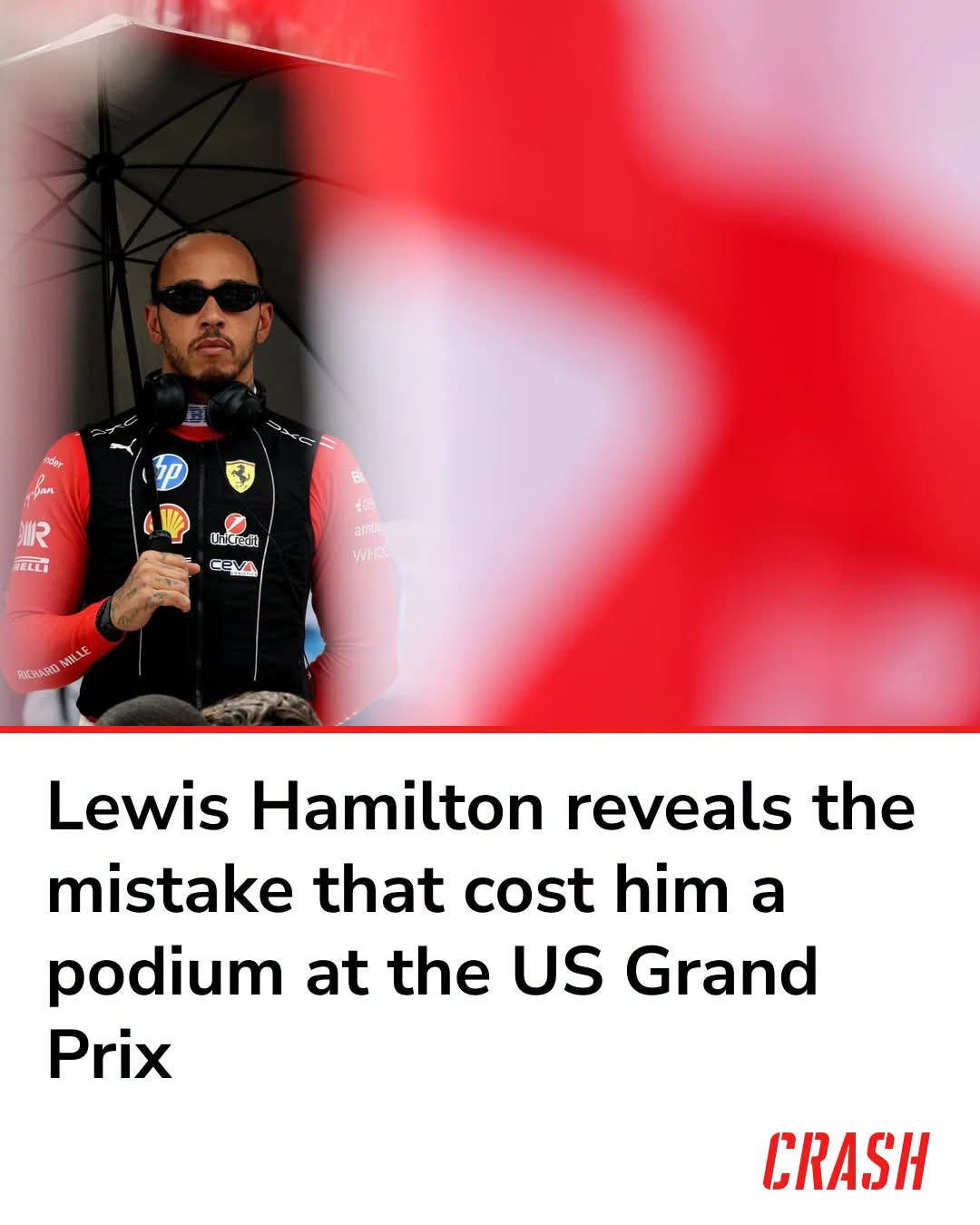
Lewis Hamilton has revealed the major problem that prevented him from fighting for a podium at the 2026 United States Grand Prix, admitting that a set-up mistake left his Ferrari suffering from severe understeer during the opening stages of the race. The seven-time Formula 1 world champion finished fourth at the Circuit of the Americas, narrowly missing out on a top-three result after struggling to extract the full potential of his SF-26.
While Ferrari teammate Charles Leclerc secured an impressive second place, Hamilton found himself fighting a car that refused to respond the way he needed it to through several crucial corners. The British driver ultimately finished just one second behind Max Verstappen, leaving him to reflect on what might have been had Ferrari found the right balance earlier in the weekend.
Hamilton’s explanation offers an important insight into Ferrari’s performance in Austin. The team’s car demonstrated sufficient pace to challenge at the front, but the difference between a podium finish and fourth place came down to the details of set-up, tyre performance and the ability to make the car work under race conditions.
### HAMILTON EXPOSES THE UNDERSTEER PROBLEM THAT RUINED HIS RACE
Hamilton explained that he struggled with substantial understeer throughout the first two stints of the race. Understeer occurs when the front tyres cannot generate enough grip to follow the driver’s intended steering direction, causing the car to run wider through a corner.
For an elite driver, this problem can be particularly costly at a circuit such as Austin, where several corners demand precise front-end response and strong changes of direction.
Hamilton specifically identified Turns 1, 11, 13 and 15 as areas where the problem was most noticeable. He explained that he struggled to turn the car properly, allowing the competitors ahead to pull away while he attempted to adjust his settings.
By the time he reached the final stint, the balance had improved, and Hamilton felt much more comfortable behind the wheel. Unfortunately, the earlier time loss had already compromised his opportunity to challenge for a podium.
His admission points to a frustrating reality in Formula 1: a car can possess competitive underlying performance and still deliver a disappointing result when its balance is not suited to the driver’s needs.
### WHY CHARLES LECLERC’S SECOND PLACE WILL RAISE QUESTIONS AT FERRARI
Leclerc’s second-place finish makes Hamilton’s explanation particularly significant.
Ferrari demonstrated that its machinery could compete near the front, with the Monegasque driver securing a podium while Hamilton struggled to maintain the same pace during the opening two stints.
However, the difference does not automatically mean that Hamilton drove poorly or that Ferrari deliberately disadvantaged him. Formula 1 cars are highly sensitive to set-up choices, tyre behaviour, driving style and changing track conditions.
Two teammates can experience very different levels of confidence in the same car, particularly when small differences in balance affect braking, corner entry and traction.
Hamilton acknowledged that Ferrari’s pit stops and race strategy were strong, directing much of his criticism toward the initial car balance rather than the team’s entire race operation.
For Ferrari, the priority will be understanding why Hamilton’s configuration left him struggling so badly while Leclerc was able to secure second place.
If the team can identify the cause and establish a more effective baseline for both drivers, it could improve its chances of delivering consistently strong results in the remaining races.
### HAMILTON ADMITS SET-UP MISTAKES HAVE COST HIM VALUABLE POINTS
Hamilton’s concerns extend beyond the United States Grand Prix.
The British driver admitted that he had lost significant points over the previous five races and believed his difficulties with set-up had been a major contributing factor.
He maintained that his driving performance had been encouraging, particularly during the final stint in Austin, when the Ferrari felt much better balanced.
That distinction matters. Hamilton is not simply looking for more speed from the car; he wants to establish a reliable set-up that allows him to perform consistently throughout an entire race.
At this level of Formula 1, small improvements can make a substantial difference across a season. A driver who repeatedly loses time during the opening stints may struggle to recover those positions, even when the car becomes more competitive later.
Hamilton’s experience and technical feedback could prove valuable as Ferrari investigates the problem. The key will be turning his observations into measurable improvements before the next race.
### THE BATTLE WITH GEORGE RUSSELL ADDS ANOTHER LAYER OF PRESSURE
Hamilton’s fourth-place finish also carries significance for the drivers’ championship.
According to the supplied report, he moved within one point of his former Mercedes teammate George Russell in their battle for second place in the standings.
That close margin makes every remaining race increasingly important. A podium in Austin could have given Hamilton a valuable advantage, but the set-up problem left him having to settle for fourth.
Russell’s own difficult weekend creates an opportunity for Hamilton to gain ground, provided Ferrari can help him extract more consistent performance from the car.
Their developing championship battle is especially compelling because both drivers know each other’s strengths and weaknesses from their time together at Mercedes.
However, Hamilton’s immediate priority is not simply beating Russell. He must ensure that Ferrari’s performance translates into stronger results across qualifying and race day, rather than relying on late recoveries to compensate for early difficulties.
### FERRARI MUST RESPOND BEFORE THE MEXICAN GRAND PRIX
Hamilton has already identified the next opportunity to put things right: the Mexican Grand Prix.
Ferrari will need to examine its set-up decisions, assess the data from Austin and determine whether adjustments can provide Hamilton with a more predictable front end.
The challenge will be finding the right balance without compromising other areas of performance. Increasing front-end responsiveness can help a driver turn into corners, but engineers must also consider stability, tyre degradation and overall race pace.
Ferrari’s second place with Leclerc provides encouragement that the team has a competitive platform. Hamilton’s fourth-place finish, meanwhile, highlights the importance of extracting the maximum from that platform.
A stronger weekend in Mexico would give Hamilton an opportunity to recover points and demonstrate that the Austin difficulties were a problem the team could solve rather than a recurring weakness.
With the season entering a crucial phase, Ferrari cannot afford to overlook the details that separate a podium contender from a race winner.
### CAN LEWIS HAMILTON BOUNCE BACK IN MEXICO?
Hamilton’s comments suggest he believes the answer depends largely on improving the car’s set-up.
His late-race pace in Austin offered some encouragement, as he felt more comfortable once Ferrari had moved closer to the balance he needed. That experience could help the team establish a better starting point for Mexico.
Nevertheless, a successful recovery will depend on execution across the entire weekend. Ferrari must get the car into a competitive window during practice and qualifying, then ensure that its race strategy gives Hamilton the opportunity to convert that pace into a strong result.
The pressure is also growing because Hamilton is competing against drivers who cannot afford to surrender valuable points. With the fight for second place reportedly separated by a single point, even a modest improvement could prove decisive.
Hamilton has identified the problem he believes cost him a podium in Austin. Now Ferrari must demonstrate that it can correct the mistake before another opportunity slips away.
His fourth-place finish was not the result he wanted, but the data from the race could prove useful if Ferrari acts on the lessons quickly. Mexico will provide the next test of whether the seven-time world champion can turn his frustration into a stronger performance.