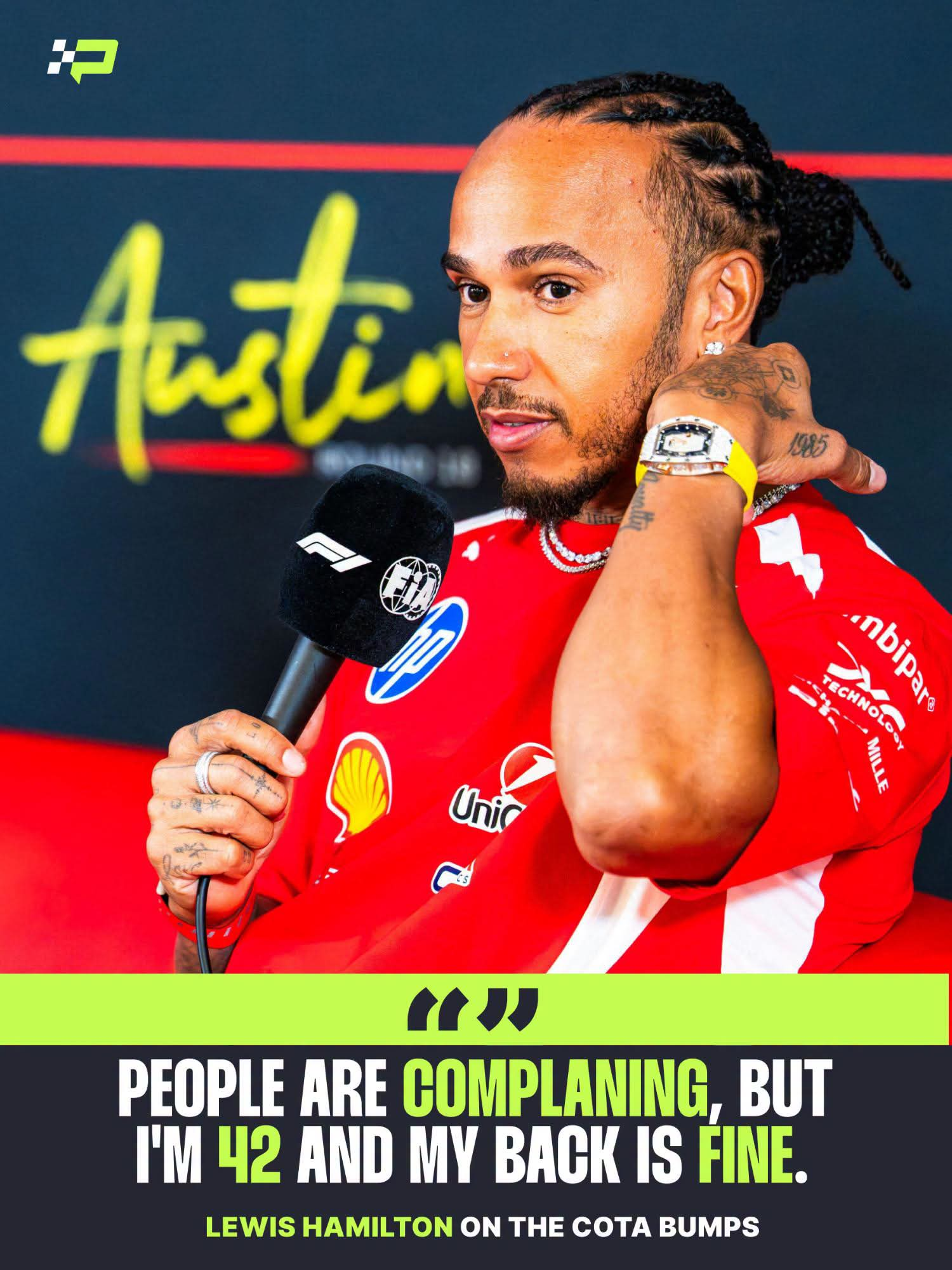
Lewis Hamilton has dismissed concerns about the bumps at the Circuit of the Americas, offering a different perspective from Max Verstappen, who has raised concerns about the impact of the track’s surface on his lower spine. The contrasting opinions have sparked fresh debate ahead of the 2026 United States Grand Prix, with several drivers questioning whether particular sections of the Austin circuit have become too rough for Formula 1 competition.
While Verstappen believes the bumps are creating an uncomfortable and potentially concerning situation for drivers, Hamilton insists they are part of what makes the Texas venue challenging and distinctive. The disagreement highlights a broader issue facing Formula 1: how to preserve the character of historic and popular circuits without compromising driver comfort and safety.
MAX VERSTAPPEN RAISES CONCERNS ABOUT HIS SPINE
Verstappen has been among the drivers expressing frustration with the uneven surface at COTA, particularly around Turns 1 and 19. The Red Bull driver explained that the repeated impacts caused by the bumps are more than a minor inconvenience, pointing to checks he has undergone on his spine.
“It’s really not nice,” Verstappen said, adding that the lower part of his spine did not look particularly good based on the checks he had undergone.
His comments have added urgency to the discussion because modern Formula 1 cars subject drivers to considerable physical forces. Although drivers are accustomed to intense braking, high-speed cornering and vibrations, repeated impacts from uneven surfaces can increase discomfort and physical strain over a race weekend.
Verstappen’s remarks do not, by themselves, establish a specific medical diagnosis or prove that the circuit has caused a particular injury. However, they underline why drivers are asking the relevant authorities to take the condition of the track seriously.
LEWIS HAMILTON DISAGREES WITH THE CRITICISM
Hamilton, meanwhile, has taken a more relaxed position on the matter. The Ferrari driver acknowledged that COTA is bumpy but argued that the surface adds character to a circuit he has enjoyed throughout his career.
“I personally like the bumps, I think it adds character to the track,” Hamilton explained. He added that he enjoys the challenge of controlling a car that moves around over an uneven surface.
The seven-time world champion also insisted that the bumps had not caused him any problems, joking that, at 42, his back was still fine.
Hamilton’s comments reflect a different interpretation of what makes a challenging race track. For him, the bumps contribute to the circuit’s personality and require drivers to make constant corrections behind the wheel. Rather than viewing every uneven section as a flaw, he sees some of the surface variation as part of the driving challenge.
However, his experience should not be taken as proof that the same conditions affect every driver equally. Different cars, driving styles and physical circumstances can produce different experiences on the same circuit.
CARLOS SAINZ IDENTIFIES TWO PROBLEMATIC SECTIONS
Williams driver Carlos Sainz has offered a more targeted assessment, arguing that the entire circuit does not need to be flattened to address the concerns.
Sainz identified the bumps approaching Turns 1 and 19 as the main areas requiring attention. He described the impact at those locations as excessive and called for a measurable threshold that would allow the FIA to identify and address particularly severe bumps before future race weekends.
According to Sainz, the rest of the circuit’s unevenness gives it character and is not necessarily a problem. His argument is that two particularly rough sections should be corrected without removing the features that make COTA distinctive.
He also revealed that the Grand Prix Drivers’ Association had discussed the issue with the FIA. Sainz indicated that the authorities had taken note of the concerns and would look at what could be done in the future.
That approach could offer a compromise between drivers who appreciate the circuit’s challenging surface and those who believe certain impacts have become unacceptable.
WHY COTA’S TRACK SURFACE MATTERS TO FORMULA 1
The Circuit of the Americas is known for its dramatic elevation changes, technical corners and challenging combinations of turns. Its layout places considerable demands on drivers, making it a popular venue for both competitors and spectators.
However, track surfaces can change over time as the ground beneath them moves and settles. Austin’s circuit has previously faced criticism over bumps, meaning the issue is not entirely new to Formula 1.
For teams, an uneven surface can complicate car setup, tyre management and consistency under braking. Drivers must adapt their lines and steering inputs to keep the car stable, particularly when approaching corners at high speed.
The concern becomes more significant when a bump produces an unusually severe impact or unsettles a car in a critical braking zone. That is why the discussion is not simply about whether a circuit should feel smooth. It is about distinguishing manageable surface variation from conditions that could compromise safety or place unnecessary physical strain on competitors.
HAMILTON STARTS FIFTH AS THE AUSTIN TITLE BATTLE INTENSIFIES
The debate comes at an important moment in the United States Grand Prix weekend. Hamilton is scheduled to start fifth, while Mercedes rookie Kimi Antonelli has secured pole position amid a championship battle that could bring the young Italian closer to the world title.
Hamilton’s immediate priority will be making the most of his starting position and challenging the cars ahead. COTA’s technical layout and overtaking opportunities could create openings, although a strong result will depend on Ferrari’s race pace, tyre strategy and execution.
For Verstappen, managing the physical demands of the circuit will be another consideration as he looks to maximise his result. His concerns do not automatically mean he will be unable to compete at his usual level, but the condition of the surface remains an issue worth monitoring.
WILL THE FIA TAKE ACTION BEFORE THE NEXT AUSTIN RACE?
The key question now is whether the FIA and circuit officials will introduce a more systematic way of measuring the severity of track bumps before future events.
Sainz’s suggestion of a defined threshold could provide a starting point for discussions, allowing officials to distinguish ordinary surface variation from particularly harsh impacts that require intervention. Any solution would need to account for the technical realities of maintaining a circuit while ensuring that the track remains suitable for Formula 1 cars.
Hamilton’s comments also demonstrate why a blanket approach may not be necessary. The aim does not have to be eliminating every bump across the circuit. Instead, attention could focus on the specific locations identified by drivers as presenting the greatest problems.
Ultimately, the disagreement between Hamilton and Verstappen reveals two different perspectives on the same track. Hamilton values the challenge and character created by COTA’s surface, while Verstappen has highlighted concerns about the physical effects of repeated impacts.
The most important consideration is whether the circuit can retain its unique character while addressing the areas that drivers believe require attention. If the FIA can find that balance, Austin could remain one of Formula 1’s most distinctive venues without allowing its bumps to overshadow the racing.