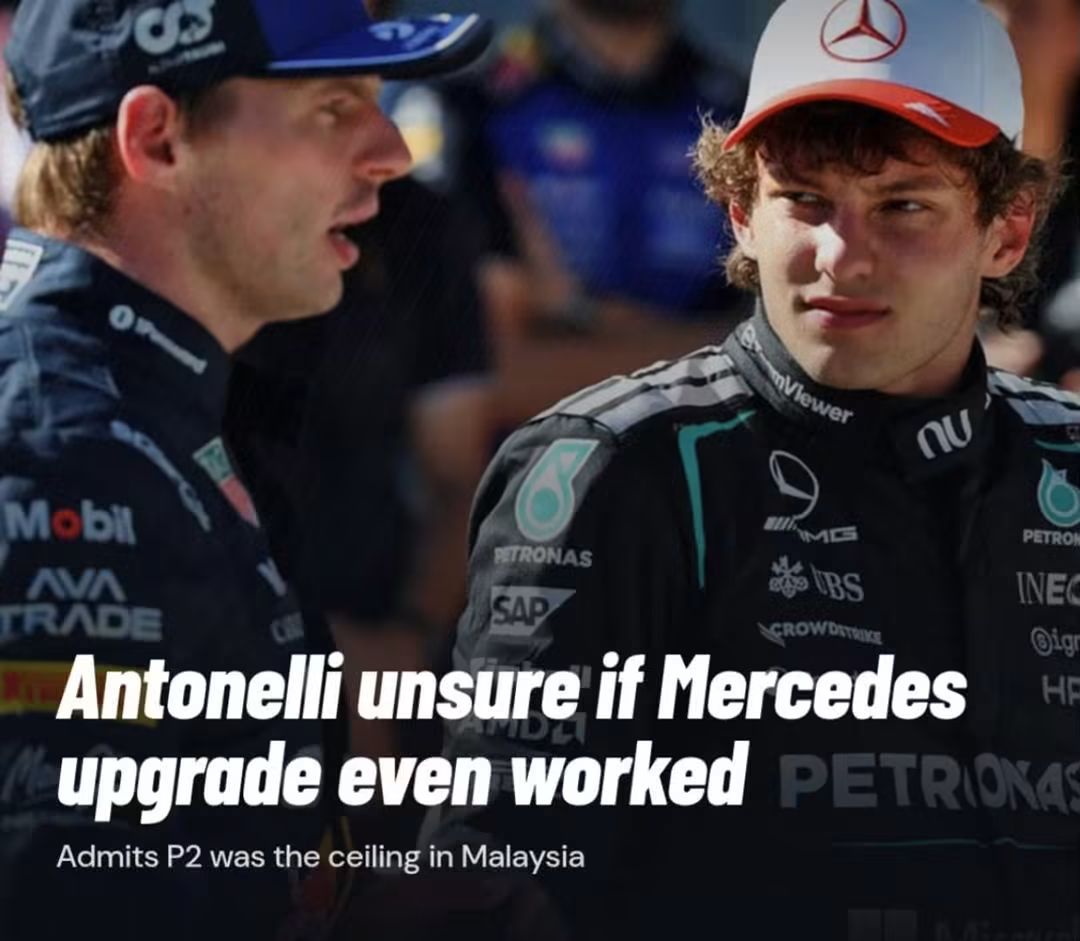
Kimi Antonelli left the Bahrain Grand Prix in Malaysia with one hand firmly on the 2026 Formula 1 drivers’ championship trophy. The 20-year-old Italian finished second behind Max Verstappen, and with teammate George Russell retiring late due to a power unit failure, Antonelli’s advantage ballooned to a commanding 84 points. Yet the Mercedes driver was in no mood to celebrate. Instead, he delivered a candid and concerning assessment of his team’s performance that should give both fans and the Silver Arrows hierarchy pause as the season enters its final stretch.
Antonelli now sits on 320 points after 16 rounds, with Russell on 236 and Lewis Hamilton further back on 214. With seven Grands Prix and a sprint still to run, roughly 183 points remain available. On pure mathematics, the Italian is in an extraordinarily strong position. Four more wins would effectively seal the title even if Russell swept everything else. Consistency has been Antonelli’s greatest weapon all year, but the Sepang weekend exposed cracks that no amount of points can fully paper over.
WHY ANTONELLI’S P2 FELT LIKE A WARNING RATHER THAN A TRIUMPH
The race itself was chaotic. Heavy rain delayed the start by around 100 minutes. When the lights finally went out on a damp track, Antonelli briefly led after Verstappen’s slow getaway. A safety-car restart flipped the script. Verstappen executed a clinical overtake, Russell also got past momentarily, and Antonelli spent the rest of the afternoon locked in second, unable to mount a serious challenge for the win.
“I think today was the maximum we could have done,” Antonelli said afterwards. “Massive congrats to Max and Red Bull for the incredible weekend. And on our side, a lot of work to do – we’ve been struggling a bit more than usual, but still really happy to come away with P2.”
That measured tone hid a deeper frustration. Mercedes arrived in Malaysia with upgrades, yet Antonelli openly admitted the team could not tell whether the new package had made the car faster or slower. The abrasive, older tarmac at Sepang, combined with extreme heat, made data comparison almost impossible. He pointed to similar struggles on high-grip or older surfaces earlier in the season, notably at Zandvoort, where McLaren had the measure of them.
This is not the language of a driver coasting to a title. It is the language of a young champion-in-waiting who understands that dominant seasons can unravel if the car stops progressing while rivals close the gap.
THE RELIABILITY SHADOW HANGING OVER MERCEDES
Russell’s late retirement was the second mechanical DNF of his season (following Canada) and the latest in a string of power-unit issues that have also affected Antonelli earlier in the year. Antonelli was quick to call it “a big shame for him and the team,” noting that a double podium had been within reach. Reliability has been the quiet Achilles’ heel of what has otherwise been a strong Mercedes campaign under the new 2026 regulations.
For a team that spent years perfecting hybrid power units, these failures are both expensive in championship terms and psychologically damaging. Every time a car fails to finish, the constructors’ points are left on the table and internal pressure rises. Toto Wolff’s squad still leads the teams’ standings comfortably, but the margin looks less secure when the cars cannot be relied upon to complete every race.
WHAT THIS MEANS FOR THE TITLE FIGHT AND THE BROADER F1 LANDSCAPE
Antonelli’s 84-point cushion is enormous by modern standards. In most seasons it would be considered decisive. Yet Formula 1 in the new regulations era has already shown how quickly the competitive order can shift. Red Bull’s first win with its in-house power unit at Sepang carried symbolic weight. Verstappen, still more than 130 points behind, remains a distant sixth in the standings but proved once again that when the RB car is dialled in, it can still humble the rest of the field.
For Antonelli personally, the weekend offered another reminder of the difference between leading a championship and dominating it. He has eight wins and 13 podiums already. At 20 years old he is rewriting records for youthful achievement. But the honest self-assessment after Sepang suggests a maturity beyond his years. He is not content with “good enough.” He wants the car to be the best, not merely the most consistent.
Mercedes now heads to Singapore knowing it must answer two urgent questions: Did the latest upgrades actually deliver a performance gain, and can the reliability issues be eradicated before the final run of races? Singapore’s unique street-circuit characteristics and different tarmac will provide an immediate opportunity for back-to-back package comparisons that Antonelli himself has requested.
THE BIGGER PICTURE FOR MERCEDES AND THE SPORT
This story matters beyond the points table. Mercedes invested heavily in the new regulations cycle and emerged as early pacesetters. Sustaining that advantage through the second half of the season is the true test of a championship team. If the Silver Arrows can resolve their current uncertainties, Antonelli looks almost certain to become the youngest world champion in Formula 1 history. If they cannot, the door remains ajar for Russell or even a late charge from elsewhere.
Antonelli’s admission is refreshing in an era of carefully managed media messaging. It signals a driver and a team still hungry rather than complacent. For fans, it injects genuine tension into what could otherwise have become a procession. For the sport, it underlines that even a massive points lead does not guarantee smooth sailing when the technical and reliability edges begin to blunt.
The next few races will reveal whether Sepang was a temporary blip or the first real warning sign of a closer championship fight than the numbers currently suggest. Antonelli has the points. The question now is whether Mercedes still has the pace and the reliability to convert that advantage into a title that already feels within touching distance.