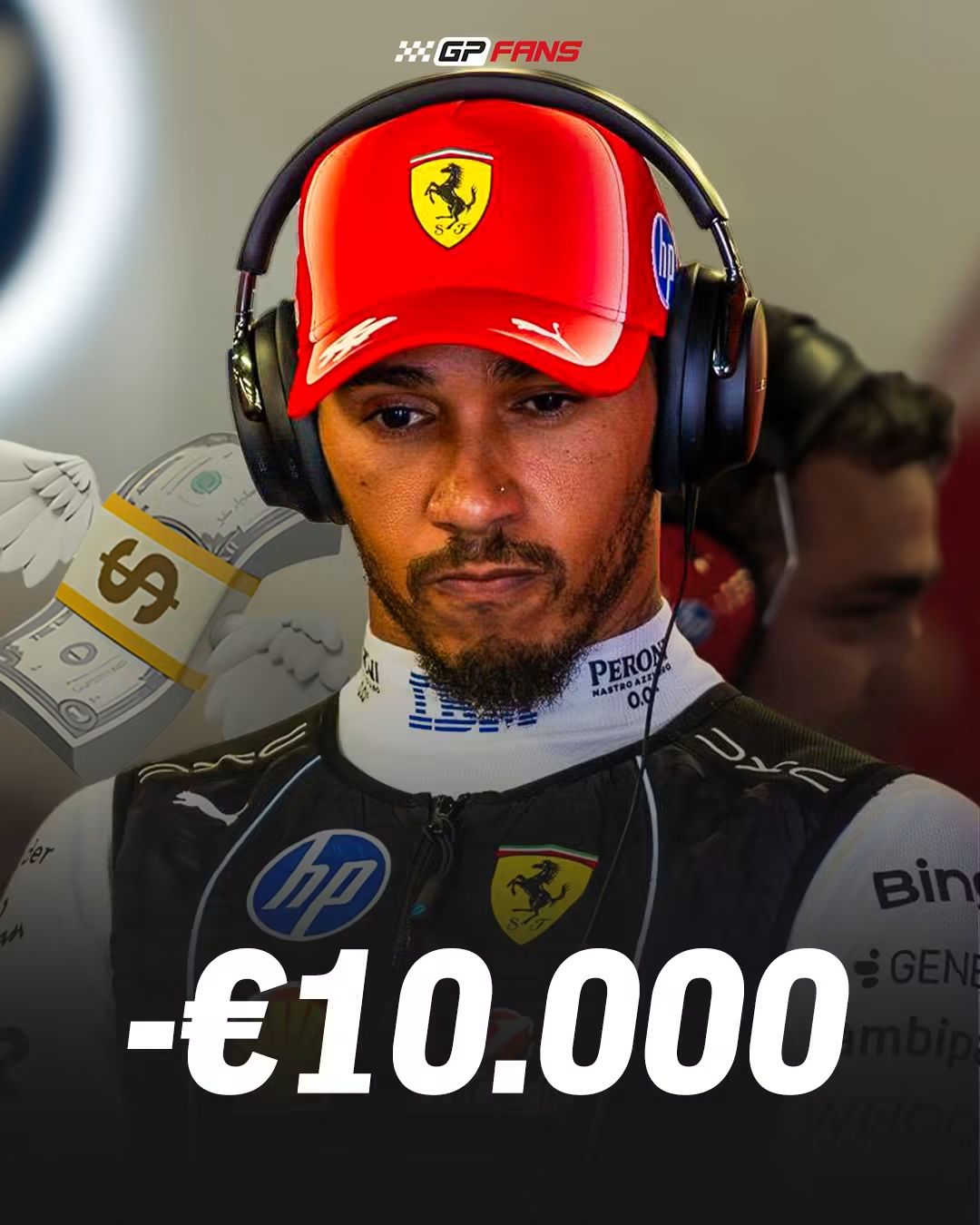


Formula 1 practice sessions are supposed to be the controlled environment where teams fine-tune cars, gather data, and avoid unnecessary drama. Yet at the Sepang International Circuit during the second free practice for the 2026 Bahrain Grand Prix (held in Malaysia), a high-speed near-miss reminded everyone just how quickly things can escalate. Lewis Hamilton, driving for Ferrari, was travelling slowly on a cool-down lap when he drifted onto the racing line and forced Audi’s Gabriel Bortoleto into emergency braking and evasive action. The FIA stewards later issued Hamilton a formal warning and hit Scuderia Ferrari with a €10,000 fine.
The incident itself was straightforward on paper, but the details reveal deeper issues around visibility, team communication, and the growing pains of a rapidly changing Formula 1 grid.
WHAT EXACTLY HAPPENED ON TRACK AT TURN 9
Halfway through FP2 under the baking Malaysian heat, Hamilton was circulating at roughly 80-85 km/h approaching Turn 9, the left-hand hairpin that ends a short straight in the middle sector. Bortoleto, on an out-lap rather than a full push lap, was closing at around 240 km/h. The relative speed difference of 155-160 km/h left almost no room for error. Hamilton moved from the middle of the track toward the racing line, forcing the Brazilian to brake hard and swerve.
Bortoleto’s frustration poured out over the radio almost immediately: “What’s that bloke doing?” followed by the more pointed observation that Hamilton appeared to have seen him yet still blocked the path. Hamilton, for his part, radioed Ferrari that his right-hand wing mirror was damaged and he could not see properly, asking the team to keep him updated on traffic.
Photographic and video evidence later confirmed the damaged mirror. Both teams told the stewards that radio warnings are not normally issued when the car behind is not on a push lap. Bortoleto confirmed he remained in control throughout. Still, the stewards concluded that Hamilton had “unnecessarily impeded” the significantly faster car by moving onto the racing line at low speed.
WHY THE STEWARDS ISSUED A WARNING TO HAMILTON BUT FINED FERRARI
The standard penalty for impeding during a practice session is a warning, and that is what Hamilton received. The stewards weighed several mitigating factors: the broken right mirror, the absence of a radio call, and the fact that Bortoleto was not on a flying lap. They also considered whether the incident qualified as “dangerous impeding,” given the high closing speed and Hamilton’s knowledge that his rearward visibility was compromised. Ultimately they decided against a grid penalty because Bortoleto avoided contact and stayed in control.
Ferrari, however, did not escape unscathed. The team knew the mirror was damaged yet failed to provide traffic information for a car approaching at a much higher speed. The stewards ruled that this knowledge created a duty of care that the team did not meet, resulting in the €10,000 fine. In effect, the driver was given the usual practice-session slap on the wrist while the team was held accountable for systemic communication failure.
WHY THIS INCIDENT MATTERS BEYOND A SINGLE PRACTICE SESSION
At first glance, a warning and a five-figure fine look minor. In the grand scheme of a Formula 1 budget, €10,000 is pocket change. Yet the episode carries larger significance for several reasons.
First, it highlights the persistent challenge of traffic management in practice. With 20 cars sharing limited track time and vastly different programmes (some on high-fuel runs, others on low-fuel flying laps), the risk of speed differentials is constant. When visibility is further reduced by damage, the margin for error shrinks dramatically. A 160 km/h closing speed leaves little room for reaction, even for elite drivers.
Second, it underscores the evolving relationship between driver and team under the current regulations. Teams have sophisticated telemetry and can see approaching cars on their systems. When a driver reports a damaged mirror, the expectation is that the pit wall becomes the primary set of eyes. Ferrari’s failure to adapt in real time suggests a process gap that other teams will now review carefully.
Third, the incident arrives at a moment when the grid is transitioning. Gabriel Bortoleto represents the new generation of drivers pushing into the sport with Audi’s manufacturer programme. Clashes between established stars and ambitious newcomers are inevitable, but each one tests the sport’s ability to keep everyone safe while allowing aggressive track usage. Hamilton’s reputation as one of the most experienced drivers on the grid makes any visibility-related issue particularly noticeable. Patterns of similar traffic incidents earlier in the season only amplify the scrutiny.
IMPACT ON THE ATHLETES, TEAMS, AND THE BROADER CHAMPIONSHIP
For Hamilton, the warning adds another entry to his disciplinary record this year without costing championship points or grid positions. He can continue the weekend without sporting handicap, which is crucial at a circuit as demanding as Sepang. Still, repeated impeding investigations create narrative pressure. Media and rival teams begin asking whether the seven-time champion is adapting as smoothly as expected to Ferrari’s processes and the 2026-generation cars.
For Bortoleto and Audi, the episode is a mixed bag. On one hand, the Brazilian demonstrated composure under pressure and successfully avoided contact. On the other, losing even a few tenths or a clean out-lap in practice can disrupt a carefully planned programme. Manufacturer teams investing heavily in their first seasons cannot afford unnecessary interruptions. The radio messages also humanise the frustration that every driver feels when blocked, reminding fans that these moments feel personal even when the outcome is purely sporting.
Ferrari’s fine is primarily reputational. The team must now demonstrate improved protocols for damaged equipment and traffic calls. In a championship where every point matters and reliability is already under the microscope, small process failures can accumulate into larger problems.
Looking at the wider industry, incidents like this keep the conversation alive around clearer guidelines for out-laps, cool-down behaviour, and when teams must prioritise radio warnings. The FIA’s consistent application of practice warnings while still fining teams for communication lapses shows a pragmatic approach: punish the root cause without derailing a driver’s weekend over a non-contact practice moment.
PREDICTIONS AND UNIQUE INSIGHTS FOR THE REST OF THE WEEKEND AND BEYOND
Expect Ferrari to be more vocal on the radio for the remainder of the Malaysian weekend. Drivers with known visibility issues will receive more proactive traffic calls, even on non-push laps. Other teams will quietly review their own mirror-damage protocols after seeing a competitor fined.
For Hamilton personally, the focus now shifts to extracting performance from the Ferrari package at a track that historically rewards precision and tyre management. Any lingering frustration from the incident must be channelled into clean, efficient running rather than further drama. Bortoleto and Audi, meanwhile, will treat the near-miss as useful data on how their car behaves under sudden braking and how the driver handles high-pressure radio situations.
In the longer term, this episode is a useful reminder that Formula 1’s technical and human systems remain imperfect. Damaged mirrors, imperfect radio discipline, and large speed differentials will continue to produce tense moments. The sport’s ability to learn from them without over-penalising is what keeps the competition both intense and relatively safe.
The €10,000 fine will not change the championship standings, but the warning and the process failure it exposed may quietly influence how every team approaches traffic management for the rest of the season. In a sport measured in thousandths of a second, the difference between a clean lap and a near-miss often comes down to communication as much as car speed. Sepang just provided another expensive, and very public, lesson.