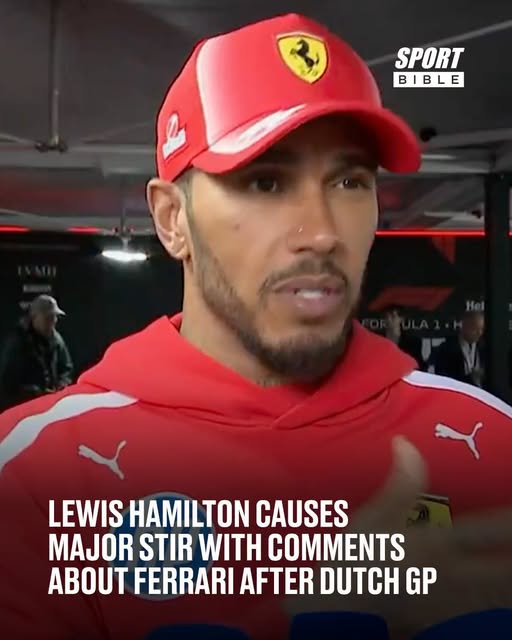
Lewis Hamilton has made it clear that Ferrari cannot afford to keep throwing away opportunities if the team genuinely intends to challenge for the 2026 Formula 1 world championship.
Hamilton finished fourth at Zandvoort on Sunday, narrowly behind Mercedes’ George Russell, while teammate Charles Leclerc came home fifth. But the result does not tell the full story. Hamilton believed Ferrari’s race execution cost him valuable time, particularly while he was stuck behind Leclerc and later when the team delayed his pit stop. His radio messages revealed growing frustration as he questioned Ferrari’s strategy, asking: “Are you using me as a guinea pig?”
HAMILTON QUESTIONS FERRARI’S RACE EXECUTION
The most revealing moment came when Hamilton compared Ferrari’s decision-making with Mercedes’ approach. Mercedes allowed championship leader Kimi Antonelli through when it became obvious that the Italian was faster than Russell, ultimately helping Antonelli secure second place.
Hamilton clearly believed Ferrari should have shown the same level of decisiveness.
“They’ve got the car, they’re fighting for the championship, in the lead and they did it straight away. Here, I’m sitting back, losing seconds. It’s something that we need to discuss offline.”
That is more than a complaint about one pit-stop decision. Hamilton’s comments expose a bigger concern: Ferrari may have the pace to fight at the front, but its execution is still preventing the team from consistently converting performance into results.
THE LECLERC SITUATION ADDED TO HAMILTON’S FRUSTRATION
Hamilton was considerably faster than Leclerc during one phase of the race and asked whether his teammate could allow him through so he could attack the cars ahead.
Instead, Ferrari’s decision-making left Hamilton losing time behind Leclerc.
Leclerc subsequently ended up on newer soft tyres and closed rapidly on Hamilton during the closing stages. The situation was particularly frustrating because Hamilton believed that several seconds lost earlier could ultimately have been the difference between fourth place and a podium.
Leclerc’s response after the race suggested there was no major breakdown between the Ferrari drivers.
“Sometimes there’s frustration on my side, sometimes there’s frustration on Lewis’ side,” Leclerc said, while insisting that the two drivers generally get along well.
That diplomatic response may prevent the situation from becoming a full-blown internal feud—but Ferrari cannot ignore what happened.
HAMILTON’S MESSAGE TO FERRARI IS CLEAR
Hamilton’s statement that he is “here to win” should not be overlooked.
At 41, he is not approaching the latter stages of his Ferrari career simply to collect podiums and respectable finishes. His objective remains an eighth world championship, and every strategically lost point becomes increasingly important as the season develops.
The Dutch GP demonstrated the difference between having a competitive car and operating like a championship-winning team. Mercedes made a crucial call in the closing stages. Ferrari, according to Hamilton, hesitated.
That difference matters enormously over a full season.
FERRARI CANNOT AFFORD TO WASTE MORE OPPORTUNITIES
Hamilton’s frustration could actually become useful for Ferrari if the team treats it as a warning rather than criticism.
The seven-time champion has experienced championship-winning operations before. He knows what decisive race management looks like, and his comparison with Mercedes was effectively a message to Ferrari’s pit wall: if the opportunity is there, act immediately.
The championship is not won purely through outright car performance. Strategy, communication, pit stops, tyre management and driver positioning can collectively decide dozens of points across a season.
Hamilton appears to believe Ferrari is leaving some of those points on the table.
THE DUTCH GP COULD BECOME A TURNING POINT
Ferrari still has time to correct its weaknesses, but Hamilton’s comments make clear that patience has limits.
The Dutch Grand Prix was not a disaster. Fourth and fifth are solid results, particularly on a weekend where McLaren and Mercedes showed strong pace. But for a driver chasing an eighth title, “solid” is not necessarily good enough.
Hamilton wants Ferrari to operate with the urgency of a championship contender.
If Ferrari can improve its strategic execution, communicate more effectively between its drivers and maximise Hamilton’s opportunities when he has superior pace, the team could still become a serious force in the championship fight.
If the same mistakes continue, however, Hamilton may increasingly find himself asking the same uncomfortable question: does Ferrari have the car to win, but not yet the operation to deliver it?