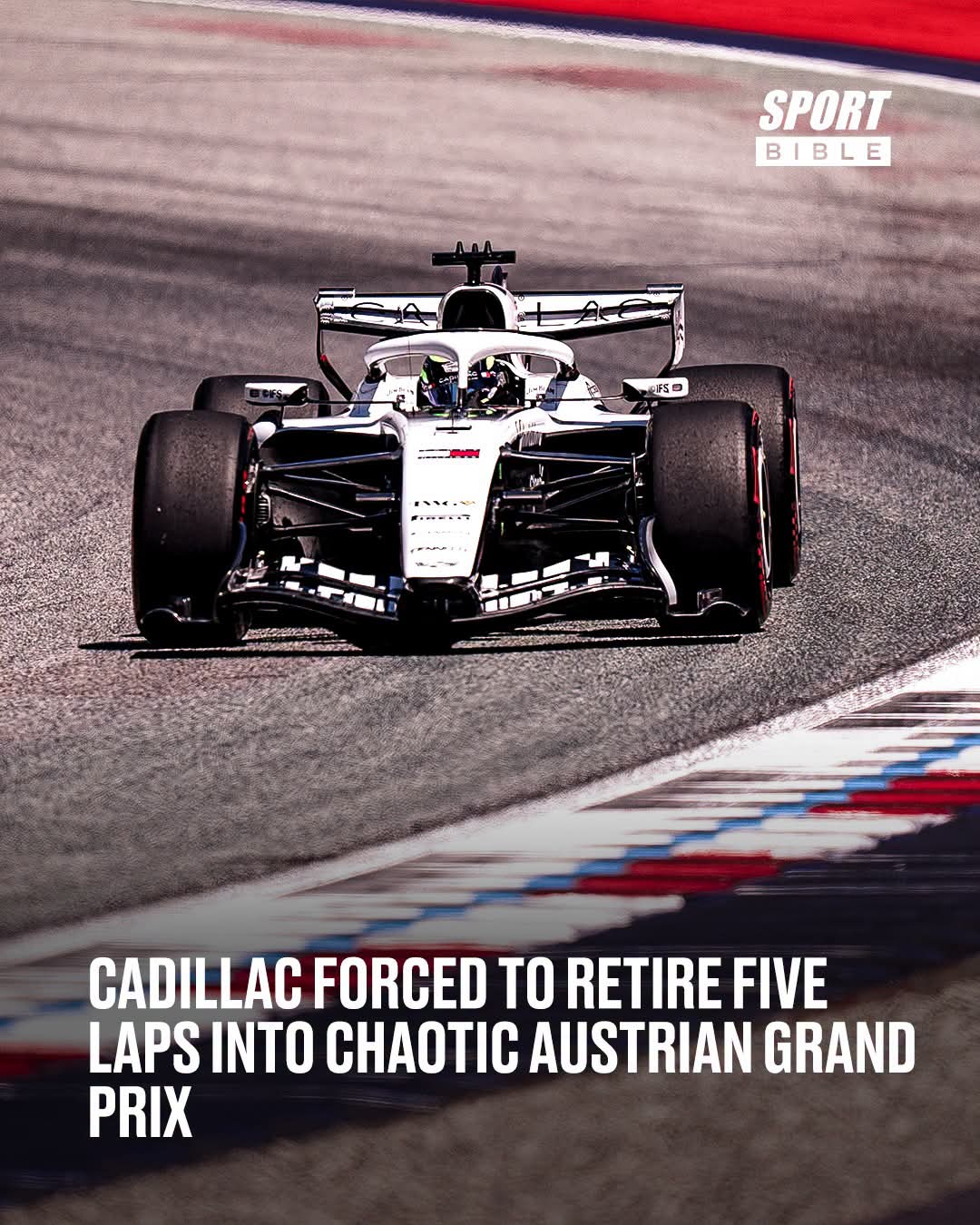
Cadillac endured one of the most disastrous starts to a Formula 1 race in recent memory after both of its cars retired within the opening five laps of the Austrian Grand Prix. What began as an opportunity to gather valuable championship points quickly turned into a nightmare as brake-related problems struck both sides of the garage, leaving the American manufacturer without a single car in the race before the opening stint had even settled.
The double retirement came during a dramatic opening phase of the race that already featured intense battles at the front between George Russell, Lewis Hamilton and championship leader Andrea Kimi Antonelli. While the leading teams fought for victory, Cadillac’s afternoon unraveled almost immediately.
BRAKE FAILURES BRING CADILLAC’S RACE TO AN EARLY END
The first sign of trouble came when Valtteri Bottas was forced to return to the pits after reporting alarming brake issues over team radio. The experienced Finn informed his engineers that his brakes were effectively on fire, forcing the team to retire the car before the situation became even more dangerous.
Only moments later, Cadillac’s problems doubled.
Sergio Perez also headed for the pit lane after reporting heavy smoke filling the cockpit. The Mexican described the worsening conditions over team radio, leaving the team with little option but to retire his car as well.
Within just five laps, Cadillac had suffered a complete race collapse, marking one of the shortest team outings of the 2026 Formula 1 season.
EXTREME CONDITIONS APPEAR TO HAVE TRIGGERED THE FAILURE
Initial information from the team suggested that overheating brakes were responsible for both retirements.
The unusually high track temperatures at the Red Bull Ring created extremely demanding operating conditions for every team. Braking systems face enormous stress around Spielberg due to several heavy braking zones combined with rapid acceleration sections, making temperature management critical throughout the race.
Although other teams also monitored brake temperatures closely, Cadillac appeared to suffer the most severe consequences, with both cars experiencing failures before the race had fully developed.
Interestingly, Bottas had already experienced similar brake concerns during practice earlier in the weekend, suggesting the underlying issue may have existed long before Sunday’s race.
A MAJOR SETBACK FOR CADILLAC’S DEVELOPMENT PROGRAM
For a new manufacturer still establishing itself in Formula 1, reliability is almost as important as outright pace.
Every completed race provides engineers with valuable performance data that cannot be replicated through simulation or practice sessions alone. Losing both cars after only a handful of laps represents a significant setback, not only in terms of championship points but also for understanding how the car behaves over full race distances.
The incident is likely to trigger an intensive investigation back at the factory as engineers search for the exact cause behind the simultaneous failures.
If the problem proves to be a design weakness rather than an isolated malfunction, Cadillac could face further challenges over the coming rounds unless a permanent solution is implemented quickly.
WHAT THIS MEANS FOR THE CHAMPIONSHIP
While Cadillac’s championship ambitions remain modest during its debut campaign, reliability problems like these can become increasingly costly as the season progresses.
Formula 1’s midfield battle is often decided by consistency rather than outright speed. Teams that repeatedly finish races frequently outperform faster rivals plagued by mechanical failures.
For Bottas and Perez, the double retirement is particularly frustrating because neither driver had the opportunity to demonstrate the true pace of the car or capitalize on any strategic opportunities that might have developed later in the race.
Meanwhile, rival midfield teams will view Cadillac’s misfortune as an opportunity to strengthen their own championship positions.
CAN CADILLAC RECOVER BEFORE THE BRITISH GRAND PRIX?
The team’s immediate priority will be identifying exactly why both brake systems overheated under similar conditions.
If the issue stems from cooling limitations, engineers may need to redesign brake duct configurations before the next race. If the cause is related to hardware reliability or operating procedures, adjustments could be implemented more rapidly.
The encouraging aspect for Cadillac is that mechanical failures can often be corrected faster than aerodynamic shortcomings. However, confidence within both garages will undoubtedly take a hit after such a damaging afternoon.
With the Formula 1 calendar moving quickly toward Silverstone, Cadillac has very little time to ensure this type of double retirement does not happen again. A strong recovery at the next Grand Prix would help restore momentum, but another reliability setback could seriously derail the team’s progress during the second half of the season.