Oscar Piastri is widely regarded as one of Formula 1’s calmest and most composed drivers, but the Australian’s patience finally ran out after a dramatic Hungarian Grand Prix that saw his victory hopes disappear in extraordinary fashion. What began as a promising afternoon for McLaren ended with a furious radio exchange, a public criticism of Carlos Sainz, and renewed debate over whether Formula 1’s blue flag procedures are still fit for purpose.
The controversial collision has quickly become one of the biggest talking points of the season, with drivers, teams, and fans questioning whether outdated race management systems are now influencing championship battles. For Piastri, the incident was more than just a lost race—it could prove to be a defining moment in his fight for the 2026 Formula 1 World Championship.
PIASTRI’S PROMISING RACE ENDED IN FRUSTRATION
McLaren entered the Hungarian Grand Prix looking capable of challenging for victory after showing impressive pace throughout the weekend. Piastri worked his way into contention and appeared well positioned to fight for the win following the second round of pit stops.
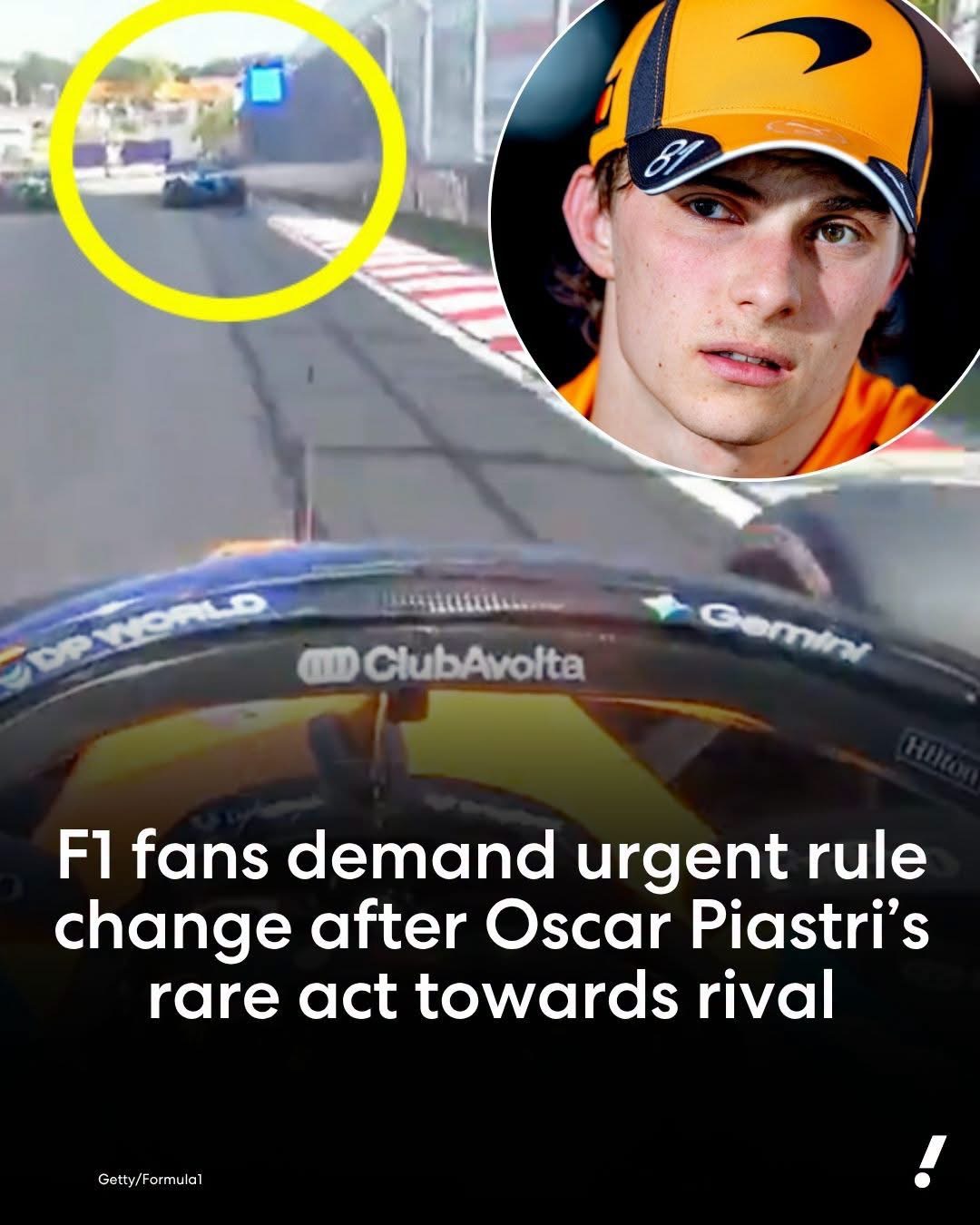
However, the race changed dramatically when he caught Williams driver Carlos Sainz, who had already been lapped. As Piastri attempted to navigate past the slower car, contact between the two drivers damaged the McLaren and effectively destroyed the Australian’s race.
Although Sainz received a time penalty for the incident, the punishment did little to help Piastri, whose afternoon deteriorated further when a gearbox failure ultimately forced him to retire from the race.
Instead of celebrating another podium—or potentially another victory—Piastri left Budapest empty-handed.
RARE EMOTIONAL OUTBURST SHOWS THE MAGNITUDE OF THE MOMENT
Known for maintaining remarkable composure under pressure, Piastri rarely criticizes rivals publicly. That made his post-race comments particularly striking.
The McLaren driver described the collision as one of the most baffling incidents he has experienced, insisting that being eliminated by a lapped car should never happen during a Formula 1 race.
Piastri argued that even though technical problems affected the electronic blue flag notification system, traditional marshal flags remained clearly visible around the circuit. In his view, the responsibility to yield safely still rested with the slower driver.
He also questioned why Sainz was racing aggressively against another backmarker instead of prioritizing awareness of the leaders approaching behind.
The unusually blunt criticism highlighted just how costly the incident was for McLaren’s championship ambitions.
BLUE FLAG MALFUNCTION ADDS ANOTHER LAYER OF CONTROVERSY
The collision did not occur in isolation.
Throughout the Hungarian Grand Prix, multiple teams reported problems with the electronic blue flag system that alerts drivers when faster cars are approaching. Several competitors admitted they relied heavily on radio communication from their engineers because dashboard notifications were inconsistent.
While traditional blue flags continued to be displayed by marshals around the circuit, the technical malfunction created confusion, especially for drivers involved in battles further down the order.
The incident has sparked fresh discussion about Formula 1’s growing dependence on electronic systems. Modern cars generate enormous amounts of data, yet basic communication failures can still have race-changing consequences.
For a championship decided by fractions of a second, reliability extends beyond engines and gearboxes—it also includes the systems that help manage races safely and fairly.
FANS DEMAND CHANGES TO THE SPORT’S BLUE FLAG RULES
The aftermath of the collision quickly shifted from frustration to debate.
Many fans argued that lapped drivers should be required to move aside more decisively once race leaders arrive, eliminating unnecessary risks during championship battles. Others suggested stricter penalties for ignoring blue flags or introducing more automated race control systems to prevent similar situations.
Some even proposed more radical ideas, including limiting how aggressively backmarkers can fight once they have been lapped.
Not everyone agrees with those suggestions. Critics argue that Formula 1 remains a race for every driver on the grid and that backmarkers still have legitimate battles of their own, particularly when fighting for positions that could determine Constructors’ Championship prize money.
Finding the right balance between preserving competitive racing and protecting frontrunners remains one of the sport’s biggest officiating challenges.
MCLAREN’S STRATEGY ALSO CAME UNDER THE MICROSCOPE
The collision was not the only source of frustration.
During the race, Piastri questioned McLaren’s strategy after his pit stop placed him back into heavy traffic while teammate Lando Norris enjoyed cleaner air and eventually secured victory.
In the heat of the moment, Piastri suggested the decision had compromised his race. However, after reviewing the situation, he acknowledged that McLaren had little choice given the circumstances and accepted that the strategy itself was reasonable.
That mature assessment reflected the trust that continues to exist between Piastri and the McLaren pit wall despite an emotionally charged afternoon.
THE CHAMPIONSHIP IMPLICATIONS COULD BE MASSIVE
Formula 1 championships are rarely decided by a single race, but they are often shaped by moments exactly like this.
Instead of collecting valuable points, Piastri recorded a costly retirement that allowed championship rivals to strengthen their positions. Kimi Antonelli increased his advantage at the top of the standings, while Lewis Hamilton also benefited from McLaren’s misfortune.
As the season enters its decisive phase, every retirement becomes increasingly significant. Recovering from a large points deficit will require flawless execution, strong reliability, and perhaps a few fortunate breaks.
For McLaren, ensuring that both strategy and reliability improve after the summer break will be essential if they hope to remain in both championship fights.
WHAT HAPPENS NEXT COULD SHAPE THE REST OF THE SEASON
The Hungarian Grand Prix may ultimately be remembered for far more than Lando Norris’ victory.
Piastri’s rare emotional reaction has highlighted growing concerns about race management, blue flag enforcement, and communication systems that Formula 1 will almost certainly review before the next round. If officials conclude that procedural weaknesses contributed to the controversy, changes could arrive sooner rather than later.
Meanwhile, Piastri faces a different challenge—turning disappointment into motivation. Elite drivers often respond to setbacks with their strongest performances, and McLaren will hope the Australian channels his frustration into a renewed title charge.
With several races still remaining, the championship is far from settled. But if the margins continue to be this fine, every decision, every system, and every split-second interaction with traffic could determine who ultimately lifts the 2026 Formula 1 World Championship trophy.