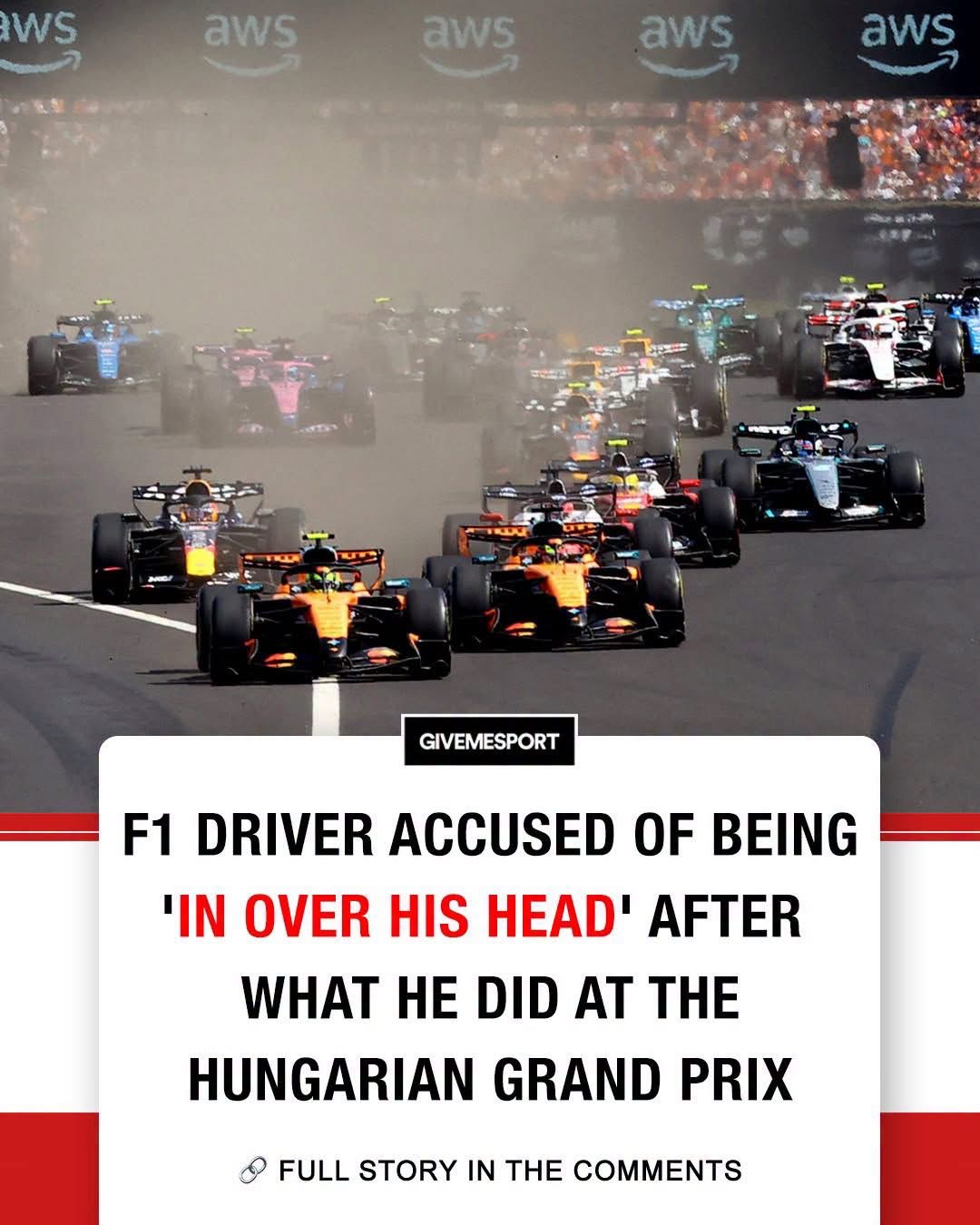
The 2026 Hungarian Grand Prix delivered one of the most dramatic races of the Formula 1 season, but much of the post-race conversation wasn’t about Lando Norris’ impressive victory or the championship battle. Instead, attention shifted to a controversial blue flag malfunction that left several backmarkers at the center of heated criticism.
Among the drivers under the spotlight was Audi rookie Gabriel Bortoleto, whose handling of faster cars during the race prompted strong reactions from Mercedes team principal Toto Wolff and former Formula 1 race winner Ralf Schumacher. While Bortoleto defended his actions by pointing to technical failures in the race control system, Schumacher questioned whether the Brazilian had shown enough awareness during one of the season’s most chaotic Grands Prix.
The incident has reignited debate over driver responsibility, race management, and whether Formula 1’s increasingly sophisticated technology can sometimes become a weakness when it fails.
BLUE FLAG MALFUNCTION CREATED CHAOS THROUGHOUT THE RACE
Blue flags are among Formula 1’s most important race signals, informing slower cars that faster competitors are approaching to lap them. Drivers normally receive these warnings through trackside marshals, electronic light panels, dashboard displays, and constant communication from their race engineers.
In Hungary, however, that system reportedly malfunctioned.
Several drivers received incorrect blue flag notifications, while others failed to receive timely warnings altogether. The confusion created dangerous situations throughout the field as leaders attempted to work their way through traffic during crucial phases of the race.
Rather than being isolated mistakes by individual drivers, multiple incidents suggested there was a broader issue affecting race communication, making the Hungarian Grand Prix unusually difficult to manage for both drivers and teams.
BORTOLETO DEFENDS HIS ACTIONS AFTER CRITICISM
Gabriel Bortoleto found himself at the center of the controversy after appearing to delay Lewis Hamilton and Kimi Antonelli during the closing stages of the race.
The Brazilian insisted he was not intentionally blocking the frontrunners, explaining that his dashboard failed to provide blue flag notifications and that he relied entirely on instructions from his race engineer.
According to Bortoleto, he immediately moved aside once his engineer informed him that Hamilton and Antonelli were approaching. He also pointed out that he had experienced similar confusion while battling other midfield cars, suggesting the issue affected multiple competitors rather than just himself.
For a rookie still adapting to Formula 1, Bortoleto argued that trusting the team’s communication was the safest approach under unusual circumstances.
RALF SCHUMACHER DELIVERS A BRUTAL ASSESSMENT
Former Formula 1 driver Ralf Schumacher was unconvinced by Bortoleto’s explanation.
Schumacher argued that every Formula 1 driver must remain aware of what is happening around them regardless of technological failures. In his view, relying solely on dashboard information or radio messages is insufficient at the highest level of motorsport.
His strongest criticism centered on Bortoleto’s suggestion that he could not safely check his mirrors while negotiating corners.
Schumacher responded by saying that if a Formula 1 driver cannot monitor approaching traffic during a race, then serious questions should be asked about their readiness for the sport.
The comments quickly generated debate throughout the Formula 1 community, with some agreeing that situational awareness is a fundamental skill, while others believed Schumacher overlooked the difficult circumstances created by the malfunctioning blue flag system.
MERCEDES LEFT FURIOUS AFTER LOSING VALUABLE TIME
Mercedes emerged as one of the biggest critics following the race.
Team principal Toto Wolff expressed frustration not only with individual backmarkers but also with the failure of the race management systems that are designed to prevent exactly these situations.
Wolff argued that delayed blue flags potentially cost Mercedes valuable race time during critical moments as George Russell and championship leader Kimi Antonelli fought for important championship points.
He also criticized communication between teams and drivers, suggesting engineers should have done more to alert slower cars when the electronic systems failed.
The Austrian’s frustration reflected the growing importance of every second in a championship where even minor delays can influence podium finishes and title battles.
THE INCIDENT ALSO HURT OSCAR PIASTRI’S RACE
The blue flag confusion affected more than just Mercedes.
Oscar Piastri’s hopes of victory were significantly damaged after becoming entangled in traffic involving Carlos Sainz while battling for the race lead.
The Australian believed the backmarker battle unnecessarily compromised his race, allowing teammate Lando Norris to seize the strategic advantage before Piastri later retired with a gearbox failure.
Without the confusion surrounding slower cars, McLaren may well have secured a comfortable one-two finish rather than watching one of its drivers retire from contention.
The sequence highlighted how backmarker management can dramatically influence the outcome of races even when championship contenders are separated by only fractions of a second.
WHY THIS INCIDENT MATTERS FOR FORMULA 1
Formula 1 has invested heavily in technology designed to improve safety and race management. Systems like electronic flag notifications, digital dashboards, GPS tracking, and instant radio communication are intended to eliminate misunderstandings that once plagued the sport.
When those systems fail, however, drivers are forced to rely on instinct, mirrors, and delayed radio messages while traveling at speeds exceeding 300 km/h.
That reality makes incidents like Hungary particularly concerning because they expose vulnerabilities in systems teams have grown accustomed to trusting.
With several championship battles still alive—including Kimi Antonelli’s title fight against Lewis Hamilton and George Russell—Formula 1 cannot afford repeated communication failures during the second half of the season.
WHAT HAPPENS NEXT?
The FIA is expected to review the blue flag malfunction before the championship resumes after the summer break, with improving race control reliability likely to become a priority before the Dutch Grand Prix at Zandvoort.
For Gabriel Bortoleto, the controversy serves as another valuable learning experience in his rookie campaign. Despite the criticism, the Brazilian has already demonstrated considerable talent through several impressive performances this season and remains one of Formula 1’s brightest young prospects.
At the same time, experienced figures such as Toto Wolff and Ralf Schumacher have highlighted the demanding standards expected at motorsport’s highest level. Whether responsibility ultimately lies with the driver, the engineer, or Formula 1’s technical systems, the Hungarian Grand Prix has reinforced one undeniable truth: in a championship where victories, podiums, and titles are often decided by seconds, even a brief communication breakdown can alter the course of an entire season.