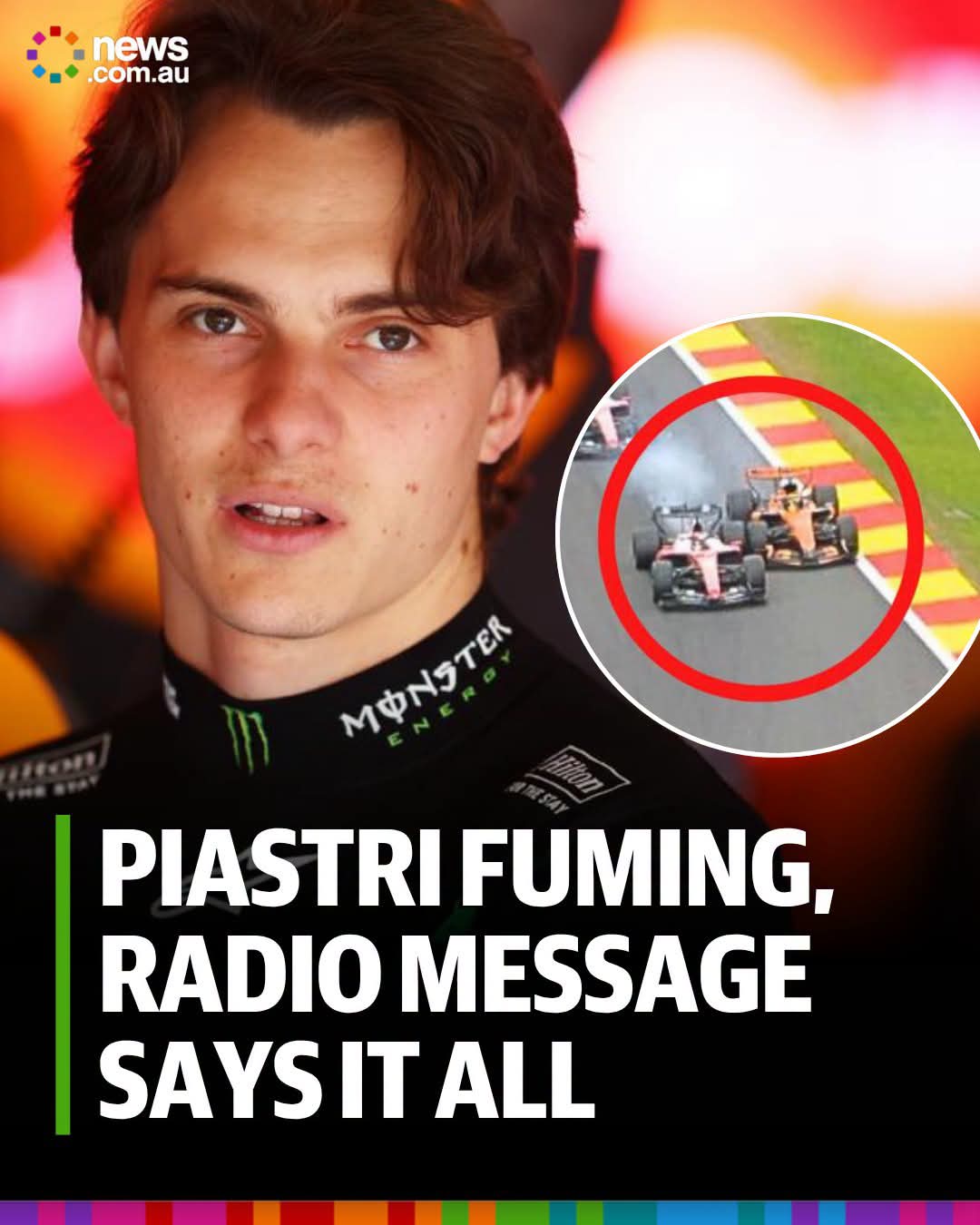
The 2026 Hungarian Grand Prix delivered another controversial flashpoint as Carlos Sainz and Oscar Piastri became involved in a collision that immediately divided opinions across the Formula 1 paddock. While stewards ultimately handed Sainz a five-second penalty for causing the incident, the Williams driver insists there was far more to the story than a simple driving error.
Sainz believes confusion surrounding Formula 1’s blue flag communication system played a major role in the clash, arguing he had every reason to believe something had gone wrong with the warnings that normally alert slower cars to approaching leaders. His explanation has reopened an ongoing debate about race control procedures, driver visibility, and whether the current blue flag system is reliable enough during high-speed battles.
THE INCIDENT THAT CHANGED THE COURSE OF THE RACE
The collision occurred during the middle phase of the race as Sainz was locked in his own battle with fellow Spaniard Fernando Alonso. At the same time, championship contender Oscar Piastri was charging through traffic while leading the Grand Prix.
As the McLaren driver attempted to lap Sainz through the exit of Turn 2 heading into Turn 3, the two cars made contact. Piastri was forced onto the grass, costing him valuable time just as teammate Lando Norris was applying pressure through pit strategy.
Although the contact did not immediately end Piastri’s race, every second proved crucial. Norris later emerged ahead after the pit-stop cycle, while Piastri eventually retired with a gearbox failure, ending what had already become an incredibly frustrating afternoon.
For McLaren, the incident became one of several moments that altered the complexion of a race in which strategy, reliability, and traffic management all played decisive roles.
SAINZ SAYS THE BLUE FLAG SYSTEM FAILED HIM
Rather than disputing responsibility entirely, Sainz acknowledged the penalty but argued the circumstances were far from straightforward.
According to the Williams driver, he never received the clear warnings drivers usually depend on when race leaders are approaching. Blue flags are designed to give slower cars enough notice to move aside safely, with both marshals and race engineers playing key roles in communicating those signals.
Sainz claimed those alerts either arrived too late or failed altogether.
He explained that while battling Alonso, he did not expect Piastri to appear alongside him at that specific point on the circuit. By the time the McLaren was visible, it had entered an area largely hidden by the natural blind spots created by modern Formula 1 cockpit designs.
Importantly, race stewards appeared to recognize part of that argument. Their report referenced the visibility limitations as a mitigating factor, reducing what could have been a more severe punishment.
That acknowledgement suggests officials accepted the collision was influenced by circumstances beyond simple driver negligence.
WHY BLUE FLAGS REMAIN A CHALLENGING ISSUE IN FORMULA 1
To many fans, blue flags appear to be one of Formula 1’s simplest rules: slower cars should allow leaders to pass.
In reality, the process is far more complicated.
Drivers are often engaged in their own wheel-to-wheel battles while simultaneously monitoring mirrors, dashboard information, engineer communications, tire management, energy deployment, and changing track conditions. Finding the safest location to yield without compromising another fight requires split-second decision-making.
Modern Formula 1 circuits also feature sections where overtaking is naturally difficult, making immediate compliance with blue flags nearly impossible without creating new risks.
If communication systems fail—or even experience brief delays—the margin for error becomes extremely small.
The Hungary incident highlights why Formula 1 continues investing in improving race control technology. As cars become faster and racing becomes closer, ensuring every driver receives clear and timely information grows increasingly important.
MCLAREN’S TITLE FIGHT LEAVES LITTLE ROOM FOR INCIDENTS
From McLaren’s perspective, the clash was particularly costly because Oscar Piastri was fighting at the very front of the race.
Even minor delays can completely reshape the outcome of a Grand Prix when leading teams are separated by only fractions of a second. Losing momentum while navigating backmarkers can influence pit-stop timing, tire strategy, and ultimately finishing position.
Although Piastri later retired because of a gearbox problem rather than the collision itself, the contact had already disrupted his race rhythm and may have affected the strategic battle unfolding against Norris and the rest of the frontrunners.
In an increasingly competitive championship, these seemingly isolated incidents can have lasting consequences. Every lost point matters, especially when title rivals continue scoring consistently throughout the season.
For McLaren, managing traffic efficiently remains just as important as maximizing outright pace.
WILLIAMS CONTINUES TO SHOW FIGHT DESPITE LIMITED REWARDS
While the incident attracted headlines, it also reflected Williams’ determination to remain competitive even outside the points-paying positions.
Sainz was battling Alonso aggressively despite running near the back of the field, demonstrating that midfield teams continue racing intensely regardless of championship position.
That competitive mindset has become one of Williams’ biggest strengths during 2026. Although podiums remain out of reach on most weekends, the team has consistently shown greater pace and confidence compared to previous seasons.
However, incidents involving front-runners inevitably draw greater scrutiny, particularly when they influence championship contenders.
For Williams, minimizing these costly moments will be essential as the team continues building toward becoming a regular points challenger.
COULD FORMULA 1 REVIEW ITS BLUE FLAG PROCEDURES?
The controversy is likely to fuel renewed discussion between drivers, teams, and the FIA regarding how blue flags are communicated during races.
Technology already provides drivers with dashboard alerts, radio messages, and trackside marshal signals, but incidents like Hungary suggest there is still room for improvement. More synchronized digital warnings or enhanced cockpit notifications could reduce the chances of misunderstandings during intense racing situations.
Formula 1 has consistently refined safety and communication systems over the past decade, and this latest incident may become another example used to evaluate whether existing procedures remain fit for increasingly competitive racing.
WHAT THIS MEANS FOR THE REST OF THE SEASON
Carlos Sainz’s explanation is unlikely to erase McLaren’s frustration, but it does present a more nuanced picture than the immediate post-race reactions suggested.
Rather than reckless driving, the incident appears to have been the product of multiple factors: intense on-track battles, limited visibility, delayed communication, and the unforgiving nature of modern Formula 1 racing.
For Oscar Piastri, the race represented another reminder that championship campaigns are often shaped by circumstances beyond outright speed. For Sainz, it reinforced how quickly drivers can find themselves penalized when communication systems fail to function perfectly.
As the 2026 Formula 1 season enters its decisive phase, every point, every strategy call, and every split-second decision carries greater significance. The Hungarian Grand Prix may ultimately be remembered not only for McLaren’s internal battle but also for reigniting important conversations about how Formula 1 manages traffic in an era of increasingly intense competition.