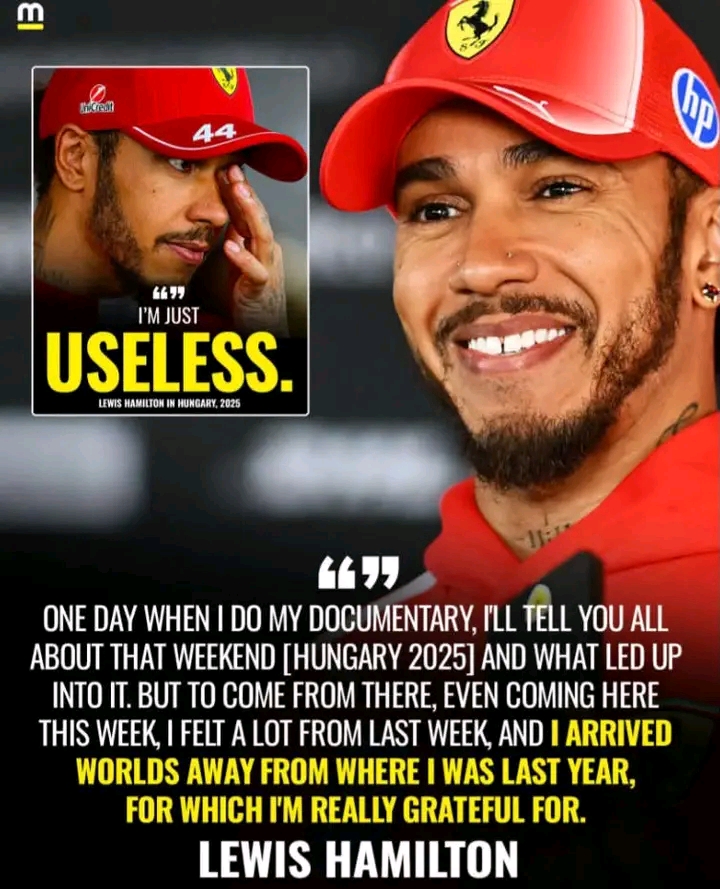
LEWIS HAMILTON’S HUNGARIAN GP CHAPTER COULD BECOME ONE OF THE MOST EMOTIONAL MOMENTS IN HIS FUTURE DOCUMENTARY
Whenever a documentary about Lewis Hamilton’s career eventually looks back at his first season with Ferrari, there is one chapter from the 2025 Formula 1 season that could carry enormous emotional weight: the Hungarian Grand Prix.
The race weekend at the Hungaroring was more than another stop on the calendar. It represented a complicated moment in Hamilton’s first season wearing Ferrari’s iconic red colors, a period filled with enormous expectations, intense scrutiny and the pressure that naturally comes with one of the biggest moves in modern Formula 1 history.
Hamilton’s switch from Mercedes to Ferrari was always going to attract extraordinary attention. After spending more than a decade with Mercedes and building one of the most successful partnerships in F1 history, joining Ferrari represented a completely new challenge.
But with that opportunity came an uncomfortable reality.
Every result was going to be judged against the enormous standards Hamilton had established throughout his career.
That is what makes the Hungarian chapter so compelling. It captures the contrast between the dream of driving for Ferrari and the brutal reality of competing at the highest level of Formula 1 when expectations are almost impossible to escape.
HAMILTON’S FERRARI DREAM CAME WITH UNPRECEDENTED PRESSURE
Hamilton’s move to Ferrari was one of the biggest stories in Formula 1 before the 2025 season had even started.
The seven-time world champion was joining the sport’s most famous team, creating a partnership that fans had imagined for years. The arrival generated global attention, with every practice session, qualifying result and race becoming a major talking point.
But Ferrari is not an ordinary Formula 1 team.
Success is expected immediately.
For Hamilton, the pressure was arguably even greater because of his status. He was not arriving as an unknown prospect hoping to establish himself. He arrived as a seven-time world champion and one of the most accomplished drivers in motorsport history.
That meant the standards were exceptionally high.
When the results did not immediately match expectations, the conversation quickly shifted from excitement to analysis.
Was the Ferrari suited to Hamilton’s driving style?
Could he adapt quickly enough?
Was the team giving him the right tools?
Could he challenge for victories and, eventually, another championship?
Those questions followed him throughout the season.
WHY HUNGARY 2025 COULD BE SO IMPORTANT IN HAMILTON’S STORY
The Hungarian Grand Prix occupies a unique place in Hamilton’s career.
The Hungaroring has historically been one of the circuits where Hamilton has excelled. His record at the track has made it something of a personal stronghold, and that history inevitably increases expectations whenever he arrives in Budapest.
That is why the 2025 edition carried such significance.
A circuit where Hamilton had previously enjoyed so much success became the setting for another chapter in his difficult adjustment to life at Ferrari.
For a future documentary, the contrast would be powerful.
On one side is the history: Hamilton, the multiple world champion, arriving at a circuit where he has repeatedly delivered exceptional performances.
On the other is the present: a new team, a new environment and a new generation of challenges.
That tension tells a bigger story than simply whether a driver finishes first or tenth.
It is the story of what happens when one of the greatest drivers in history starts over.
THE HUMAN SIDE OF HAMILTON’S FIRST FERRARI SEASON
The most interesting documentaries about Formula 1 are rarely just about lap times.
They are about people.
Hamilton’s Ferrari journey naturally lends itself to that kind of storytelling because of everything surrounding the move.
Imagine the pressure of walking into Maranello after years at Mercedes.
Imagine knowing that millions of fans are watching every decision.
Imagine competing for a team whose history includes legendary drivers such as Michael Schumacher, Niki Lauda and Juan Manuel Fangio.
Every weekend becomes part of a much larger narrative.
The 2025 Hungarian Grand Prix could therefore represent an important emotional moment because it reflects the reality of Hamilton’s transition.
The expectation was simple from the outside: Ferrari and Hamilton should win.
The reality was far more complicated.
Formula 1 does not work like a fairytale. A great driver cannot simply arrive at a new team and guarantee championship success. The car must be competitive. The engineering direction must be correct. The driver must understand the machinery. Communication between the cockpit and pit wall must be precise.
And sometimes, even all of those elements are not enough.
HAMILTON’S CHALLENGE WAS BIGGER THAN ONE RACE
It would be unfair to judge Hamilton’s Ferrari project based on one Grand Prix.
The bigger challenge was adaptation.
Hamilton had spent years developing a deep understanding of Mercedes machinery. He knew how the team operated, how the car behaved and how to communicate with engineers.
Ferrari required him to start building that relationship again.
Even a driver with Hamilton’s experience needs time to understand a new car.
The steering characteristics can be different.
The braking behavior can change.
The way the car responds to tire temperatures can be unfamiliar.
Even the communication style between driver and engineers can take time to develop.
These small details matter enormously at the highest level.
That is why Hamilton’s first season at Ferrari should be viewed as a process rather than a simple pass-or-fail test.
THE IMPACT ON CHARLES LECLERC
Hamilton’s arrival also changed the dynamic inside Ferrari.
Charles Leclerc had spent years as the team’s leading driver and had become deeply integrated into Ferrari’s structure.
Suddenly, he had a seven-time world champion as his teammate.
That created one of the most fascinating internal battles on the 2025 grid.
For Leclerc, Hamilton’s arrival represented both a challenge and an opportunity.
If Leclerc consistently outperformed Hamilton, it would strengthen his reputation as Ferrari’s future championship leader.
If Hamilton gained the upper hand, it would demonstrate that experience and adaptability could still overcome the advantage of a driver who had spent years inside the Ferrari system.
The rivalry was never simply about who finished ahead on Sunday.
It was about two different generations of Formula 1 talent competing inside one of the sport’s most historic teams.
That dynamic makes the Hungarian Grand Prix chapter even more interesting from a storytelling perspective.
FERRARI’S BIGGEST CHALLENGE IS TURNING POTENTIAL INTO RESULTS
The pressure surrounding Hamilton cannot be separated from Ferrari’s own history.
The team has one of the largest fanbases in global sport, and its expectations are enormous.
A driver can have a strong weekend and still face criticism if the team fails to maximize the opportunity.
That is because Ferrari’s problems have rarely been limited to driver performance.
Strategy, development, qualifying pace and race execution all matter.
For Hamilton, joining Ferrari meant stepping into an organization where every mistake receives international attention.
That pressure affects everyone.
Engineers feel it.
Team principals feel it.
Drivers feel it.
Even a minor strategic error can dominate headlines for days.
The Hungarian Grand Prix therefore forms part of a broader question about whether Ferrari can build a complete championship-winning operation around its talented driver lineup.
WHAT THIS MEANS FOR HAMILTON’S CHAMPIONSHIP FUTURE
The biggest question surrounding Hamilton’s Ferrari era is not necessarily whether he can win another individual race.
It is whether Ferrari can provide the consistency required for a championship campaign.
Modern Formula 1 championships are won over an entire season.
A driver needs qualifying speed, race pace, reliability, strategic execution and development throughout the year.
A single dominant weekend is not enough.
That is where Hamilton’s experience could eventually become valuable.
He has already experienced championship pressure at the highest level. He understands how momentum develops over a season and how quickly a small performance advantage can become significant.
But experience can only take a driver so far.
Ferrari must give him the machinery to compete.
WHY THIS CHAPTER COULD HIT DIFFERENTLY IN A DOCUMENTARY
If Hamilton’s Ferrari journey is eventually explored in a documentary, the Hungarian Grand Prix could become one of those episodes that feels more powerful with hindsight.
At the time, fans see a single race weekend.
Years later, they may see something different.
They may see the moment when expectations collided with reality.
They may see a legendary driver confronting the difficulty of starting again.
They may see the emotional weight of trying to succeed with Ferrari after already achieving almost everything possible with Mercedes.
That is what makes sports documentaries compelling.
The audience already knows the results.
The drama comes from understanding what the people involved were feeling at the time.
Hamilton’s career has already produced countless iconic moments, from championship victories to heartbreaking defeats. His Ferrari chapter adds a different dimension because it is about reinvention.
And reinvention is rarely comfortable.
THE BIGGER LEGACY OF HAMILTON’S FERRARI MOVE
Regardless of how the Ferrari chapter ultimately ends, Hamilton’s decision to join the team will remain one of the defining moves of his career.
It was a risk.
He could have remained with Mercedes, the team with which he had achieved unprecedented success.
Instead, he chose a new challenge.
That decision alone changed the final chapters of his career.
The significance of the move is also larger than Hamilton himself.
It brought enormous global attention to Ferrari and Formula 1, created a fascinating teammate battle with Leclerc and added another layer to the sport’s modern history.
For younger fans, Hamilton in Ferrari red may eventually become as iconic as his Mercedes years.
For longtime fans, however, the transition carries a different emotional weight.
They are watching a driver who spent years at the top of the sport attempt to write a new ending.
THE HUNGARIAN GP COULD BECOME A SYMBOL OF THE JOURNEY
There is still plenty of racing left to define Hamilton’s Ferrari legacy.
The story is not finished.
That is precisely why the Hungarian Grand Prix chapter matters.
It represents the uncertainty of the journey.
The pressure.
The expectations.
The adjustment.
The search for performance.
And the reality that even the greatest drivers in Formula 1 history must sometimes fight to rediscover their place at the front.
If a documentary eventually revisits this period, fans may look back at Hungary 2025 differently.
What felt like a difficult weekend at the time could become an important part of a much larger story about resilience, ambition and reinvention.
Lewis Hamilton’s Ferrari journey was never going to be simple.
It was never going to be just about winning.
It was about what happens when one of the greatest drivers in Formula 1 history decides to take one of the biggest risks of his career and discovers that the hardest chapter may not be the one where he first became a champion, but the one where he tries to prove himself all over again.
And if that documentary ever does arrive, the Hungary 2025 chapter could be the one fans watch with the most emotion—not necessarily because of the result, but because of everything that moment represented.