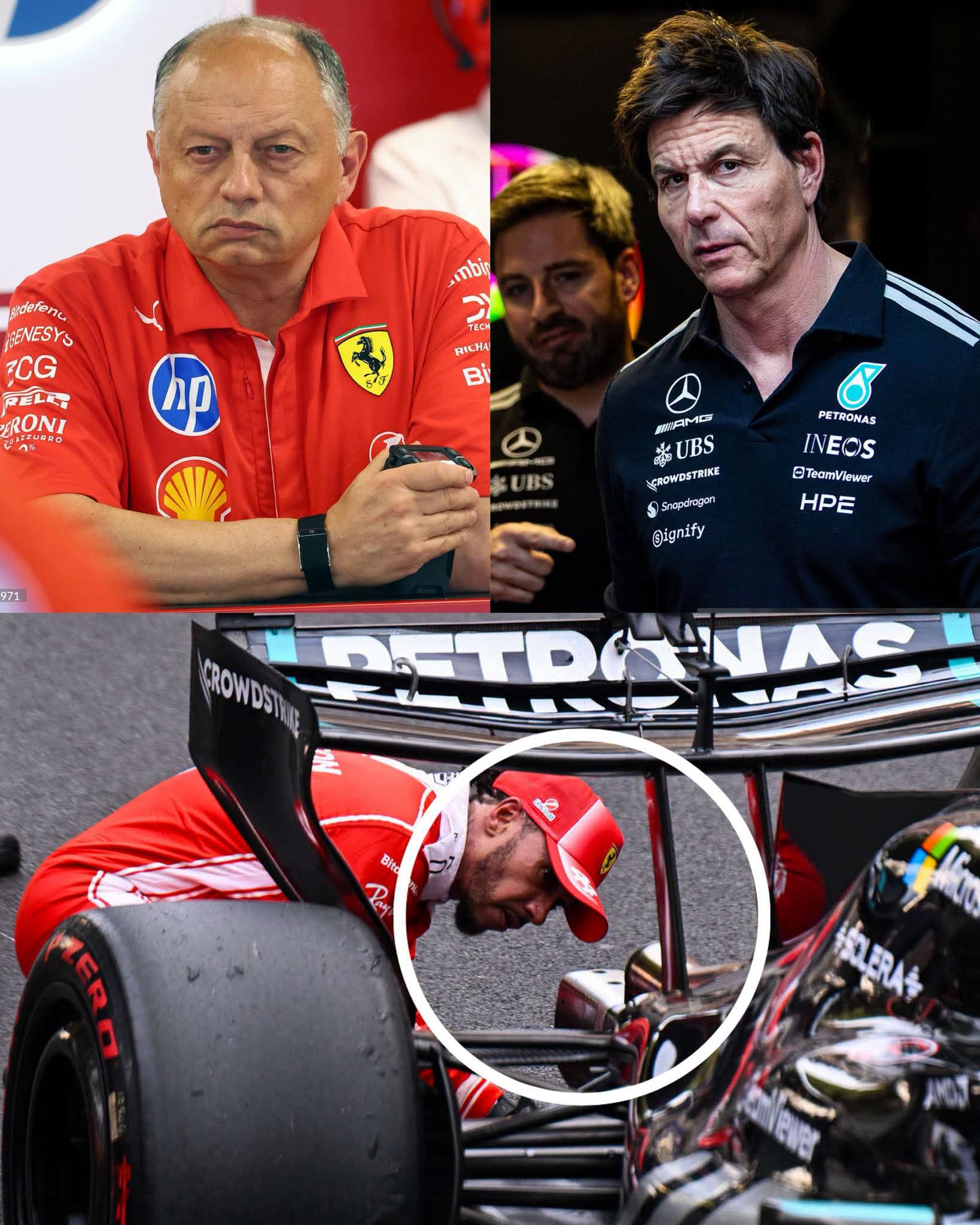
Formula 1’s fierce rivalry between Ferrari and Mercedes may have just entered a new chapter, and this time the battle is being fought away from the racetrack. Reports emerging from the paddock suggest Ferrari has requested clarification from the FIA regarding a controversial diffuser design used on Mercedes’ 2026 challenger, a component believed to play a key role in the team’s recent performance gains.
While technical disputes are nothing new in Formula 1, this latest development has quickly become one of the most talked-about stories of the season. If the FIA determines that changes are required, the consequences could extend far beyond a simple design adjustment and potentially influence the balance of power in both championships.
THE DIFFUSER AT THE CENTER OF THE DEBATE
According to reports, Ferrari questioned a distinctive toothed diffuser concept on the Mercedes W17. The diffuser is one of the most important aerodynamic components on an F1 car, responsible for managing airflow underneath the car and generating crucial downforce without significantly increasing drag.
The concern from Ferrari reportedly centers on whether Mercedes’ interpretation of the regulations falls within the spirit of the rules. Sources suggest Ferrari explored a similar concept during development but believed it would not receive FIA approval.
As a result, the Italian team sought clarification from the governing body rather than filing a direct protest. However, what began as a technical inquiry has now evolved into a much larger discussion involving engineers, aerodynamic experts, and FIA officials.
WHY THIS ISSUE MATTERS SO MUCH
Modern Formula 1 is often decided by tiny performance margins. A gain of just a few tenths of a second per lap can transform a midfield contender into a race-winning machine.
Mercedes has shown encouraging signs of progress throughout the 2026 season, and many observers have pointed to improved rear-end stability as one of the strengths of the W17. A more stable rear allows drivers to attack corners with greater confidence, preserve tyres more effectively, and extract maximum performance over race distance.
If the diffuser design contributes significantly to those strengths, any FIA intervention could potentially impact Mercedes’ competitiveness heading into the second half of the season.
That is precisely why Ferrari’s inquiry has attracted so much attention. The team is not merely questioning a component; it is questioning a potential performance advantage enjoyed by one of its biggest rivals.
FIA FACES A DELICATE DECISION
The FIA regularly receives requests for technical clarification from teams. These inquiries are an important part of maintaining regulatory consistency across the grid.
However, situations become particularly sensitive when one team believes a rival has found a legal interpretation that pushes the boundaries of the rulebook.
If the FIA concludes that Mercedes’ solution complies fully with existing regulations, the team will likely continue using the design. In that scenario, rival teams may attempt to develop similar concepts for their own cars.
On the other hand, if the governing body issues a technical directive requiring modifications, Mercedes could be forced to redesign portions of the car. Such directives have altered competitive dynamics in the past, making this a story every team will be monitoring closely.
ANOTHER CHAPTER IN THE FERRARI-MERCEDES RIVALRY
Although McLaren, Mercedes, Ferrari, and Red Bull are all involved in the current competitive picture, Ferrari and Mercedes remain two of Formula 1’s most influential technical powerhouses.
Throughout the hybrid era and beyond, both teams have repeatedly challenged each other’s innovations. Whether it involved power units, suspension concepts, aerodynamic solutions, or floor designs, the battle for engineering superiority has often extended into FIA meeting rooms as much as onto race circuits.
This latest dispute reinforces the reality that championship campaigns are rarely decided solely by driver talent. Engineering interpretation, regulatory understanding, and political influence often play equally important roles.
COULD THIS AFFECT THE CHAMPIONSHIP FIGHT?
The timing of the controversy is particularly significant.
With several teams introducing upgrades throughout the European leg of the season, every performance gain matters. If Mercedes is forced to alter a key aerodynamic component, it could affect development plans for upcoming races.
Meanwhile, Ferrari continues to push aggressively after recent improvements to its own package. Lewis Hamilton’s victory in Spain demonstrated that Ferrari has made genuine progress, and the team appears determined to maintain pressure on its rivals both on and off the track.
Should the FIA side with Ferrari’s interpretation, the competitive landscape could shift. If Mercedes retains the design unchanged, Ferrari and other teams may instead focus on replicating similar concepts in future upgrades.
WHAT HAPPENS NEXT?
For now, all eyes remain on the FIA’s response.
Technical clarifications can sometimes pass quietly through the paddock with little consequence. At other times, they become defining moments that reshape an entire season.
Regardless of the final verdict, this controversy highlights one of Formula 1’s most fascinating realities: championships are won not only through speed and strategy but also through innovation, interpretation, and constant battles at the edge of the rulebook.
As Ferrari continues to challenge Mercedes both on track and in the technical arena, the story is unlikely to disappear anytime soon. The next FIA decision could determine whether this remains a minor disagreement or becomes one of the defining technical controversies of the 2026 Formula 1 season.