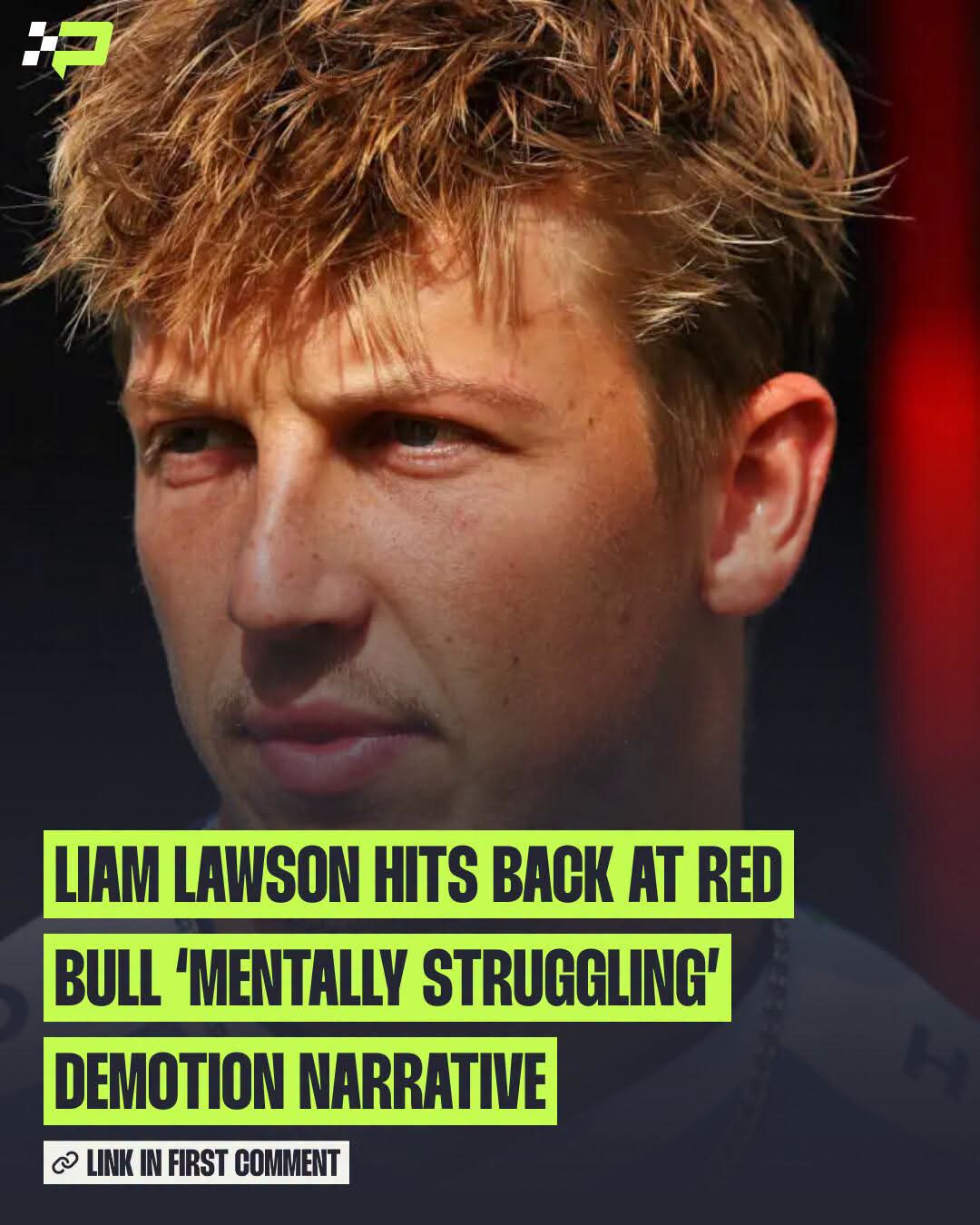
Liam Lawson has launched a powerful defense of his brief Red Bull stint, rejecting suggestions that he was mentally overwhelmed before being demoted and insisting that the circumstances surrounding his exit were far more complicated than the public was led to believe.
The New Zealander’s promotion to Red Bull was one of the biggest stories heading into the 2026 Formula 1 season. After years of waiting for a full-time opportunity, Lawson finally secured a seat alongside Max Verstappen. Yet just two race weekends later, his dream appeared to collapse when Red Bull sent him back to Racing Bulls and promoted Yuki Tsunoda in his place.
Now, months later, Lawson is offering his side of the story—and it paints a very different picture from the one Red Bull presented.
A PROMOTION THAT TURNED INTO A NIGHTMARE
Lawson entered the 2026 season under difficult circumstances. Pre-season testing problems limited his preparation, while the opening races took place at circuits where he had little or no Formula 1 experience.
Australia proved challenging from the start. After qualifying near the back, Red Bull made significant changes to his car, forcing him to start from the pit lane. His race ultimately ended in the barriers during a chaotic Grand Prix.
Things failed to improve in China. A disappointing Sprint weekend was followed by another difficult qualifying session that left him starting at the rear of the field.
To outsiders, the results looked alarming. Internally, however, Lawson says there was much more going on than simple lack of pace.
THE SET-UP GAMBLE THAT CHANGED EVERYTHING
One of the most revealing aspects of Lawson’s account concerns Red Bull’s decision to radically alter the car before the Chinese Grand Prix.
According to the driver, the team was unhappy with the RB21’s behavior and believed drastic experimentation was necessary. Rather than making small adjustments, Red Bull opted for what Lawson described as an extreme set-up change rarely attempted during a race weekend.
The idea was not solely about helping Lawson feel comfortable in the car. It was also an effort to gather data and potentially uncover solutions for broader issues affecting the team.
The gamble failed.
Lawson struggled throughout the race, and within days he received the call informing him that he would be returning to Racing Bulls.
From his perspective, the situation felt deeply unfair. A race run with an experimental set-up became part of the evidence used to justify his removal.
WHY LAWSON BELIEVES TWO RACES WERE NOT ENOUGH
Perhaps the strongest part of Lawson’s argument is his belief that two race weekends simply do not provide enough information to accurately judge a Formula 1 driver.
Modern Formula 1 is more competitive than ever. Drivers need time to understand new cars, adapt to team processes, build relationships with engineers, and find confidence behind the wheel.
History is filled with examples of drivers who struggled initially before becoming race winners and championship contenders.
Lawson argues that his evaluation period was effectively over before it truly began.
For a team fighting for victories and championships, patience is often in short supply. Yet the speed of Red Bull’s decision continues to divide opinion throughout the paddock.
THE MENTAL HEALTH NARRATIVE THAT FRUSTRATED HIM
What appears to have frustrated Lawson most was the suggestion that Red Bull’s decision was partly made to protect his mental wellbeing.
Christian Horner and other senior figures suggested the pressure was heavily affecting the young driver and that a return to Racing Bulls would allow him to rebuild his confidence.
Lawson strongly disagrees.
He insists he was not mentally broken, overwhelmed, or unable to cope with the demands of Formula 1. Instead, he says he simply accepted responsibility publicly for poor results because that is what professional drivers are expected to do.
That willingness to take accountability was then interpreted by many observers as evidence that he was struggling psychologically.
For Lawson, that narrative became one of the most frustrating consequences of the entire episode.
SOCIAL MEDIA AND THE MODERN F1 PRESSURE COOKER
Lawson’s experience highlights another growing issue within Formula 1: the influence of social media narratives.
Every qualifying session, radio message, and team decision is dissected instantly by millions of fans. Rumors spread rapidly, and speculation often becomes accepted as fact before drivers have a chance to respond.
The New Zealander revealed that he has largely removed Formula 1 content from his social media feeds in an effort to avoid the endless cycle of opinions and rumors.
It is a strategy increasingly adopted by modern athletes who understand that constant exposure to online commentary can become a distraction from performance.
In many ways, Lawson’s comments provide a reminder that Formula 1 drivers are competing not only against rivals on track but also against public narratives off it.
HOW THE DEMOTION MAY HAVE SAVED HIS CAREER
Ironically, the move that initially appeared devastating may now be helping Lawson rediscover his best form.
Back at Racing Bulls, he has emerged as the team’s leading driver, outperforming highly-rated teammate Arvid Lindblad and becoming a consistent points scorer.
The environment appears to suit him far better. Expectations are lower, pressure is reduced, and he has been given the freedom to rebuild confidence and demonstrate his abilities without the constant comparison to Verstappen.
His performances suggest there was always talent beneath the struggles.
The question now is whether Red Bull acted too quickly.
WHAT THIS MEANS FOR RED BULL’S FUTURE
Red Bull’s handling of second drivers continues to attract scrutiny.
Over the past decade, several talented racers have struggled alongside Verstappen. Pierre Gasly, Alex Albon, Sergio Perez, Yuki Tsunoda, and now Lawson have all experienced the immense challenge of adapting to the role.
The situation raises difficult questions about whether the issue lies solely with the drivers or whether the team environment itself makes success nearly impossible for anyone not named Max Verstappen.
If Lawson continues to thrive at Racing Bulls while Red Bull’s second seat remains unstable, the debate will only intensify.
CAN LAWSON EARN ANOTHER SHOT?
Formula 1 has always been a sport of second chances.
Lawson’s current performances suggest he is determined to prove that his Red Bull stint did not accurately reflect his capabilities. Every strong result strengthens his case and keeps his name in future driver market discussions.
Whether that opportunity comes at Red Bull, another top team, or elsewhere remains to be seen.
What is clear, however, is that Lawson has no intention of allowing two difficult race weekends to define his Formula 1 career.
His message is simple: the story was never as straightforward as many people believed, and he is determined to show that his journey in Formula 1 is only just beginning.