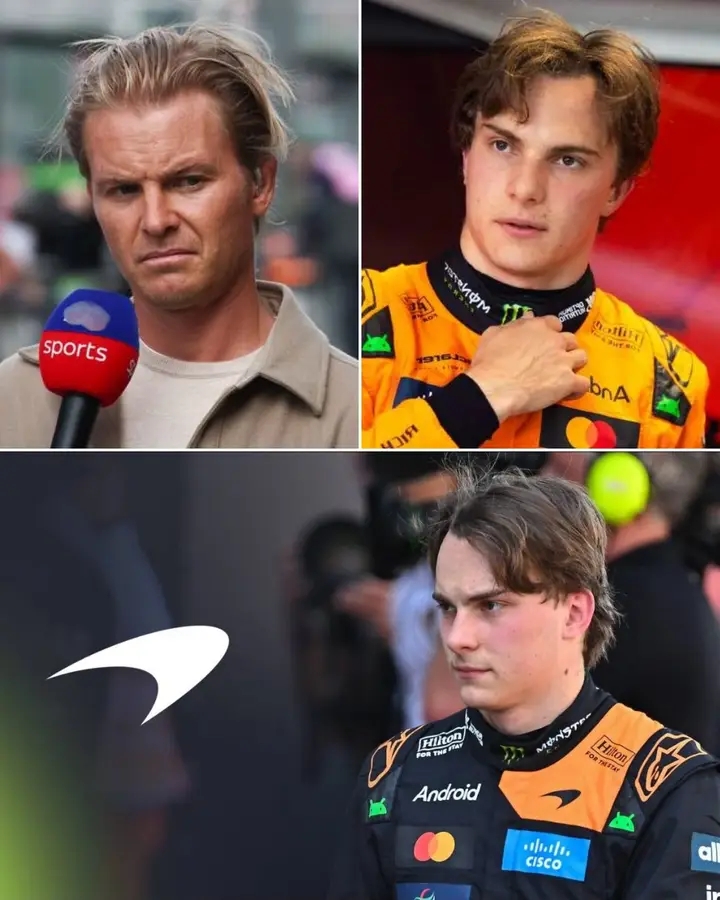
Formula 1 has never been short of strong opinions, but the latest criticism directed at McLaren driver Oscar Piastri has ignited one of the most heated debates of the 2026 season.
Following a disappointing Spanish Grand Prix weekend in Barcelona, former world champions Nico Rosberg and Jacques Villeneuve questioned Piastri’s recent performances, with Rosberg suggesting the Australian’s “market value” had declined and Villeneuve claiming he had effectively “collapsed” compared to the expectations surrounding him just months ago.
Their comments immediately divided fans and paddock insiders, with many arguing that the criticism overlooks the bigger picture surrounding McLaren’s current struggles and Piastri’s overall standing within Formula 1.
As the championship battle intensifies, the controversy raises an important question: Is Oscar Piastri genuinely losing his status as one of F1’s brightest stars, or are pundits reacting too harshly to a difficult stretch of races?
WHY BARCELONA BECAME A TURNING POINT
The Spanish Grand Prix was far from Piastri’s strongest performance.
After qualifying seventh, the Australian crossed the line in fifth place, but the result did not tell the full story. Several circumstances worked in his favor, including a poor start from Isack Hadjar and reliability problems that struck both Andrea Kimi Antonelli and Charles Leclerc.
Without those setbacks for his rivals, Piastri could have finished significantly lower in the order.
Even more concerning was the comparison to teammate Lando Norris. While Norris secured a podium finish, Piastri ended the race more than 34 seconds behind his fellow McLaren driver.
That gap immediately fueled questions about whether Piastri has lost momentum at a crucial stage of the season.
The result left him sixth in the Drivers’ Championship standings and a substantial 88 points behind the championship leader, creating the impression that his title hopes are rapidly fading.
ROSBERG AND VILLENEUVE DELIVER BRUTAL VERDICTS
Few former drivers are known for holding back their opinions, and Rosberg and Villeneuve certainly did not soften their assessments.
Rosberg suggested Piastri’s reputation in the driver market had suffered over recent months, arguing that the Australian needed to reverse the trend before slipping further down the competitive hierarchy.
Villeneuve went even further, claiming that Piastri’s decline began during the second half of last season and that the driver who was once generating major excitement around the paddock is no longer commanding the same attention.
Such comments generated instant reaction across social media, with many fans questioning whether a handful of disappointing weekends justify such sweeping conclusions.
The criticism also highlighted a recurring Formula 1 phenomenon: expectations can rise so quickly that even solid performances begin to feel like failures.
THE CASE FOR PIASTRI’S DEFENSE
While the headlines focused on Rosberg and Villeneuve, several respected figures quickly pushed back against their assessment.
Supercars legend Garth Tander was among the most vocal critics of the remarks, arguing that the narrative surrounding Piastri simply does not align with reality.
His reasoning was straightforward.
If Piastri’s value had genuinely collapsed, why would multiple top teams reportedly continue to view him as one of the most desirable drivers on the market?
In an era where elite driver talent is scarce, Piastri remains one of the youngest proven race winners in Formula 1. His combination of speed, racecraft, composure, and technical feedback continues to make him an attractive option for any team seeking a long-term investment.
Tander’s argument cuts to the heart of the debate. Market value in Formula 1 is not determined by a single disappointing weekend. It is built on years of performance, potential, and future prospects.
By that measure, Piastri remains one of the most valuable drivers in the sport.
THE RED BULL AND MERCEDES FACTOR
Perhaps the strongest counterargument to claims of a declining reputation is the ongoing speculation linking Piastri to several top organizations.
Should a major seat become available at Red Bull or Mercedes in the future, few observers doubt that Piastri would be among the first names considered.
That alone suggests that team principals still view him as a driver capable of leading a championship challenge.
Formula 1 teams spend millions analyzing driver performance through data, simulations, and long-term projections. Their evaluations often differ dramatically from the emotional reactions that follow a difficult race weekend.
While public perception can fluctuate from race to race, top teams tend to focus on the bigger picture.
And the bigger picture still favors Piastri.
MCLAREN’S DECLINE IS A BIGGER STORY
Another important factor often overlooked in the criticism is McLaren’s own performance trajectory.
The team entered 2026 carrying enormous expectations after previous success, but maintaining dominance under Formula 1’s modern regulations is far from easy.
Former Supercars champion James Courtney argued that McLaren’s struggles have made it difficult for either driver to consistently shine.
When a car is no longer clearly among the fastest on the grid, even elite drivers can appear less impressive than they truly are.
This season has highlighted just how competitive Formula 1 has become. The margins separating the top teams are smaller than ever, meaning slight losses in performance can produce dramatically different results.
Piastri may be experiencing the consequences of McLaren’s challenges as much as any personal decline.
HOW F1’S DEVELOPMENT RULES MAY BE HURTING MCLAREN
One of the most fascinating aspects of McLaren’s situation lies in Formula 1’s aerodynamic testing regulations.
Teams that finish higher in the Constructors’ Championship receive less wind tunnel time and reduced computational fluid dynamics (CFD) allocation compared to their rivals.
The system is specifically designed to prevent long-term domination and encourage competitive balance throughout the grid.
As a result, successful teams often face a hidden penalty the following season.
McLaren’s previous success means it now has fewer development resources than many of its direct competitors. That can significantly slow progress when rivals are aggressively improving their cars.
The same challenge has affected Red Bull in recent years and helps explain why teams such as Mercedes and Ferrari appear to have gained ground in 2026.
Rather than exposing a weakness in Piastri, McLaren’s struggles may simply reflect the natural consequences of Formula 1’s development rules.
WHY THE CHAMPIONSHIP PICTURE STILL MATTERS
Although Piastri sits well behind the championship leader, the season is far from over.
Formula 1 campaigns are rarely defined by a single stretch of races. Momentum can change quickly, particularly if teams introduce successful upgrades during the European summer phase.
What matters now is how both McLaren and Piastri respond.
If the team can unlock additional performance and close the gap to the front-runners, the Australian could rapidly return to the spotlight.
Conversely, continued inconsistency would only intensify scrutiny and give further ammunition to his critics.
The coming races may prove crucial in determining which narrative ultimately wins.
IS THE CRITICISM FAIR?
There is no denying that Barcelona was disappointing for Piastri.
Elite drivers are judged against the highest standards, and finishing well behind a teammate will always attract attention.
However, declaring a dramatic decline appears premature.
Piastri remains one of Formula 1’s most highly regarded young talents, and there is little evidence to suggest that leading teams have lost confidence in his abilities.
The reality likely sits somewhere between the extremes.
His recent performances have not matched the hype that surrounded him at his peak, but neither do they justify claims that his reputation has collapsed.
In Formula 1, perception can change in a single weekend.
One standout performance could quickly silence the criticism and remind the paddock why Oscar Piastri remains one of the sport’s most coveted drivers.
FINAL THOUGHTS
The controversy surrounding Oscar Piastri reveals how quickly narratives can form in modern Formula 1.
A difficult race weekend in Barcelona has triggered widespread debate about his future, his value, and his place among the sport’s elite.
Yet history shows that great drivers are often defined not by their setbacks, but by how they respond to them.
For Piastri, the next few races could become an opportunity to prove that reports of his decline have been greatly exaggerated.
And if he does, the same voices questioning his future today may soon be praising his resurgence tomorrow.