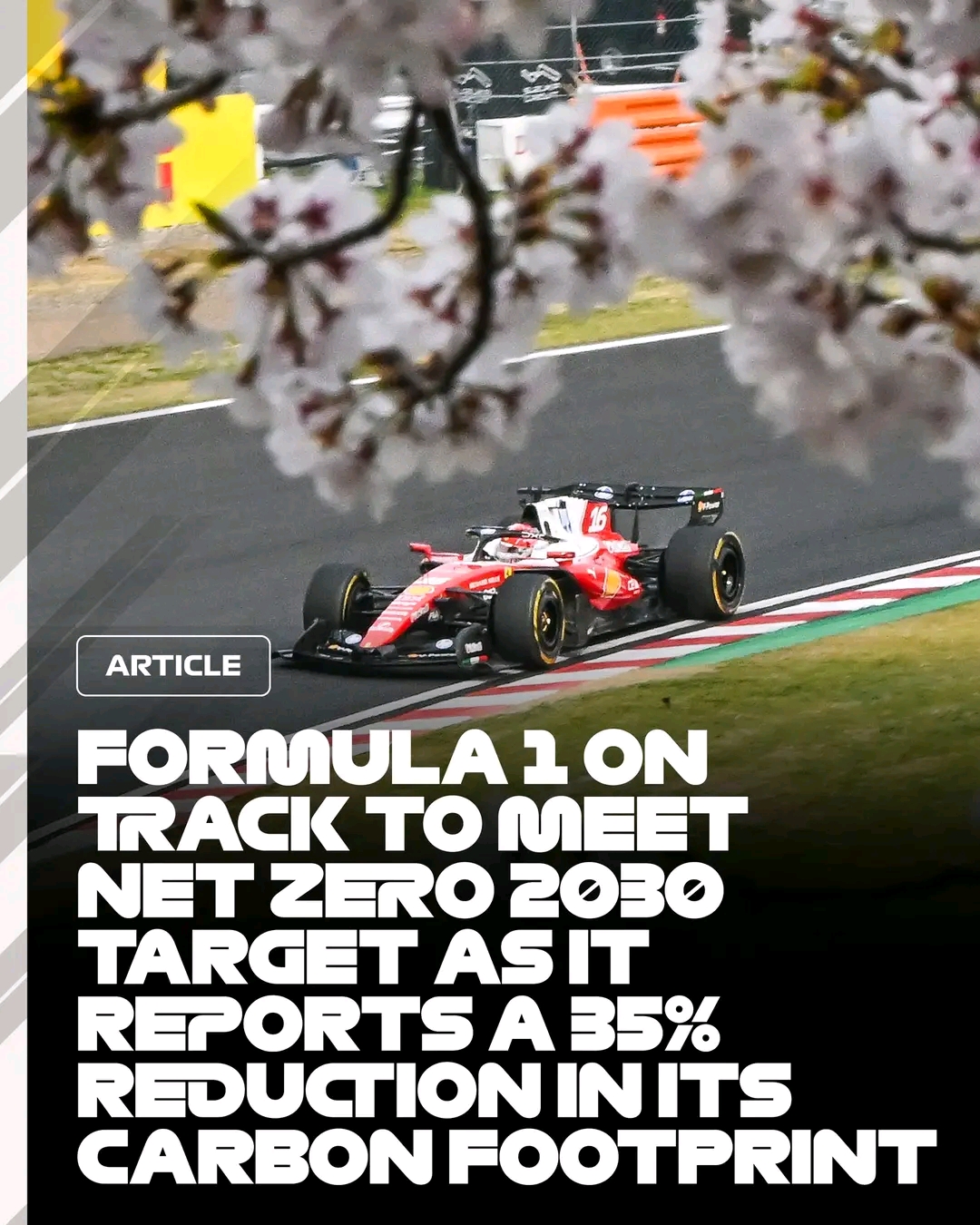
Formula 1 has released its latest Impact Report, outlining significant progress in its long-term sustainability strategy and reinforcing its commitment to achieving net zero carbon emissions by 2030. The update highlights measurable reductions in environmental impact across multiple areas of the sport, showing that F1’s sustainability drive is moving beyond promises and into execution.
While Formula 1 remains a global, high-travel motorsport series, the report suggests that structural changes are starting to reshape how the championship operates behind the scenes.
WHAT THE LATEST IMPACT REPORT REVEALS
The newest sustainability update confirms that Formula 1 continues to make steady progress toward its environmental targets, with improvements recorded across key operational areas.
The report focuses on:
Reduction in overall carbon emissions compared to the 2018 baseline
Improved logistics efficiency across global race transport
Greater use of renewable energy at factories and paddock operations
Expansion of sustainable fuel development initiatives
Continued reduction of single-use plastics at events
Taken together, these efforts reflect a coordinated push across teams, suppliers, and race promoters.
WHY F1’S SUSTAINABILITY TARGET IS SO AMBITIOUS
Formula 1’s goal is not just incremental improvement. The sport has committed to becoming net zero carbon by 2030, a target that is unusually aggressive for a global sporting championship that operates across five continents.
Unlike many industries, F1 faces unique challenges:
A fully global calendar with long-distance travel
Heavy reliance on air freight for equipment
High energy demands for team operations and race events
A large and mobile workforce that travels every weekend
Despite these barriers, the report shows that emissions are still trending downward, largely due to system-wide changes rather than symbolic offsets.
HOW FORMULA 1 IS CUTTING EMISSIONS IN PRACTICE
The progress highlighted in the report is not abstract. It comes from specific operational changes that are reshaping how the sport functions.
MORE EFFICIENT LOGISTICS AND TRAVEL PLANNING
One of the biggest contributors to F1’s carbon footprint is global logistics. The sport has improved efficiency by:
Grouping flyaway races more strategically
Reducing unnecessary back-and-forth freight movement
Increasing regional storage hubs for equipment
Optimizing transport schedules between events
ENERGY TRANSITION IN FACTORIES AND PADDOCKS
Teams and F1 facilities are increasingly shifting toward renewable energy sources. This includes:
Solar and renewable electricity usage in factories
Energy-efficient paddock systems at race weekends
Reduced generator dependency at circuits
SUSTAINABLE FUELS AND FUTURE POWER UNITS
One of the most important long-term changes is the development of 100% sustainable fuels, which will be crucial for future engine regulations.
This directly connects sustainability with performance, ensuring that environmental goals are not separate from racing innovation.
WHY THIS REPORT MATTERS FOR TEAMS AND DRIVERS
Sustainability in Formula 1 is not just a corporate initiative. It directly affects how teams operate on a weekly basis.
LOGISTICS AFFECT PERFORMANCE PLANNING
Improved freight systems and scheduling mean teams can focus more on performance preparation rather than logistical uncertainty. Even small improvements in efficiency can affect race weekend readiness.
ENGINEERING DIRECTION IS CHANGING
As sustainability targets tighten, engineering priorities are evolving:
More focus on energy efficiency
Increased hybrid system development
Integration of fuel innovation into car design philosophy
This means future performance gains may come as much from efficiency improvements as from aerodynamic upgrades.
DRIVERS ARE PART OF THE BRAND SHIFT
Drivers are increasingly being used as public-facing ambassadors for sustainability messaging. While their focus remains racing, they also play a role in shaping how fans perceive Formula 1’s environmental progress.
CAN F1 REALLY REACH NET ZERO BY 2030?
The report reinforces confidence, but the challenge remains significant.
REASONS FOR OPTIMISM
Measurable reductions already achieved
Strong governance and long-term planning
Continued investment from teams and stakeholders
Innovation in logistics and fuel technology
REMAINING CHALLENGES
Global air travel footprint is still substantial
Expansion of the race calendar increases demand
Full decarbonization of logistics is extremely complex
Most experts agree that while major reductions are achievable, some level of offsetting may still be required to reach full net zero status.
WHAT COMES NEXT FOR FORMULA 1 SUSTAINABILITY
Looking ahead, several developments will define the next stage of F1’s environmental strategy:
Wider adoption of sustainable fuels across all race cars
Further optimization of the race calendar to reduce travel impact
Expansion of low-carbon freight systems
Greater collaboration with circuits on renewable infrastructure
Increased transparency in emissions reporting
These steps suggest that sustainability will remain a central pillar of F1’s long-term identity, not just a side project.
FINAL THOUGHT
Formula 1’s latest Impact Report shows a sport in transition. While the championship is still built on global travel and high-performance engineering, the structure behind it is steadily changing.
The progress outlined is not just about meeting targets. It reflects a broader shift in how Formula 1 defines success in the modern era, where performance, innovation, and sustainability are becoming increasingly interconnected.
If current trends continue, F1’s 2030 net zero ambition may become one of the most significant transformation projects in modern sport.