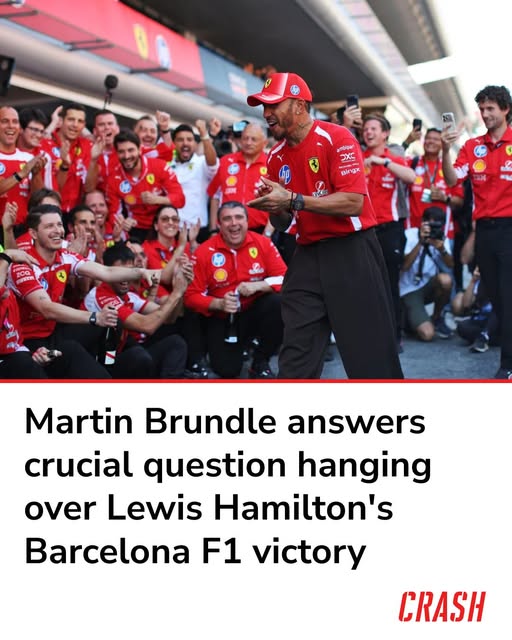
Lewis Hamilton’s long-awaited first Formula 1 victory with Ferrari at the Spanish Grand Prix has reignited one of the sport’s most familiar debates: was the win earned purely on pace, or was it handed to him by perfect timing?
While the Virtual Safety Car (VSC) period undoubtedly played a major role in shaping the outcome of the race, many inside the paddock believe Hamilton was already on course for victory before fortune smiled on Ferrari. The discussion has become one of the biggest talking points following a race that may prove pivotal in the 2026 championship battle.
HAMILTON FINALLY DELIVERS HIS BREAKTHROUGH FERRARI WIN
After months of pressure, questions, and growing scrutiny following his blockbuster switch from Mercedes, Hamilton finally delivered the moment Ferrari had been waiting for.
The seven-time world champion produced a commanding performance in Barcelona, securing his first victory in red and ending a lengthy personal drought. More importantly, the result strengthened his growing challenge in the drivers’ championship and reinforced Ferrari’s belief that they remain genuine contenders against the dominant Mercedes outfit.
The victory did not come through conservative strategy or luck alone. Ferrari opted for an aggressive three-stop approach that placed Hamilton on fresher tyres throughout the race, allowing him to maintain impressive pace while rivals attempted to stretch their stints.
THE VIRTUAL SAFETY CAR THAT CHANGED EVERYTHING
The defining moment arrived when Fernando Alonso’s Aston Martin stopped on track, triggering a Virtual Safety Car.
At that stage, Hamilton was rapidly closing on the leading Mercedes cars but still faced the challenge of making an additional pit stop. Under normal racing conditions, that final stop would have cost Ferrari approximately 22 seconds.
Instead, the VSC reduced the pit stop loss dramatically.
Hamilton was able to pit while the field circulated at reduced speed, rejoining ahead of George Russell and effectively taking control of the race. To make matters even more dramatic, the VSC ended almost immediately after Hamilton exited the pit lane, maximizing Ferrari’s advantage.
From the outside, it appeared to be the perfect piece of luck.
WHY MANY BELIEVE HAMILTON WOULD HAVE WON ANYWAY
The argument against the “lucky winner” narrative lies in the pace Hamilton demonstrated throughout the weekend.
Before the VSC appeared, Ferrari’s strategy was already proving effective. Hamilton consistently set competitive lap times, benefiting from fresher tyres while Mercedes struggled to manage degradation on a more conventional approach.
Several analysts have pointed out that Hamilton still had substantial tyre life remaining and was significantly quicker than the cars ahead. Even without the VSC, there was a realistic possibility that he would have caught and passed his rivals during the closing stages.
What makes this argument stronger is what happened after Hamilton inherited the lead.
Rather than simply managing the gap, he pulled away.
By the chequered flag, Hamilton had built a commanding advantage, finishing nearly 20 seconds clear of his nearest challenger. That level of dominance suggests the Ferrari possessed the pace to win regardless of the fortunate timing of the VSC.
A MASSIVE STATEMENT IN THE CHAMPIONSHIP FIGHT
Beyond the victory itself, the result sends an important message to the rest of the grid.
For much of 2026, Mercedes has controlled the narrative. Kimi Antonelli has emerged as the championship leader, while George Russell has consistently scored valuable points. Ferrari, meanwhile, appeared to be chasing from behind.
Barcelona may represent a turning point.
Hamilton’s recent podium streak, combined with this breakthrough victory, suggests Ferrari has finally unlocked more performance from the SF-26. If that trend continues, the championship battle could become far more complicated for Mercedes than it appeared just a few races ago.
Momentum in Formula 1 can shift quickly, and Ferrari suddenly looks capable of applying sustained pressure.
WHAT THIS MEANS FOR FERRARI AND LECLERC
The victory also creates an interesting dynamic inside Ferrari.
Hamilton’s adaptation period appears to be ending, while Charles Leclerc has endured several frustrating weekends and ongoing technical concerns. The gap between the two drivers is becoming a growing storyline within the team.
If Hamilton continues this upward trajectory, Ferrari may increasingly find itself building championship strategies around him rather than maintaining equal status between both drivers.
That scenario would have seemed unlikely at the start of the season, but recent performances suggest it is becoming a realistic possibility.
THE BIGGER PICTURE FOR THE REST OF 2026
Whether the Virtual Safety Car ultimately decided the race may never be fully answered.
What is clear, however, is that Hamilton and Ferrari placed themselves in position to capitalize when the opportunity arrived. Great teams often create their own luck by choosing bold strategies and executing them flawlessly.
Barcelona demonstrated exactly that.
The victory showcased Hamilton’s experience, Ferrari’s strategic confidence, and a car that appears to be growing stronger with each race weekend. If the Spanish Grand Prix proves to be the beginning rather than the peak of Ferrari’s resurgence, the battle for the 2026 Formula 1 World Championship may be far from settled.
For Mercedes, it serves as a warning.
For Hamilton, it may be the moment his Ferrari journey truly began.