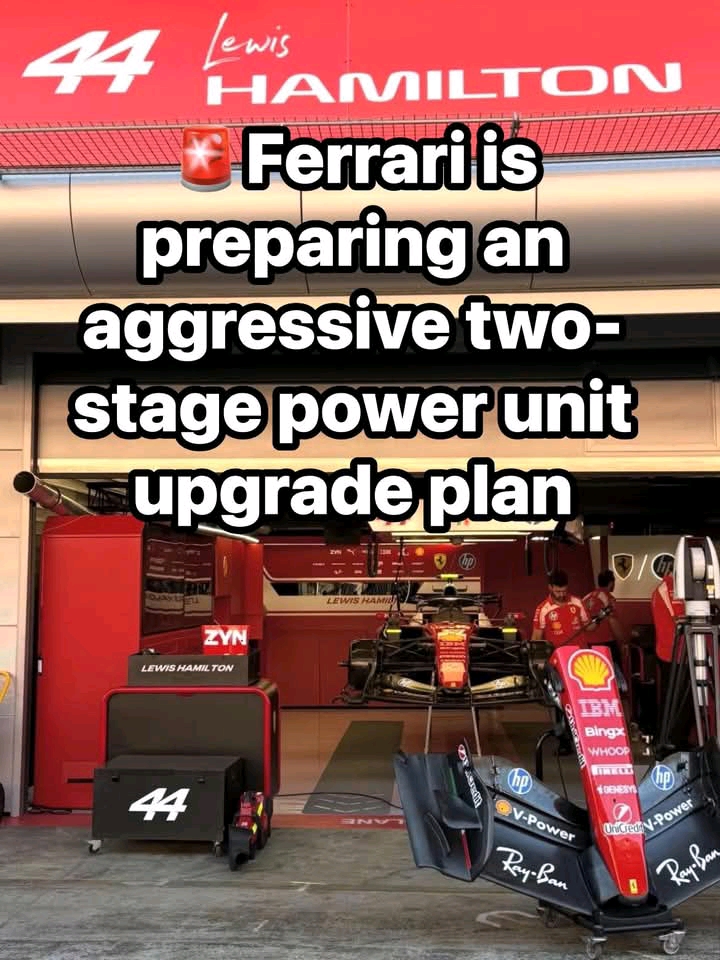
Ferrari may have received a crucial opportunity to address one of its biggest weaknesses of the 2026 Formula 1 season, and the timing could not be more important.
Throughout the opening races of the campaign, Ferrari drivers Lewis Hamilton and Charles Leclerc have repeatedly pointed to a lack of straight-line performance as a key factor limiting the team’s ability to consistently challenge at the front. While Ferrari has shown flashes of competitiveness in corners and race management, the team’s struggles on longer straights have often left both drivers vulnerable against rival teams.
Now, reports indicate that Ferrari is expected to benefit from the FIA’s ADUO provisions, potentially giving the Italian team greater flexibility to improve elements of its 067/6 power unit. If those opportunities lead to meaningful gains, Ferrari’s season could look very different in the months ahead.
WHY FERRARI HAS BEEN PUSHING FOR ENGINE IMPROVEMENTS
Modern Formula 1 is a game of tiny margins. Even a small deficit in power unit performance can translate into significant lap time losses over the course of a race weekend.
For Ferrari, the issue has become increasingly visible during qualifying sessions and on circuits where straight-line speed plays a major role. Both Hamilton and Leclerc have publicly acknowledged that the car has struggled to match the top speeds of some of its direct competitors.
While Ferrari has remained competitive in other performance areas, Formula 1 championships are rarely won with obvious weaknesses. Teams fighting for victories need complete packages, and Ferrari’s power unit concerns have become one of the most discussed topics inside the paddock.
The team’s engineers have undoubtedly spent months identifying areas where performance could be unlocked if regulations allowed additional intervention.
WHAT THE FIA’S ADUO PROVISIONS COULD MEAN
The FIA’s ADUO framework was designed to provide certain manufacturers with opportunities to improve areas where they may be lagging behind competitors.
Although the exact scope of any changes remains subject to regulatory approval and technical limitations, qualifying for such provisions could offer Ferrari a pathway to reduce its performance gap without waiting for the next generation of Formula 1 regulations.
For a team with Ferrari’s ambitions, that possibility is enormously valuable.
Rather than simply accepting a disadvantage for the remainder of the season, Ferrari could potentially make targeted improvements that enhance acceleration, efficiency, reliability, or overall power delivery.
Even modest gains could make a noticeable difference in modern Formula 1, where grid positions and race results are often decided by tenths or even hundredths of a second.
WHY THIS MATTERS FOR LEWIS HAMILTON
Lewis Hamilton’s arrival at Ferrari generated enormous expectations across the motorsport world.
The seven-time world champion joined the Scuderia with hopes of helping return the team to championship-winning form. However, adapting to a new environment while dealing with performance limitations has not always been straightforward.
An improved power unit would give Hamilton a stronger platform to maximize his experience and racecraft.
Hamilton has built much of his career around extracting every possible advantage from competitive machinery. If Ferrari can provide additional straight-line speed, it could allow him to challenge rivals more aggressively in qualifying and defend positions more effectively during races.
At this stage of his career, Hamilton does not simply need a fast car. He needs a complete package capable of fighting consistently at the front.
WHY CHARLES LECLERC COULD BENEFIT EVEN MORE
While Hamilton’s move has attracted headlines, Charles Leclerc remains central to Ferrari’s long-term future.
Leclerc has spent years carrying Ferrari’s championship hopes and has often delivered exceptional performances despite various setbacks.
A stronger power unit could enhance one of Leclerc’s greatest strengths: qualifying speed.
The Monegasque driver is already regarded as one of Formula 1’s fastest drivers over a single lap. If Ferrari can improve its straight-line performance, Leclerc may be able to convert more qualifying opportunities into pole positions and race victories.
That could prove critical as Ferrari attempts to close the gap to its closest rivals.
THE CHAMPIONSHIP IMPLICATIONS
The significance of Ferrari’s potential engine improvements extends beyond just one team.
Formula 1’s competitive balance can shift rapidly when a leading manufacturer finds additional performance. Rivals who currently enjoy an advantage on high-speed circuits could suddenly face greater pressure from the Maranello squad.
If Ferrari successfully unlocks meaningful gains, it could influence:
- Qualifying battles at multiple circuits
- Race strategy options
- Overtaking opportunities
- Constructor standings
- Driver championship momentum
Even if the gains are relatively small, the psychological impact inside the paddock could be substantial.
Teams monitor each other’s progress constantly, and any sign that Ferrari is closing the gap will attract immediate attention from competitors.
WHY THE FIA’S DELAYED DECISION CREATED SPECULATION
The absence of an official FIA announcement before the Spanish Grand Prix fueled widespread speculation throughout the Formula 1 community.
When regulatory decisions are delayed, teams, analysts, and fans naturally begin to wonder what discussions are taking place behind closed doors.
The additional investigations reportedly conducted by the FIA only intensified those rumors.
Now that more information is emerging, the picture appears clearer, but the situation highlights just how important power unit development remains in today’s Formula 1 landscape.
Every regulatory decision has the potential to affect competitive order, making these rulings some of the most closely watched developments of the season.
PREDICTION: CAN FERRARI TURN THIS INTO RACE-WINNING PERFORMANCE?
The answer depends on one critical factor: how much performance Ferrari can realistically unlock.
History shows that technical opportunities do not automatically guarantee dramatic gains. Development takes time, and rivals are constantly improving as well.
However, Ferrari does not necessarily need a revolutionary breakthrough.
If the team can recover even a portion of its straight-line deficit while maintaining its strengths in other areas, race victories could become significantly more achievable.
The most realistic expectation is not an overnight transformation but a gradual improvement that allows Ferrari to become a more consistent threat throughout the remainder of the season.
Should that happen, both Hamilton and Leclerc could find themselves firmly back in the conversation whenever Grand Prix victories are discussed.
FINAL THOUGHTS
Ferrari’s reported eligibility for FIA ADUO provisions may prove to be one of the most important technical developments of the 2026 Formula 1 season.
After months of concerns regarding straight-line speed and power unit performance, the team could finally have an opportunity to address a weakness that has frustrated both Lewis Hamilton and Charles Leclerc.
Whether those changes are enough to alter the championship picture remains to be seen. What is certain, however, is that Ferrari now has a chance to fight back.
In a sport where fractions of a second can determine success or failure, that opportunity could be worth far more than many realize.