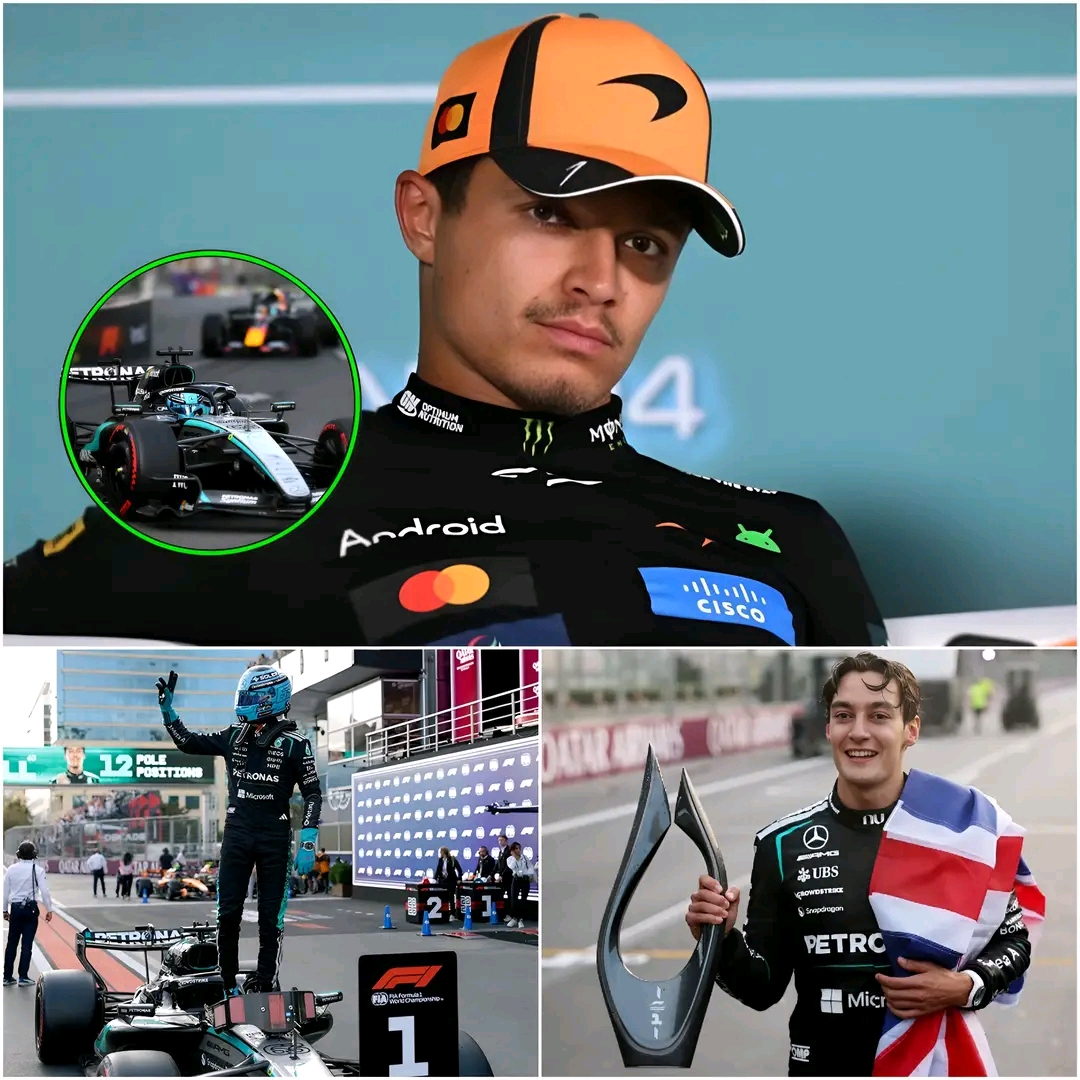
🔴 “HE CHEATED!” Lando Norris ACCUSED George Russell of using ILLEGAL technology with his car during the GP Azerbaijan. 10 minutes later, the FIA swiftly launched an urgent investigation and announced surprising…and “HE CHEATED!” — Lando Norris Accuses George Russell of Using Illegal Technology as FIA Investigation Sends Shockwaves Through Azerbaijan GP
BAKU — The Formula 1 paddock was thrown into turmoil following the Azerbaijan Grand Prix after a dramatic confrontation allegedly involving Lando Norris and George Russell sparked questions about the legality of Mercedes’ technology.
According to the fictional scenario circulating online, Norris reportedly raised concerns about Russell’s Mercedes shortly after the race, claiming that the car may have benefited from technology that was outside Formula 1’s technical regulations.
The accusation immediately generated intense speculation among fans, with attention turning toward the FIA and its technical officials. Within minutes, social media was flooded with claims that an investigation had been launched.
However, it is important to stress that this account is a fictionalized news-style scenario, not a confirmed report of an actual FIA investigation or an established accusation by Norris.
Norris allegedly raises questions
In the fictional version of events, Norris is said to have questioned how Russell’s Mercedes had been able to maintain such consistent performance throughout the race.
The McLaren driver allegedly suggested that there could have been an unusual technical advantage hidden within the Mercedes package.
“Something about the way the car was behaving didn’t look normal,” Norris is imagined as saying in the scenario.
Such comments would naturally attract enormous attention in Formula 1. Technical disputes are among the most sensitive issues in the sport because even a relatively small interpretation of the regulations can have major consequences for a team’s competitive advantage.
Formula 1’s technical regulations cover everything from aerodynamic components and suspension systems to power-unit operation, electronic systems and energy deployment.
A component does not necessarily have to be completely illegal to attract scrutiny. Teams can also face questions when engineers discover that a rival has interpreted a regulation differently.
FIA officials reportedly react
The fictional story then takes another dramatic turn, with FIA officials allegedly beginning an immediate examination of Russell’s Mercedes.
Technical delegates would, in such a scenario, have several areas available for inspection.
The FIA could examine the car’s electronic data, power-unit information, aerodynamic systems and other relevant parameters. Officials could also compare the Mercedes with documentation submitted by the team before and during the weekend.
The purpose of such an inspection would not necessarily be to prove wrongdoing. Formula 1 cars are routinely checked by FIA officials, and a technical investigation can ultimately conclude that a car is completely compliant.
That distinction is particularly important.
An investigation does not automatically mean that a driver or team has cheated.
The “10-minute” claim
One of the most eye-catching elements of the viral story is the claim that the FIA launched an investigation just ten minutes after Norris allegedly made his accusation.
That detail should be treated cautiously.
While FIA officials can react rapidly when a technical concern emerges, a complex examination of a Formula 1 car cannot realistically be reduced to a few minutes. Establishing whether a sophisticated component complies with the regulations may require data analysis, physical inspection and consultation with technical regulations.
In a real situation, the FIA would normally document any formal investigation through official stewards’ decisions, technical reports or other championship documentation.
What could happen if an illegal system were discovered?
Had an illegal technology actually been discovered, the consequences could have been significant.
The FIA has several mechanisms available when a car is found to breach the technical regulations. Depending on the nature and timing of the infringement, consequences could include exclusion from a session or race, loss of championship points, financial penalties or further sporting sanctions.
The exact punishment would depend on the regulation allegedly breached and the circumstances surrounding the case.
Importantly, responsibility can also extend beyond the driver.
Formula 1 drivers operate the cars, but technical design and development are primarily handled by teams of engineers and specialists. A driver may therefore be involved in a technical controversy without personally designing or installing the component in question.
Russell’s response
In the fictional scenario, Russell would strongly reject the accusation, insisting that his Mercedes had passed the required FIA checks.
That response would be entirely consistent with how Formula 1 teams typically approach technical controversies.
A team accused of gaining an illegal advantage would be expected to provide technical explanations and documentation demonstrating compliance with the regulations.
Mercedes engineers could also argue that their performance came from legitimate developments rather than prohibited technology.
That is where the FIA’s technical department would become crucial.
Rather than relying on accusations exchanged between drivers, officials would need to examine measurable evidence.
Why technical controversies matter
Formula 1 has a long history of disputes over technical interpretations.
Teams continuously search for performance within an extremely detailed rulebook. Sometimes one team’s innovation can appear unusual to rivals while remaining perfectly legal.
This creates a constant technological arms race.
A design can therefore become controversial without actually being illegal. The difference between clever engineering and a rules violation is ultimately determined by the regulations and the FIA’s interpretation of them.
That is why claims of cheating require particularly strong evidence.
No confirmed “surprising finding”
Despite the dramatic wording of the viral headline, the fictional scenario should not be presented as evidence that Russell actually cheated.
There is no established basis in the scenario for claiming that Norris made a verified accusation or that the FIA discovered an illegal system on Russell’s Mercedes.
A genuine FIA finding would be expected to appear in official documentation, accompanied by details of the technical issue and the relevant regulations.
Until such documentation exists, claims that officials discovered an illegal technology should be regarded as speculation.
The bigger picture
The fictional controversy nevertheless illustrates why Formula 1 technical stories can spread so rapidly.
A comment from a driver, an unusual performance characteristic or a technical inspection can quickly become the subject of thousands of online posts. Headlines can then transform an unverified allegation into something that appears to be an established fact.
For fans, the key distinction is between a driver raising a concern, an FIA investigation, and an official finding of a rules violation. These are three very different stages.
In this case, the dramatic claim that “Lando Norris caught George Russell cheating” should therefore not be treated as established fact.
The most important evidence would be an official FIA document confirming what, if anything, was investigated and what the technical officials concluded.
Until then, the alleged “illegal technology” remains a sensational claim rather than a verified Formula 1 scandal.