Few Formula 1 teams are as ruthless as Red Bull when it comes to driver decisions, but Liam Lawson’s brief stint with the senior squad remains one of the most controversial calls in recent memory. As the New Zealander reflects on his demotion after just two race weekends, many inside and outside the paddock are still questioning whether Red Bull acted too quickly.
LAWSON BELIEVES HE WAS JUDGED TOO QUICKLY
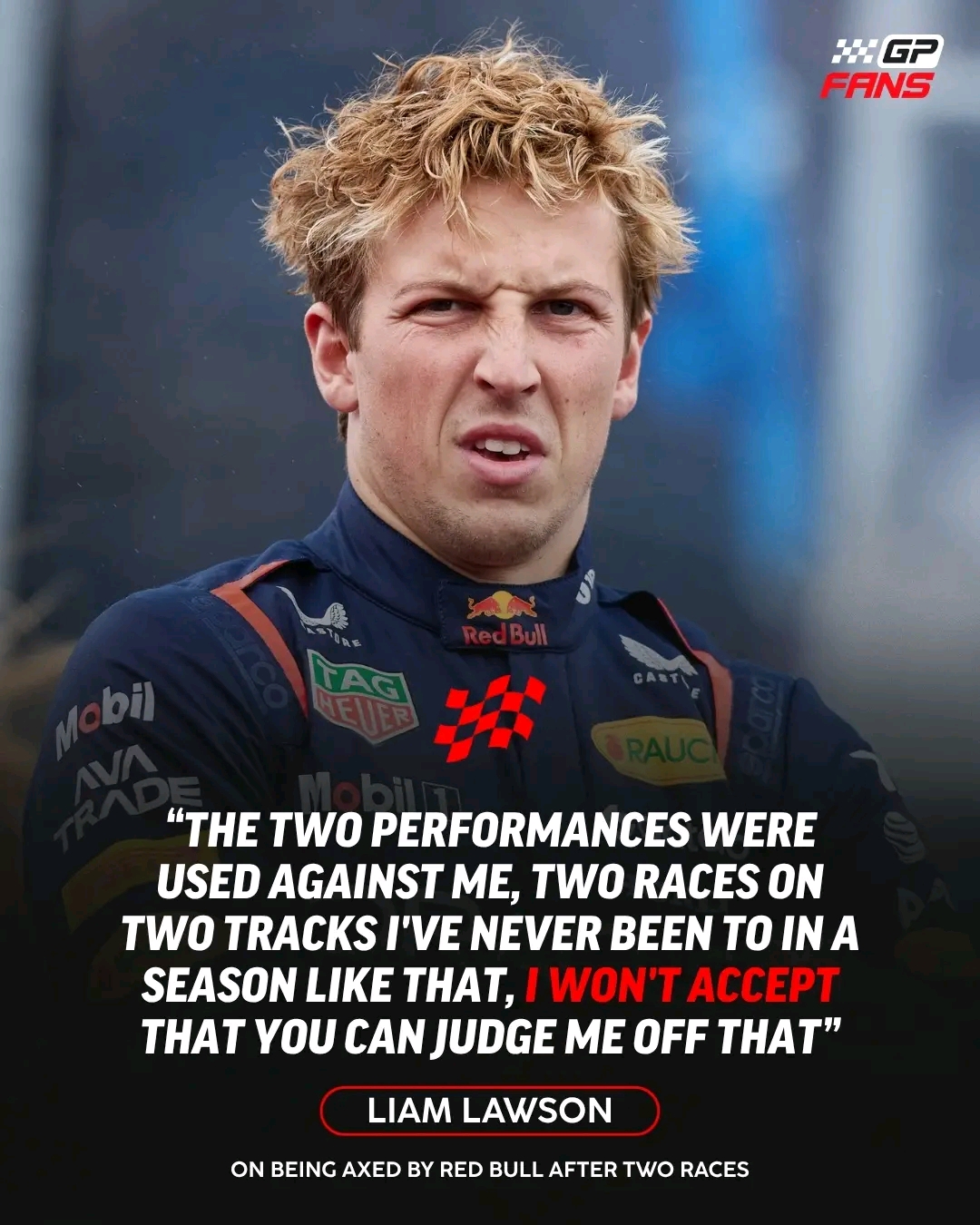
Lawson has opened up about the difficult period that followed his promotion to Red Bull and subsequent return to Racing Bulls. According to the Kiwi, two races were never enough to fairly assess his potential, especially considering both events took place on circuits he had never raced at before.
He also revealed that Red Bull experimented with aggressive setup changes during the Chinese Grand Prix weekend. Those changes failed to deliver performance and ultimately became part of the disappointing results that were later used to justify his demotion.
From Lawson’s perspective, the circumstances made it impossible to show his true pace.
RED BULL’S HISTORY OF TOUGH DRIVER DECISIONS
Red Bull’s driver program has produced world champions, but it has also developed a reputation for being unforgiving.
Over the years, several drivers have experienced rapid promotions and equally swift exits. Pierre Gasly, Alex Albon, Daniil Kvyat, and now Lawson all discovered how demanding life alongside Max Verstappen can be.
The second Red Bull seat has become one of the most difficult jobs in Formula 1. Even experienced drivers have struggled to consistently extract performance from cars that are largely developed around Verstappen’s driving style.
That context has led many fans and analysts to question whether the issue lies with the drivers or with Red Bull’s approach to evaluating them.
WHY TWO RACES MAY NEVER HAVE BEEN ENOUGH
Formula 1 rookies usually need time to adapt to:
New circuits.
Different tire compounds.
Team procedures.
Increased media pressure.
Unique car characteristics.
Lawson had only two opportunities before the team decided to replace him. Meanwhile, Verstappen himself acknowledged that the RB21 was far from an easy machine to drive, making the learning curve even steeper.
Most teams prefer to evaluate drivers over several months rather than two weekends. That is why many observers consider Red Bull’s decision unusually severe.
THE MOVE BACK TO RACING BULLS CHANGED EVERYTHING
Ironically, Lawson appeared much more comfortable after returning to Racing Bulls.
Freed from the enormous pressure of the senior team, he rediscovered confidence and managed to establish himself as a reliable performer. His improved form eventually secured his future with the Faenza-based squad, something he admitted brought relief after a difficult year.
Sometimes a setback becomes an opportunity, and Lawson’s case may prove exactly that.
WHAT THIS MEANS FOR RED BULL
Red Bull’s aggressive management style has often produced results, but it can also create instability.
Constant driver changes can:
Hurt confidence.
Increase pressure on young talent.
Reduce continuity within the team.
Make future prospects nervous about accepting promotions.
With Isack Hadjar currently partnering Verstappen, Red Bull will hope to avoid another revolving-door situation. Stability could prove essential if the team wants to challenge consistently for championships in the coming seasons.
THE CHAMPIONSHIP IMPLICATIONS
While Lawson’s departure did not immediately affect Verstappen’s title ambitions, driver instability can have long-term consequences.
Constructors’ championships are won through two competitive cars, not one. If Red Bull cannot consistently maximize performance from its second seat, rivals like McLaren, Ferrari, and Mercedes could continue to capitalize.
Developing young talent successfully remains one of Red Bull’s greatest strengths, but maximizing that talent requires patience as much as speed.
WAS RED BULL RIGHT OR WRONG?
There are arguments on both sides.
Red Bull operates in a results-driven environment where every point matters. If management believed another driver could score more consistently, making a change was understandable.
However, judging Lawson after only two race weekends appears harsh, particularly given the difficult car and experimental setups involved. Even Red Bull advisor Helmut Marko later admitted the team may have made a mistake with the promotion timing.
LOOKING AHEAD
Lawson’s Formula 1 story is far from over. At just 24 years old, he still possesses the speed and determination that earned him a place in Red Bull’s junior program.
If he continues to impress at Racing Bulls, another opportunity could emerge elsewhere on the grid.
And years from now, Red Bull’s decision to pull the plug after two races may be remembered as either a justified business move or one of Formula 1’s most premature driver calls.
For now, the debate Continues.