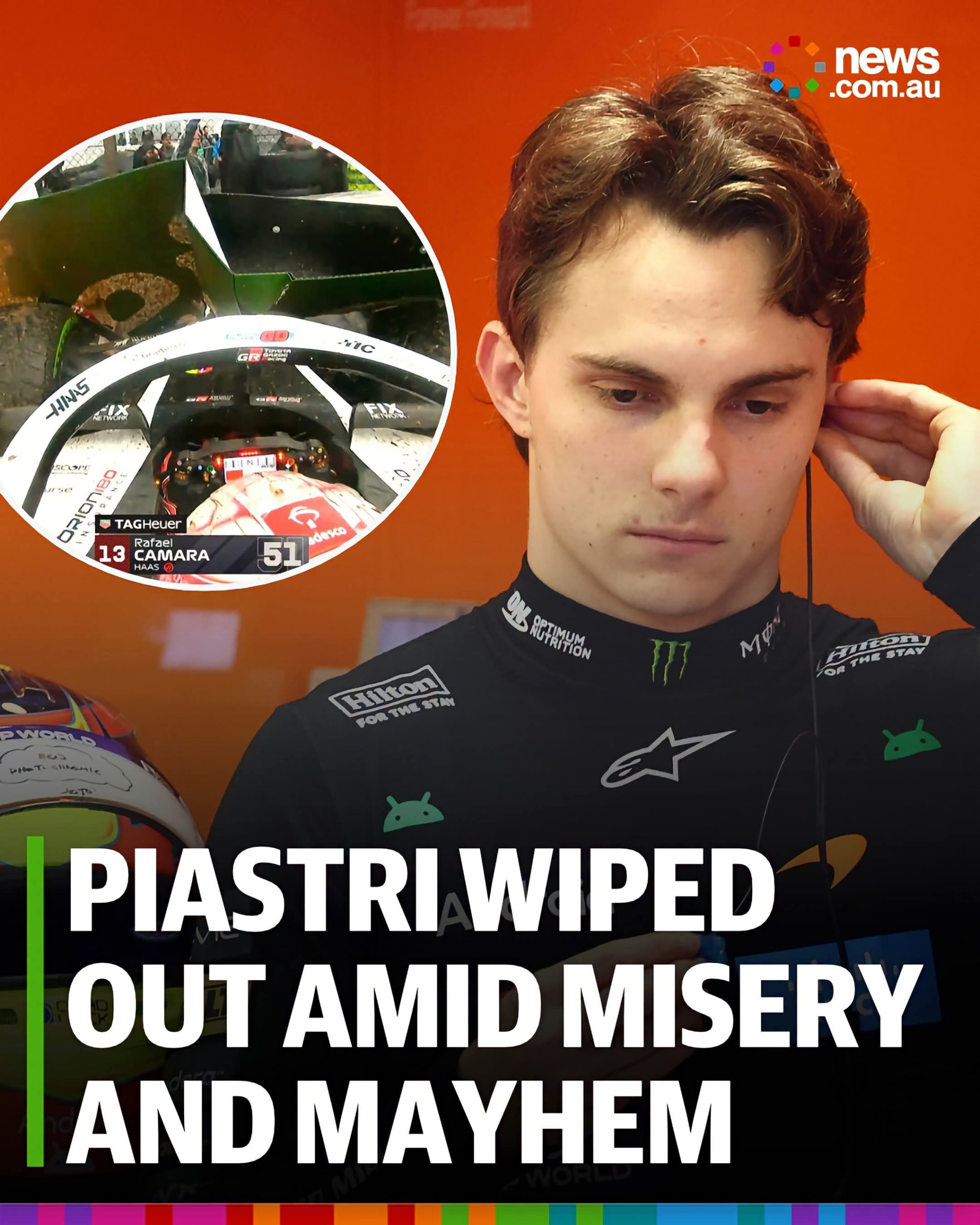
Oscar Piastri endured another painful qualifying session at the 2026 Brazilian Grand Prix after a dramatic red flag ended his hopes of reaching Q3 at Interlagos. While McLaren teammate Lando Norris celebrated another pole position, the Australian found himself facing yet another disappointing result in a season that has increasingly turned into a nightmare. Piastri’s failure to progress beyond Q2 has intensified questions about his confidence, McLaren’s strategy and whether he can recover his competitive momentum before the championship campaign reaches its conclusion.
PIASTRI’S QUALIFYING NIGHTMARE CONTINUES
The Brazilian Grand Prix qualifying session delivered another frustrating chapter in Piastri’s difficult 2026 season. The McLaren driver finished Q2 in 12th position after a late red flag prevented him from completing his final attempt, leaving him outside the top 10 and unable to fight for pole position.
The result was particularly disappointing because Piastri appeared capable of securing a place in Q3 before the interruption. However, Rafael Camara’s crash at Turn 12 brought out the red flag, effectively ending the session and eliminating several drivers who still had opportunities to improve their times.
Piastri finished more than 3.5 seconds behind George Russell, who topped the Q2 timesheets, while also trailing Norris by approximately 2.4 seconds. The performance gap raised further concerns about McLaren’s execution during a session in which changing weather conditions made every strategic decision crucial.
RED FLAG DESTROYS PIASTRI’S LAST CHANCE
The decisive moment came when Camara lost control at Turn 12 and crashed into the barriers. Although the driver immediately confirmed he was okay, the incident forced officials to stop qualifying.
For Piastri, the timing could hardly have been worse. His final opportunity to improve his position disappeared, leaving him stranded in P12 despite having the potential to move into the top 10.
Sky Sports commentator David Croft described Piastri’s elimination as a major surprise, highlighting how unexpected his failure to progress had become.
However, the red flag was not the only factor behind the Australian’s disappointing result. His qualifying performance had already placed him under pressure, and the interruption ultimately exposed the risks of relying on a final lap in unpredictable conditions.
McLAREN’S TYRE STRATEGY UNDER SCRUTINY
F1 analyst Karun Chandhok suggested McLaren may have contributed to Piastri’s qualifying disappointment through its tyre strategy.
According to Chandhok, the team kept the Australian on wet-weather tyres for additional laps while several competitors made the switch to intermediate tyres earlier. With the track conditions evolving rapidly, that decision may have cost Piastri valuable performance.
Intermediate tyres generally offer a significant advantage when the circuit becomes suitable for them, allowing drivers to generate greater speed than full wet tyres. However, switching too early can also be dangerous if standing water remains on the track.
The challenge for McLaren was identifying the precise moment when conditions had changed enough to justify the gamble.
While Norris successfully navigated the session to secure pole position, Piastri’s struggles highlighted the importance of making the correct tyre decision at the right time. In modern Formula One, even a small strategic delay can transform a potential top-10 qualifying result into a disappointing elimination.
NORRIS DELIVERS WHEN PIASTRI NEEDS HIM MOST
The contrast between McLaren’s two drivers was particularly striking.
Norris emerged from the chaotic qualifying session with pole position, putting himself in an excellent position to fight for another Grand Prix victory. Meanwhile, Piastri was left watching from the sidelines after another missed opportunity.
The result strengthens Norris’ position within the team and provides him with another chance to demonstrate his ability to deliver under pressure.
For Piastri, the growing difference between the two McLaren drivers could become psychologically difficult. Teammates are often the most important benchmark in Formula One, particularly when they are driving identical machinery.
Although qualifying results do not always translate directly into race performance, repeatedly losing ground to a teammate can affect confidence and intensify internal pressure.
GEORGE RUSSELL FUMING AFTER MERCEDES TEAM DECISION
George Russell also experienced frustration during the wet-weather qualifying session after Mercedes instructed him to abandon a hot lap.
The British driver suggested the decision potentially cost him a chance to challenge Norris for pole position. Russell ultimately qualified seventh, despite showing impressive pace earlier in the session.
His frustration added another layer of drama to an already unpredictable qualifying battle.
Mercedes will now have to assess whether its cautious approach was justified by the weather conditions or whether Russell could have been given greater freedom to continue pushing.
Meanwhile, teammate Kimi Antonelli secured second place on the qualifying timesheets, putting Mercedes in a strong position for the race.
PIASTRI GETS A GRID POSITION LIFELINE
Despite his qualifying disappointment, Piastri will receive an unexpected opportunity to limit the damage on race day.
Penalties affecting several leading drivers have reshuffled the starting order, promoting the Australian to 10th position for the Brazilian Grand Prix.
Lewis Hamilton and Max Verstappen are among those facing substantial grid penalties following power-unit changes, while other drivers have also been affected by separate sanctions.
That means Piastri will start ahead of several competitors who would otherwise have occupied positions closer to the front.
The revised order places Norris on pole, Antonelli second and Liam Lawson third, with Nico Hulkenberg and Isack Hadjar completing the top five.
Piastri’s promotion to 10th gives him a realistic opportunity to recover positions, particularly if the race features further weather complications.
CAN PIASTRI TURN HIS SEASON AROUND IN BRAZIL?
The Brazilian Grand Prix represents an important opportunity for Piastri to demonstrate that his recent struggles have not permanently damaged his competitiveness.
Interlagos is famous for unpredictable weather, safety cars and dramatic race finishes. Those conditions can create opportunities for drivers starting outside the top positions, provided they maintain consistency and avoid costly mistakes.
Piastri will need a strong opening stint, careful tyre management and decisive overtaking if he hopes to move toward the podium.
More importantly, he needs a performance that restores confidence after several difficult weekends.
McLaren also faces an important responsibility. The team must ensure that both drivers receive effective strategic support, particularly when changing weather conditions create opportunities to gain or lose substantial positions.
A WORRYING TREND FOR OSCAR PIASTRI
Piastri’s latest qualifying disappointment is another reminder of how quickly fortunes can change in Formula One.
Earlier in his career, the Australian established himself as one of the sport’s most promising young drivers through his composure, consistency and ability to compete against established stars.
However, the 2026 campaign has increasingly become a struggle, with difficult results placing additional pressure on both the driver and his team.
While one qualifying session cannot define an entire career, repeated setbacks can become damaging if they continue without a convincing response.
The Brazilian Grand Prix now offers Piastri a chance to change the narrative.
Starting 10th rather than 12th gives him a modest advantage, but the real challenge will be converting that opportunity into a competitive race result.
With Norris leading the McLaren charge from pole position, the Australian will be desperate to avoid another weekend in which his teammate dominates the headlines while his own campaign continues to unravel.