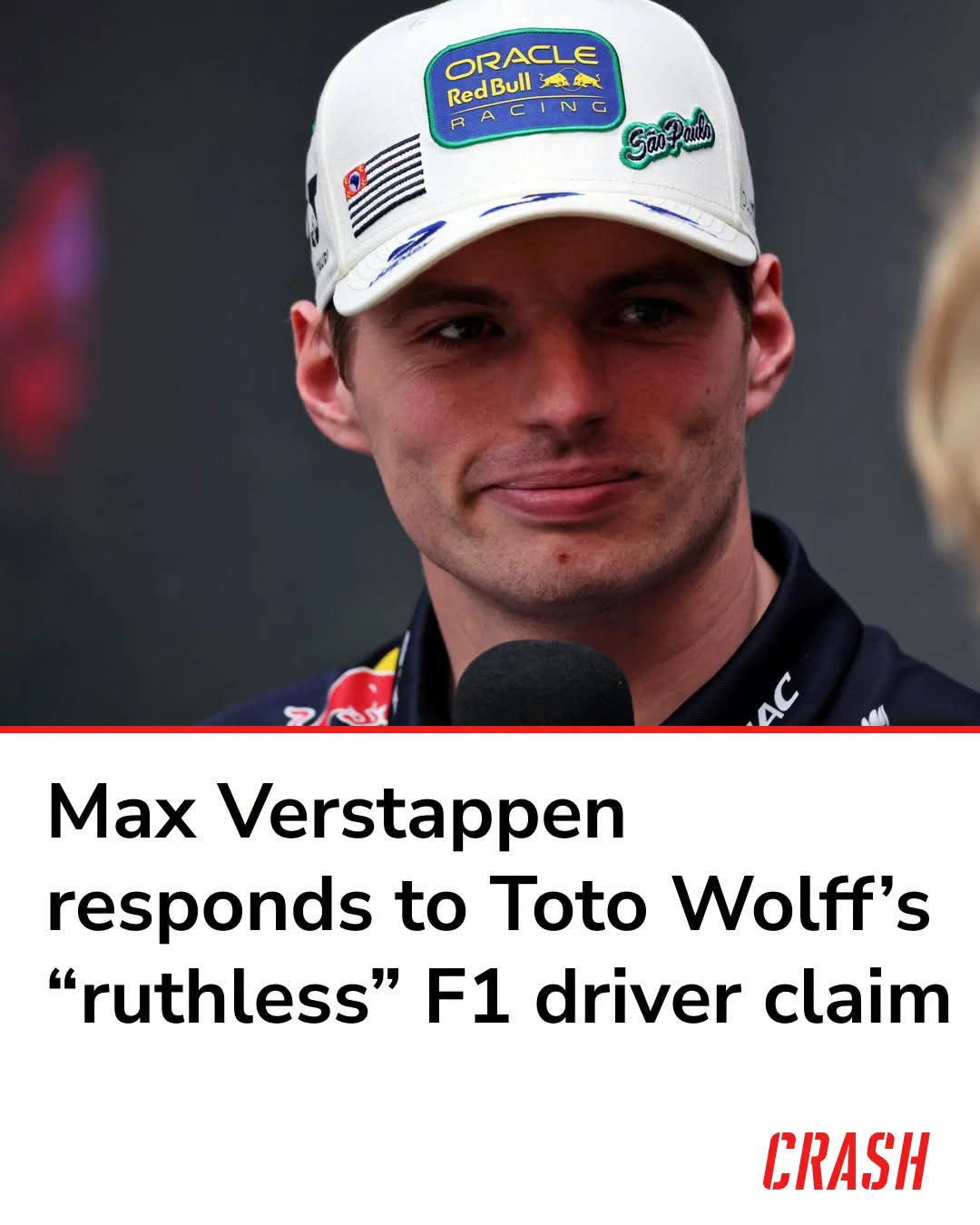
Max Verstappen has delivered a pointed response to Toto Wolff after the Mercedes team principal declared that Formula 1’s era of ruthless, self-centred drivers had come to an end following Kimi Antonelli’s historic championship triumph. The Red Bull superstar, widely regarded as one of the most uncompromising competitors on the grid, refused to endorse Wolff’s controversial assessment, instead insisting that Formula 1 benefits from having drivers with different personalities. The exchange has added another fascinating storyline to the Brazilian Grand Prix weekend, with Verstappen arriving in São Paulo determined to continue his remarkable late-season resurgence after winning the Mexican Grand Prix.
VERSTAPPEN RESPONDS TO WOLFF’S CONTROVERSIAL DRIVER CRITICISM
Verstappen was asked about Wolff’s comments during Thursday’s media activities ahead of the Brazilian Grand Prix, but the four-time world champion appeared unwilling to become directly involved in the controversy.
“Everyone is entitled to their opinion, right? I have nothing else to say, really,” Verstappen responded.
The Dutchman subsequently emphasised that individuality remains an important part of Formula 1, arguing that the championship would become considerably less interesting if every driver possessed the same personality.
His response was brief, but the message was significant. Verstappen has built much of his reputation around an uncompromising racing mentality, frequently pushing the boundaries of competition while refusing to surrender positions without a fight.
Wolff’s comments therefore inevitably raised questions about whether the Mercedes chief was indirectly criticising drivers such as Verstappen, although he did not explicitly identify anyone.
TOTO WOLFF DECLARES THE ERA OF RUTHLESS F1 DRIVERS OVER
Wolff made his controversial remarks after Antonelli secured the 2026 Formula 1 world championship with a third-place finish at the Mexico City Grand Prix.
The Mercedes team principal described the young Italian as a different kind of champion, highlighting qualities including humility, integrity, loyalty and respect.
According to Wolff, the traditional mentality of winning at all costs, prioritising personal interests and taking advantage of every opportunity had become outdated.
He also criticised drivers he described as entitled competitors, persistent complainers over team radio and individuals who repeatedly become involved in crashes.
Although Wolff did not mention names, his remarks immediately attracted attention because several established Formula 1 stars are known for their aggressive approaches to racing and their willingness to challenge decisions publicly.
The timing was particularly interesting because Verstappen, Lewis Hamilton and other experienced competitors remain prominent examples of drivers who regularly express strong opinions and demand maximum performance from their teams.
KIMI ANTONELLI’S CHAMPIONSHIP CHANGES THE CONVERSATION
Antonelli’s remarkable championship victory has provided Mercedes with a powerful opportunity to celebrate a new generation of Formula 1 talent.
At just 20 years and 68 days old, the Italian became the youngest world champion in the sport’s history, achieving a milestone that places him among the most significant emerging talents Formula 1 has produced.
His success has also strengthened Wolff’s belief that modern drivers can combine exceptional competitiveness with humility and professionalism.
However, Antonelli’s achievement should not necessarily be interpreted as proof that aggressive or uncompromising racing personalities are becoming obsolete.
Formula 1 has historically produced champions with vastly different approaches to competition. Some have relied on calculated aggression, others on technical intelligence, consistency or exceptional racecraft.
Antonelli’s personality may represent a refreshing addition to the championship, but the sport’s appeal has always depended partly on the contrast between its competitors.
WHY VERSTAPPEN’S RACING MENTALITY REMAINS IMPORTANT
Verstappen’s response highlights an important distinction between being ruthless and being disrespectful.
The Red Bull driver has repeatedly demonstrated an unwillingness to settle for mediocre results, even during periods when his machinery was incapable of consistently challenging for victories.
That mentality became particularly evident during the difficult opening stages of the 2026 season, when Red Bull struggled to produce a competitive car.
Rather than accepting lower positions as the team’s permanent reality, Verstappen continued extracting maximum performance from the available package.
His approach eventually paid dividends as Red Bull improved its understanding of the car and power unit, allowing the Dutchman to return to the front of the field.
For Verstappen, determination and uncompromising competitiveness are essential characteristics of a successful racing driver. His comments suggest that personality differences should remain part of Formula 1 rather than being replaced by a single idealised model of behaviour.
VERSTAPPEN ADMITS RED BULL’S SEASON TURNAROUND SURPRISED HIM
Despite winning the Mexican Grand Prix, Verstappen admitted that his position near the top of the championship standings had exceeded his expectations.
The Dutchman acknowledged that Red Bull experienced significant difficulties during the opening stages of the campaign, with the car initially failing to deliver the performance required to compete consistently for victories.
He also explained that the team needed time to understand its power unit and address several technical limitations.
The improvements became increasingly visible during the latter stages of the season, allowing Verstappen to return to regular podium contention and eventually secure multiple victories.
His Mexican Grand Prix triumph represented another important statement from a driver who had refused to abandon his ambitions despite facing considerable setbacks earlier in the year.
Verstappen credited Red Bull’s determination and development work for the turnaround, emphasising that the team continued pushing to understand its problems instead of accepting disappointing results.
MAX VERSTAPPEN’S CHAMPIONSHIP FIGHT ADDS ANOTHER DIMENSION
Verstappen arrives in Brazil second in the 2026 drivers’ championship standings following his victory in Mexico.
His position represents a remarkable recovery considering the difficulties Red Bull encountered earlier in the season.
Although Antonelli has already secured the championship, Verstappen’s remaining objectives include strengthening Red Bull’s position and demonstrating that the team can finish the campaign among the strongest competitors.
The late-season resurgence also provides valuable momentum heading into the next championship cycle.
For Red Bull, Verstappen’s ability to remain competitive despite technical challenges reinforces his importance to the team’s long-term ambitions.
His performance also serves as a reminder that Formula 1 championships are rarely determined by personality alone. Technical development, strategy, consistency and teamwork remain essential components of success.
FERNANDO ALONSO REFUSES TO ENTER THE VERSTAPPEN-WOLFF DEBATE
Fernando Alonso was also asked about Wolff’s assessment of modern Formula 1 drivers, but the Aston Martin competitor declined to comment.
Alonso’s decision to remain silent contrasts with Verstappen’s brief response and Hamilton’s increasingly outspoken approach to controversy.
The Spaniard, himself renowned for an exceptionally competitive mentality throughout his career, has frequently demonstrated how different personalities can coexist within Formula 1.
His refusal to enter the debate leaves Wolff’s comments open to interpretation while avoiding an unnecessary confrontation ahead of the Brazilian Grand Prix.
BRAZIL GP COULD REVEAL WHETHER WOLFF’S NEW CHAMPION MODEL IS THE FUTURE
Wolff’s comments have opened a wider conversation about what Formula 1 expects from its champions and whether the sport is entering a different cultural era.
Antonelli’s success provides Mercedes with an inspiring example of youthful talent achieving extraordinary results while maintaining a positive public image.
However, Verstappen’s response offers an equally important perspective: Formula 1 should not lose the individuality that makes its competitors distinctive.
The championship needs drivers capable of challenging authority, demanding better performance and fighting relentlessly for victories. At the same time, teams must ensure that competitiveness does not become destructive behaviour that undermines sporting integrity or collective objectives.
Ultimately, Antonelli’s historic triumph and Verstappen’s continued competitiveness demonstrate that Formula 1 can accommodate different approaches to success.
As the Brazilian Grand Prix unfolds, the rivalry between established champions and the emerging generation will remain one of the sport’s most compelling narratives.
Wolff may believe the era of ruthless drivers is fading, but Verstappen’s response suggests that uncompromising ambition is still very much alive in Formula 1.