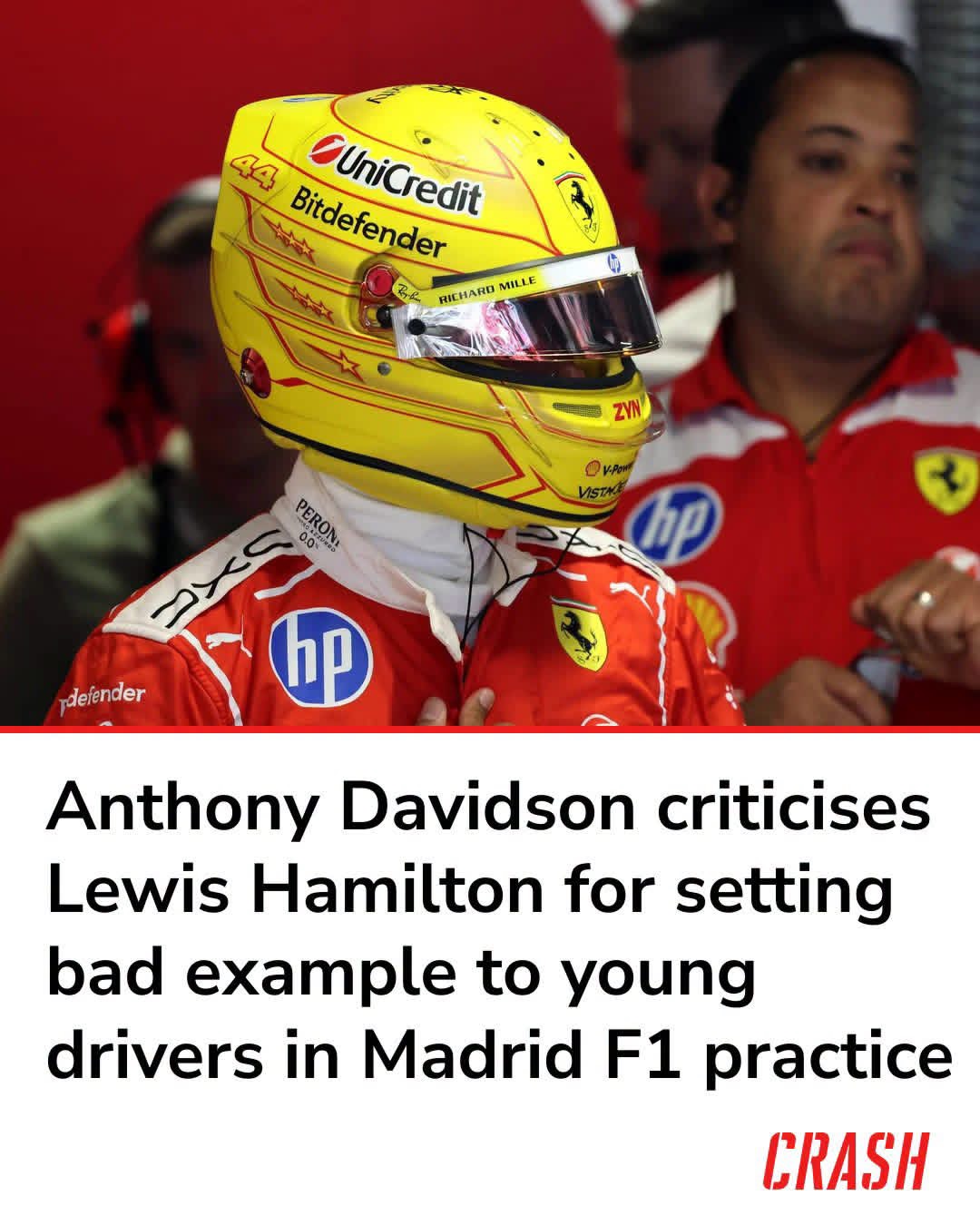
Lewis Hamilton’s dramatic crash in final practice at the Spanish Grand Prix quickly turned into something far more controversial than a simple barrier contact. The seven-time world champion not only lost a potential fastest lap but then continued driving a heavily damaged Ferrari despite clear instructions to stop, drawing sharp criticism from former Formula 1 driver and Sky Sports F1 pundit Anthony Davidson.
The incident has sparked debate across the paddock about safety, leadership, and the example set by one of the sport’s biggest stars to the next generation of drivers.
WHAT HAPPENED IN MADRID FINAL PRACTICE
During FP3 at the Circuit de Madrid, Hamilton looked set to post the session’s fastest time when he lost control at the final corner and crashed into the barriers. He reversed the SF-26 out of the wall and attempted to limp back to the pits with the front wing lodged underneath the car. The damage quickly caused a puncture to the front-right tyre.
Ferrari’s pit wall, via race engineer Carlo Santi, repeatedly instructed Hamilton to stop in a safe place. The message became more urgent after race director Rui Marques issued a formal request for the car to be stopped before Turn 12 (La Monumental) on the left. Hamilton eventually complied, but not before causing a lengthy delay to the session.
When running resumed, championship leader Andrea Kimi Antonelli topped the timesheets for Mercedes.
WHY DAVIDSON BELIEVES HAMILTON SET A DANGEROUS EXAMPLE
Davidson did not hold back during Sky Sports F1’s coverage. “Any young driver that is watching this right now, you don’t do that. You just don’t do that,” he said. He acknowledged the natural instinct to try returning to the pits but stressed that the rule exists for clear safety reasons.
If the front wing had fully gone under the car and lifted the front wheels, or if marshals had been on track, the consequences could have been severe. Davidson’s point was straightforward: experienced drivers must model the correct behaviour, especially when the regulations are unambiguous.
THE RULES AND POTENTIAL CONSEQUENCES
Formula 1’s 2026 sporting regulations explicitly address this situation. Driving with, or failing to stop, a car that has significant or obvious damage during a free practice session can result in a reprimand or a grid penalty. At the time of writing, the FIA had not yet confirmed whether Hamilton would face an investigation.
The delay caused by the incident also disrupted the final practice session for every team, compressing preparation time ahead of qualifying.
WHY THIS MATTERS BEYOND ONE PRACTICE SESSION
Hamilton remains one of the most influential figures in the sport. Young drivers, including rising stars such as Antonelli, watch how the veterans handle pressure, damage, and official instructions. When a driver of Hamilton’s stature appears to prioritise getting the car back over immediate compliance with safety directives, it risks normalising behaviour the regulations are designed to prevent.
For Ferrari, the episode adds another layer of frustration. The team is already fighting to maximise every opportunity in a tight championship battle. A potential grid drop or even a reprimand would compound the cost of the crash itself. For Mercedes and Antonelli, the delayed session may have limited their ability to fine-tune setups, though the young championship leader still emerged on top.
Safety culture in Formula 1 has improved dramatically over the decades, partly because of strict enforcement of rules around damaged cars. Incidents that once seemed like “just trying to get back” are now viewed through the lens of potential multi-car or marshal involvement. Davidson’s criticism reflects that modern standard.
THE BIGGER PICTURE FOR HAMILTON AND THE GRID
Hamilton has built a career on pushing limits, recovering from setbacks, and delivering under pressure. That competitive instinct is part of what made him a seven-time champion. Yet the same drive can sometimes collide with the need for absolute discipline when a car is compromised. At this stage of his career, every public action carries extra weight as a leadership signal to the grid.
The episode also highlights the constant tension between a driver’s desire to minimise lost track time and the collective responsibility to keep the circuit safe. Free practice may feel lower-stakes than a race, but the same physical risks exist for marshals, recovery crews, and other drivers.
WHAT COMES NEXT
All eyes will now turn to the FIA stewards. A decision on whether to investigate, and any subsequent penalty, will set an important marker for the remainder of the season. Teams will also be watching closely to see how consistently the regulations are applied.
For Hamilton and Ferrari, the priority shifts immediately to limiting the damage in qualifying and the race. For the wider paddock, the conversation Davidson started is likely to continue: how much responsibility do the sport’s biggest names carry when it comes to setting the standard for those coming up behind them?
In a championship as competitive as 2026 is proving to be, every practice session, every decision, and every example matters. Hamilton’s damaged-car drive in Madrid has ensured this particular moment will be remembered for more than just a crash.