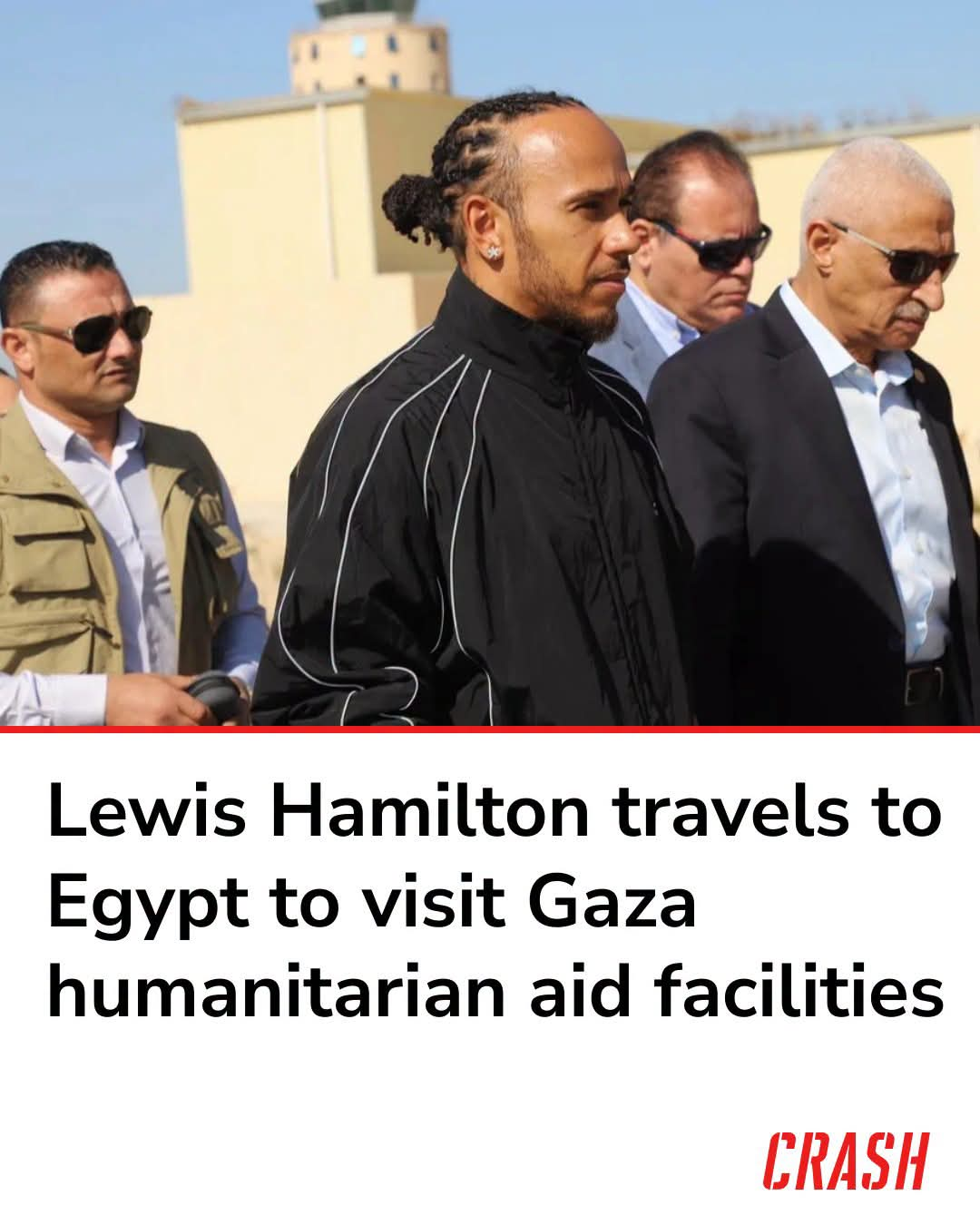
Seven-time Formula 1 world champion Lewis Hamilton touched down in Egypt’s North Sinai on Tuesday, stepping away from the racetrack to focus on one of the most pressing humanitarian challenges of our time. The Ferrari driver arrived at Al-Arish International Airport, where North Sinai Governor Major General Khaled Megawer received him, before heading to the Rafah border crossing and the Egyptian Red Crescent’s aid warehouses. There, Hamilton is learning how humanitarian and relief supplies are received, prepared, coordinated, and sent into the Gaza Strip.
This is not a photo opportunity. It is a deliberate move by one of sport’s most visible figures to see the logistics of aid delivery up close and amplify the work already happening on the ground.
THE LOGISTICS OF AID AT THE EDGE OF CONFLICT
North Sinai has functioned as a critical staging area for Gaza-bound assistance since the escalation of the conflict in October 2023. Egyptian authorities and the Egyptian Red Crescent have coordinated the movement of more than one million tonnes of aid. Just one day before Hamilton’s arrival, the Red Crescent dispatched its 308th convoy, carrying over 2,581 tonnes of supplies that included tents for families displaced by winter weather.
Hamilton’s itinerary centers on understanding this pipeline: how goods arrive by air and sea, how they are sorted and packed in Al-Arish warehouses, and how they move through the Rafah crossing. Officials briefed him on the coordination required to keep the flow of medical supplies, food, shelter materials, and other essentials moving under difficult conditions. The visit gives the 41-year-old driver a ground-level view of operations that most of the world only sees through distant reports.
HAMILTON’S LONG-STANDING HUMANITARIAN COMMITMENT
This trip builds directly on earlier work. In December 2025, Hamilton traveled to Jordan with the British Red Cross. He met volunteers from the Jordan Red Crescent and Palestine Red Crescent societies, observed aid preparation, and visited a hospital treating medical evacuees from Gaza. He has publicly supported humanitarian efforts and called for peace, while also founding Mission 44 in 2021 to expand educational and employment opportunities for young people.
Hamilton has never treated his platform as limited to motorsport. Whether addressing diversity in racing, climate issues, or conflict-related suffering, he consistently uses his visibility to draw attention beyond the podium. Arriving in North Sinai continues that pattern at a moment when attention on Gaza’s humanitarian needs remains urgent.
WHY A FORMULA 1 STAR’S PRESENCE CARRIES WEIGHT
Athletes of Hamilton’s stature move public conversation in ways few others can. Formula 1 commands a global audience that spans continents and demographics. When a driver currently fourth in the championship—after Kimi Antonelli secured the title with three races remaining—chooses to spend time at a border crossing rather than in a simulator or media day, it signals that human cost sits above sporting calendar priorities.
The impact operates on several levels. For aid organizations and Egyptian authorities managing the Rafah corridor, high-profile visitors help keep international focus on the practical difficulties of delivering assistance. For F1 itself, the visit reinforces a growing expectation that elite athletes engage with the world beyond the paddock. Teams, sponsors, and the broader industry increasingly navigate questions about athletes’ social and humanitarian statements. Hamilton’s consistent approach makes those conversations harder to dismiss as temporary.
There is also a quieter effect on younger athletes and fans. Seeing a multiple world champion treat humanitarian logistics with the same seriousness he brings to race engineering can normalize the idea that sporting success and social responsibility are not mutually exclusive.
THE BROADER CONTEXT AND WHAT COMES NEXT
Egypt’s role as a primary conduit for aid into Gaza has been steady and substantial. The scale of the response—hundreds of convoys and more than a million tonnes—demonstrates both capacity and sustained commitment. Hamilton’s presence does not change the underlying political or security realities that shape access. It does, however, add a layer of public accountability and visibility to the work of warehouse staff, Red Crescent volunteers, and officials managing the flow of goods.
Predictions are necessarily cautious. One high-profile visit will not resolve access constraints or end the underlying conflict. Yet history shows that sustained celebrity engagement can keep issues in the news cycle longer than they might otherwise remain. Hamilton’s previous Jordan trip already demonstrated follow-through. A second visit to the region suggests this is not a one-off gesture.
For Formula 1, the visit arrives late in a season already decided at the top. It may prompt further discussion within the sport about how drivers balance competition with external advocacy. Some will welcome the example. Others may prefer the focus stay strictly on racing. That tension is healthy. Sports that matter culturally are rarely insulated from the world around them.
Hamilton’s time in North Sinai is a reminder that the same precision and focus required to win championships can be applied to understanding how aid reaches people who need it. The warehouses in Al-Arish and the Rafah crossing are not glamorous stages, but they are places where real decisions about survival are made every day. By showing up, Hamilton has chosen to stand in that space and invite others to pay attention.