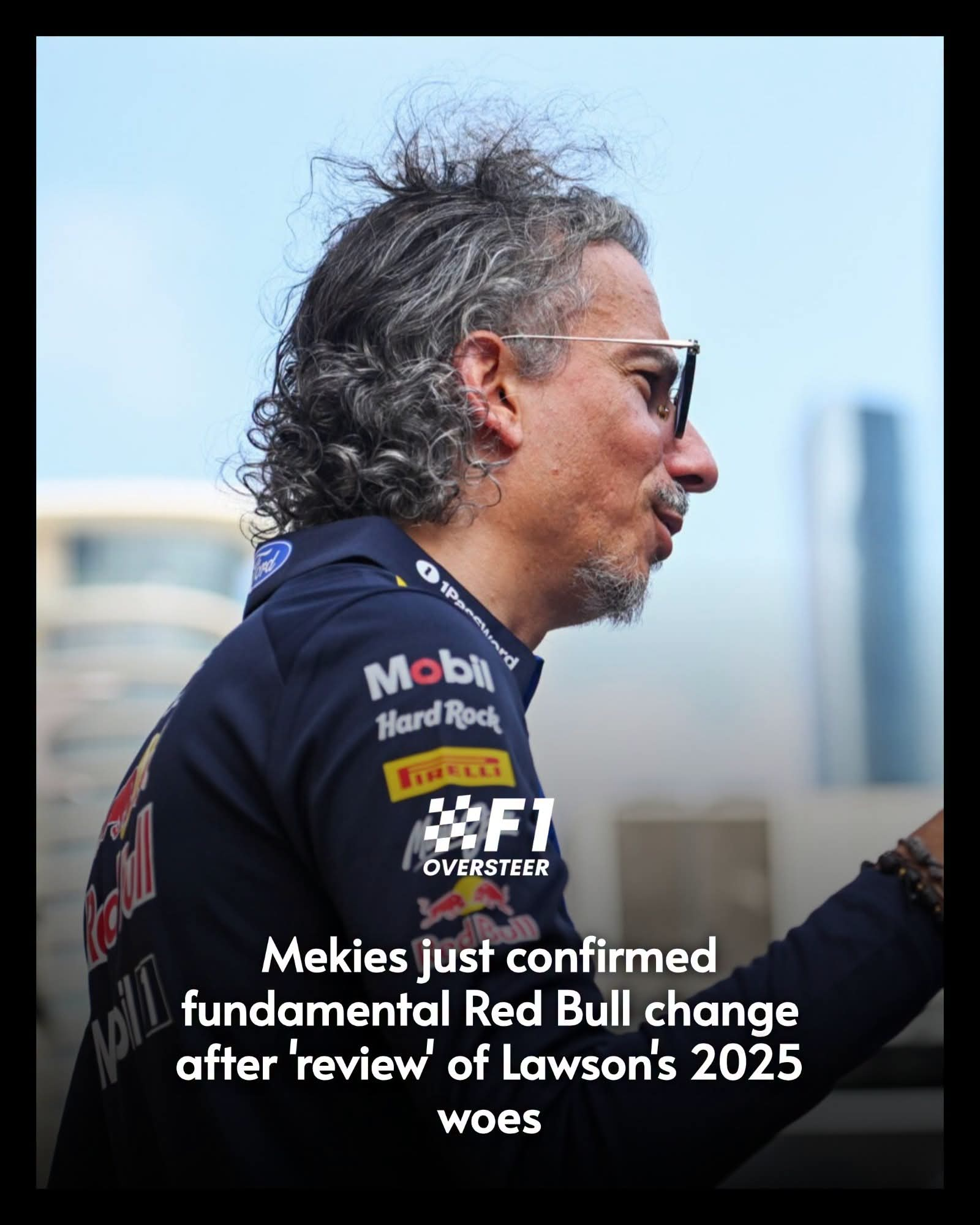
Red Bull appears to be changing the way it manages its Formula 1 driver programme, with team principal Laurent Mekies confirming that Racing Bulls will have greater responsibility for deciding its own driver lineup.
The development could be particularly important for Liam Lawson, whose place on the grid remains uncertain ahead of the 2027 season. After experiencing a difficult period in 2025 and losing his Red Bull Racing seat after only two race weekends, the New Zealander now has an opportunity to rebuild his reputation.
Lawson’s impressive seventh-place finish at the 2026 Sao Paulo Grand Prix has strengthened his argument for another season with Racing Bulls. However, he is still competing with Red Bull junior driver Nikola Tsolov for a place on the 2027 grid, while Arvid Lindblad is widely believed to be secure.
Mekies’ latest comments suggest that Lawson’s future will not be decided through the same top-down process that previously defined Red Bull’s driver decisions.
LAURENT MEKIES EXPLAINS WHO WILL DECIDE LAWSON’S FUTURE
Speaking after the Brazilian Grand Prix, Mekies made it clear that Racing Bulls will lead the decision-making process concerning its drivers.
He told The Race that the Racing Bulls driver decision belongs to the team itself, explaining that although Red Bull operates a shared junior programme, promotions to the senior team remain possible when a driver proves capable of taking that next step.
His comments are significant because Red Bull’s driver contracts are connected to the wider organisation, creating an expectation that senior management in Milton Keynes would ultimately control the lineup.
However, the reported structure gives Racing Bulls greater influence over the drivers it works with every weekend.
Team principal Alan Permane and his management team are expected to communicate their preferred lineup before the decision receives final approval from the Red Bull board.
This represents an important distinction: Racing Bulls may not have complete independence, but its assessment of driver performance is expected to carry considerably more weight.
RED BULL APPEARS TO BE MOVING AWAY FROM THE HORNER AND MARKO ERA
The development highlights how much Red Bull’s internal structure has evolved since Christian Horner and Helmut Marko departed their influential positions in 2025.
During their time together, the pair played major roles in shaping Red Bull’s driver decisions. Their influence extended beyond the senior team, particularly when it came to promotions, demotions and the development of young drivers.
The organisation’s aggressive approach produced several successful promotions, most notably Sebastian Vettel and Max Verstappen. However, its treatment of second drivers also attracted considerable criticism.
Lawson’s short-lived promotion to Red Bull Racing in 2025 became another example of how quickly the organisation could change its driver lineup.
After struggling during his opening two race weekends alongside Verstappen, Lawson was moved back to Racing Bulls, with Yuki Tsunoda taking his place.
The decision placed enormous pressure on Lawson, whose confidence and reputation were affected by an experience that offered very little time to establish himself.
Red Bull subsequently faced further difficulties with its second-driver situation, making it increasingly difficult to ignore questions about whether its previous approach was sustainable.
THE 360-DEGREE REVIEW COULD HAVE CHANGED EVERYTHING
Mekies previously indicated that Red Bull was conducting a comprehensive review of its difficulties with drivers outside Verstappen.
The review followed Lawson’s demotion and the challenges experienced by Tsunoda after his promotion to the senior team.
Rather than focusing exclusively on individual driver performances, Red Bull appeared interested in understanding whether its environment, expectations and development structure were contributing to the repeated struggles.
That distinction matters.
Formula 1’s midfield drivers often operate under enormous pressure when promoted to a team where the leading driver is already deeply familiar with the machinery, engineering processes and race strategy.
They must adapt quickly, deliver results and demonstrate that they can compete against an established world-class teammate.
When expectations are extremely high, even a short period of poor performance can create consequences that affect an entire career.
Giving Racing Bulls more influence could help Red Bull make decisions based on longer-term development rather than immediate pressure.
It could also allow the junior team to identify problems earlier and determine whether a driver needs more time before being considered for promotion.
ALAN PERMANE’S SUPPORT COULD BE CRUCIAL FOR LIAM LAWSON
One of the most encouraging details for Lawson is the reported position of Alan Permane.
According to the original report, the Racing Bulls team principal is believed to favour retaining the New Zealander for another season.
Permane’s recent contract extension has also strengthened his authority within the team, making his assessment particularly important.
Lawson’s seventh-place finish in Brazil provides a strong argument for continuity.
The result demonstrated that he can deliver valuable points when given a competitive opportunity, while also helping Racing Bulls in its battle against the other midfield teams.
Keeping an experienced driver for another season could offer important stability, especially as the team continues developing its younger talent.
Replacing Lawson with Tsolov might provide an exciting opportunity for Red Bull’s academy, but it would also introduce another inexperienced driver into an increasingly competitive Formula 1 environment.
Racing Bulls must therefore consider whether immediate potential or proven experience offers the better foundation for 2027.
NIKOLA TSOLOV REMAINS A THREAT TO LAWSON’S PLACE
Although Lawson has strengthened his position, his future is not guaranteed.
Nikola Tsolov remains an important contender for a Racing Bulls seat after progressing through Red Bull’s junior programme and competing in Formula 2.
Red Bull has invested heavily in developing young drivers, and the opportunity to introduce another academy graduate into Formula 1 will naturally be attractive.
However, a promotion should not be based solely on a driver’s potential or junior-category reputation.
Formula 1 requires consistency, technical feedback, tyre management, race intelligence and the ability to handle pressure across an entire season.
Lawson has already experienced the demands of the championship and understands the challenges of competing within the Red Bull environment.
That experience could give him an advantage when Racing Bulls evaluates its options.
The decision will ultimately depend on how the team balances long-term development with the need to remain competitive in 2027.
MAX VERSTAPPEN AND ISACK HADJAR HAVE REDUCED THE PRESSURE ON RACING BULLS
Another factor that could influence the decision is the situation at Red Bull Racing.
Max Verstappen remains under contract until 2030, while Isack Hadjar has impressed since joining the senior team.
With Hadjar establishing himself as a promising teammate, Red Bull may feel less pressure to identify an immediate replacement from its junior outfit.
That could be beneficial for Lawson.
Previously, Racing Bulls operated with the expectation that its strongest drivers could quickly become candidates for promotion to the senior team.
However, if Verstappen and Hadjar provide stability, the junior team can concentrate more heavily on developing its own competitive lineup.
This would allow Lawson to continue building his Formula 1 experience without the immediate expectation of returning to Red Bull Racing.
It could also give Tsolov more time to develop if the team eventually decides that he is not yet ready for a full-time seat.
WHAT THIS MEANS FOR RED BULL’S FUTURE
Mekies’ comments could signal one of the most important organisational changes within Red Bull’s driver programme in recent years.
The previous approach produced exceptional talent, but its handling of second drivers repeatedly became a source of controversy.
A greater role for Racing Bulls could create a more balanced system in which decisions are influenced by the people working directly with the drivers.
For Lawson, that may represent a significant opportunity to secure his future through performance rather than remain caught in the uncertainty surrounding Red Bull’s senior management.
His Brazilian Grand Prix result has given him momentum, and reported support from Permane could further strengthen his case.
Nevertheless, nothing has been officially confirmed regarding the 2027 lineup.
The coming weeks will be crucial as Racing Bulls weighs Lawson’s experience against Tsolov’s potential.
One thing is becoming increasingly clear: Red Bull’s approach to managing its young drivers is changing, and Liam Lawson could become one of the biggest beneficiaries of that transformation.