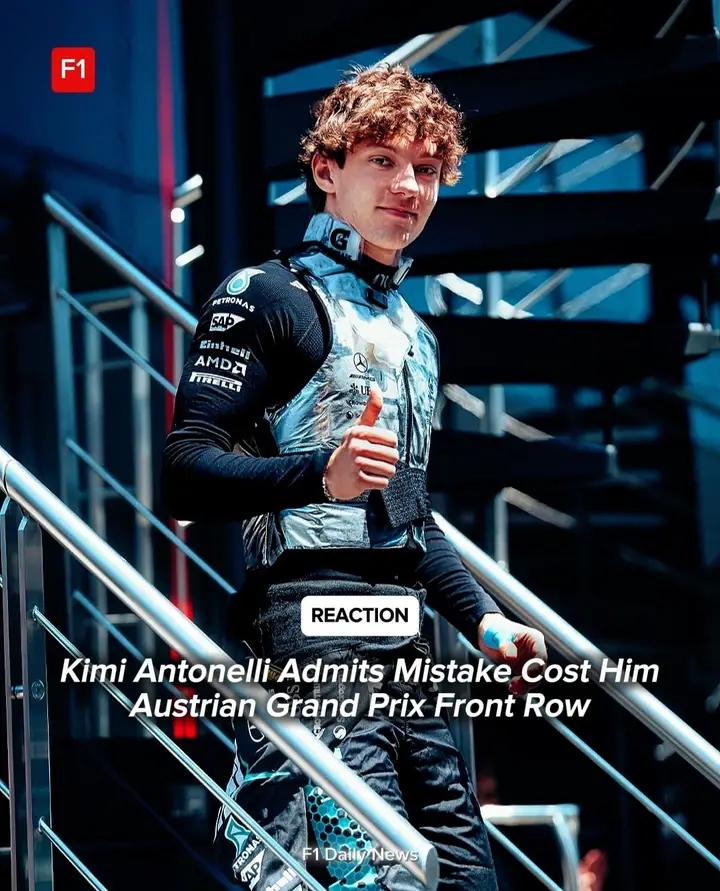
Mercedes rookie Kimi Antonelli walked away from Austrian Grand Prix qualifying with mixed emotions after admitting that a misunderstanding over yellow flags likely denied him a place on the front row at the Red Bull Ring.
The 19-year-old Italian had been one of the standout performers throughout the weekend, demonstrating impressive pace from the very beginning. After topping both Friday practice sessions and briefly holding provisional pole position during the first Q3 runs, Antonelli looked capable of delivering another breakthrough moment in his remarkable rookie campaign.
Instead, a split-second decision under yellow flag conditions changed the outcome of his qualifying session.
A MOMENT OF CONFUSION CHANGED EVERYTHING
As Antonelli began his final flying lap in Q3, Max Verstappen’s accident at Turn 9 triggered yellow flags. Believing that double yellow flags had been displayed, the Mercedes youngster immediately abandoned his lap.
However, the incident was actually covered by a single yellow flag.
Under Formula 1 regulations, a single yellow requires drivers to reduce speed and be prepared to change direction if necessary, but it does not automatically mean the lap must be abandoned. Mercedes teammate George Russell correctly lifted off the throttle through the affected sector before continuing his lap, ultimately securing pole position.
Antonelli later admitted that the mistake was entirely his own.
He explained that he genuinely believed he had seen double yellows, prompting him to abort the lap completely. After reviewing the situation, he realized he could have managed the corner with a lift off the throttle instead of giving up on the lap altogether.
FRONT ROW WAS WITHIN REACH
While Antonelli acknowledged that George Russell’s ultimate pace may still have been enough for pole position, the young Italian believes second place was a realistic possibility.
Telemetry suggested he was only around a tenth of a second behind Russell before reaching the yellow flag zone. Given the pace Mercedes showed throughout qualifying, a front-row start appeared well within reach.
Instead, Antonelli was forced to settle for fourth on the grid behind Russell and the Ferrari duo of Charles Leclerc and Lewis Hamilton.
For a driver who has consistently impressed during his rookie season, it was a painful reminder of how small decisions can have massive consequences in Formula 1.
WHY THIS MISTAKE MATTERS
Qualifying at the Red Bull Ring is notoriously important.
The Austrian circuit is one of the shortest on the Formula 1 calendar, meaning lap times are incredibly close and overtaking opportunities, while possible, often depend heavily on track position.
Starting from the front row would have given Antonelli a genuine opportunity to challenge for victory into Turn 1. Beginning from fourth instead means he’ll have to fight through two Ferraris before even thinking about attacking his own teammate.
It’s the kind of lesson every young Formula 1 driver experiences sooner or later.
Understanding race control signals, reacting instantly under pressure, and making the correct judgement while travelling at over 250 km/h are all part of becoming a complete Grand Prix driver.
MERCEDES HAS EVERY REASON TO BE ENCOURAGED
Despite the disappointment, Mercedes will leave qualifying feeling optimistic.
Russell’s pole position confirms that the team’s upgrades are working well around the Red Bull Ring, while Antonelli’s pace throughout the weekend proves the rookie can consistently fight at the front.
Perhaps most encouraging is the fact that Antonelli’s mistake was not caused by a lack of speed.
Instead, it was a judgement error that can be corrected through experience.
Those are exactly the kinds of lessons Mercedes expects a teenage rookie to learn during his first full Formula 1 season.
CAN ANTONELLI RECOVER IN THE RACE?
The Italian remains optimistic heading into Sunday’s Grand Prix.
Starting fourth still places him firmly in the fight for a podium finish, particularly if he can make a strong launch off the line.
Strategy, tyre management, and the potential for Safety Cars could all create opportunities to move forward.
Mercedes also has the advantage of having two cars near the front, allowing the team greater strategic flexibility against Ferrari and Red Bull.
If Antonelli can maintain the pace he displayed during practice and qualifying, climbing onto the podium is a very realistic objective.
WHAT THIS MEANS FOR THE CHAMPIONSHIP
Russell’s pole position gives Mercedes an excellent chance to score maximum points in Austria and continue closing the gap to its rivals in the Constructors’ Championship.
Meanwhile, Antonelli has another opportunity to strengthen his growing reputation as one of Formula 1’s brightest young talents.
One qualifying mistake does little to overshadow an exceptional weekend of speed.
If anything, it highlights just how fine the margins are at the very highest level of motorsport.
The Austrian Grand Prix could now become another defining chapter in Antonelli’s development—not because of the error itself, but because of how he responds when the lights go out on race day.
FINAL THOUGHTS
Championship-calibre drivers are often defined not by avoiding mistakes altogether, but by learning from them quickly.
Antonelli’s honest admission after qualifying demonstrated maturity beyond his years. Rather than making excuses, he accepted responsibility and immediately shifted his focus to maximizing Sunday’s race.
With Mercedes showing genuine race-winning pace and the rookie starting from the second row, don’t be surprised if Antonelli turns Saturday’s disappointment into Sunday’s redemption story.
Sometimes the biggest lessons create the strongest performances.