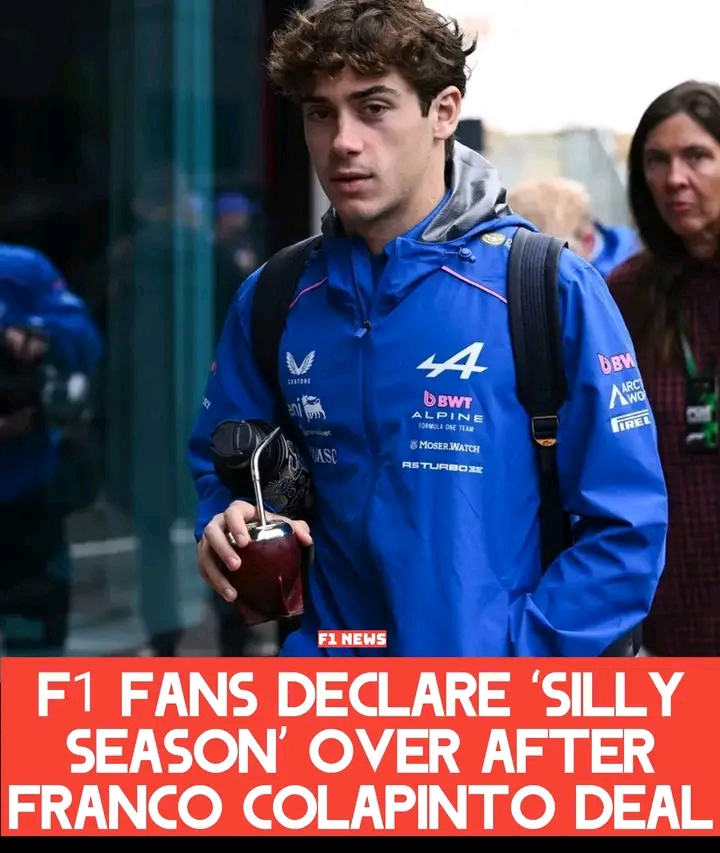
Franco Colapinto’s Formula 1 future is no longer a question mark. Alpine has confirmed that the Argentine driver will remain with the team for the 2027 season, continuing alongside Pierre Gasly and giving the French manufacturer a settled driver pairing for another year.
The announcement has been met with a largely positive response from Formula 1 fans, with many supporters pointing to Colapinto’s development, speed and growing confidence since joining Alpine. While his 2026 campaign has not yet produced the same points total as Gasly’s, the trajectory of his performances has strengthened the case for Alpine to continue investing in him.
Colapinto currently sits 12th in the 2026 Drivers’ Championship with 19 points, while Gasly has accumulated 44. On the surface, that gap suggests there is still work to do. However, Alpine’s decision appears to be based on a broader assessment of Colapinto’s potential rather than simply his current championship position.
ALPINE CHOOSES CONTINUITY OVER ANOTHER DRIVER GAMBLE
For Alpine, retaining Colapinto is about more than keeping a popular driver. It provides continuity at a time when stability could become increasingly valuable in Formula 1.
The modern F1 driver market can move quickly. One contract extension can trigger a chain reaction involving several teams, while a single vacancy can create months of speculation. By confirming both Colapinto and Gasly for 2027, Alpine has effectively removed itself from much of that uncertainty.
That could allow the team to concentrate more heavily on car development, operational improvements and long-term performance rather than dealing with constant questions about its driver line-up.
Colapinto also brings something that cannot easily be measured by championship points. His popularity in Argentina has helped strengthen Alpine’s profile in an important motorsport market, while his growing international fanbase gives the team additional commercial appeal.
The challenge now is turning that popularity and potential into consistently strong results.
COLAPINTO STILL HAS A POINT TO PROVE
Despite the positive reaction, Colapinto’s contract extension should not be interpreted as proof that he has already established himself as one of F1’s elite drivers.
His 19 points compared with Gasly’s 44 show that there remains a performance gap within the Alpine garage. Gasly has the advantage of greater experience and has generally been the benchmark Colapinto must measure himself against.
That makes 2027 particularly important.
A new contract gives Colapinto security, but it also removes one possible excuse. With his future settled, attention will increasingly shift toward what he can deliver on track.
The Argentine will need to demonstrate stronger qualifying performances, maximize opportunities when Alpine has a competitive car and reduce the number of weekends where points opportunities disappear.
If he can make another significant step forward, Alpine could eventually have one of the more intriguing driver combinations on the grid.
WHY THE 2027 DRIVER MARKET IS STARTING TO TAKE SHAPE
Colapinto’s extension is significant because it comes after several other important contract decisions.
Max Verstappen has committed his future to Red Bull through 2030, while Williams has extended the contracts of Alex Albon and Carlos Sainz. Those decisions have removed several drivers and potential destinations from the speculation surrounding the 2027 season.
That is why the driver market is beginning to look considerably different from the traditional F1 “silly season.”
Rather than waiting for a wave of contracts to expire and then watching the market explode, teams are increasingly locking down their preferred drivers early.
For drivers without confirmed seats, that creates a much more difficult environment.
Every extension reduces the number of available opportunities. A driver hoping to enter F1, return to the championship or move to a more competitive team now has fewer openings to target.
THE PRESSURE MOVES TO THE UNCONFIRMED SEATS
The biggest consequence of these announcements could be felt by drivers still waiting for clarity over their futures.
With Red Bull, Williams and Alpine making major decisions, the remaining vacancies become considerably more valuable. Teams with unresolved line-ups now have greater leverage because there are fewer realistic alternatives for drivers.
That could create an interesting dynamic as the 2027 season approaches.
Drivers may need to accept opportunities that would previously have been considered less attractive, while teams could afford to take more time before committing to their final choices.
The market may therefore become less about a huge number of available seats and more about which drivers can convince a small group of teams that they represent the best long-term investment.
GASLY AND COLAPINTO COULD BECOME AN IMPORTANT BENCHMARK
Alpine’s decision also sets up an intriguing internal battle.
Gasly enters 2027 with the advantage of experience and a stronger 2026 points tally. Colapinto, meanwhile, has youth, momentum and considerable room for development.
That contrast could make their rivalry particularly useful for Alpine.
If Colapinto starts consistently matching or beating Gasly, the team will have evidence that its investment in the Argentine is paying off. If Gasly maintains a substantial advantage, Alpine may have a clearer understanding of where Colapinto still needs to improve.
Either way, the pairing gives Alpine a useful reference point.
The key will be whether the two drivers can push each other forward without allowing an internal rivalry to become disruptive.
WHAT THIS MEANS FOR ALPINE’S LONG-TERM PROJECT
Alpine has spent considerable time attempting to establish itself as a genuine contender in Formula 1 rather than simply fighting in the midfield.
Driver stability can be an important part of that process.
A driver who understands the team, engineers and operating philosophy can contribute more effectively to development over time. Colapinto’s continued presence therefore gives Alpine the opportunity to build a longer-term relationship rather than constantly resetting its driver programme.
The same applies to Gasly.
Keeping both drivers together means Alpine can focus on extracting more performance from the package instead of introducing another variable into an already complicated technical environment.
Of course, a stable line-up alone does not guarantee success. The car ultimately determines how competitive the team can be. But if Alpine can produce a faster machine, having two established drivers ready to exploit it could become a major advantage.
FANS HAVE GOOD REASON TO BE EXCITED
The reaction from fans has reflected Colapinto’s growing popularity.
Many supporters have welcomed Alpine’s decision because they believe the Argentine has shown enough promise to justify another opportunity. Others have pointed toward his speed, personality and commercial value as reasons why keeping him makes sense.
There has also been plenty of humor surrounding the increasingly settled 2027 grid, with fans joking that the traditional “silly season” is beginning to look more like a “serious season.”
The joke reflects a genuine change in the market.
Instead of waiting for the biggest names to make dramatic moves, fans are watching teams steadily eliminate possibilities from the board.
That can make the eventual remaining battles for seats even more interesting.
THE BIG QUESTION FOR COLAPINTO IN 2027
The most important question is no longer whether Colapinto belongs in Formula 1.
It is whether he can establish himself as a driver capable of delivering consistently at a high level.
His next target should be closing the gap to Gasly. If he can turn more qualifying appearances into strong grid positions, convert those opportunities into points and show greater consistency across a full season, his reputation could change dramatically.
A breakthrough season in 2027 could also put him on the radar of bigger teams in the future.
Conversely, if his development stalls, Alpine may eventually face difficult questions despite having already committed to him.
That makes the extension both an endorsement and a challenge.
PREDICTION FOR COLAPINTO AND ALPINE
The most likely outcome is that Colapinto enters 2027 with greater confidence and a clearer understanding of what Alpine expects from him.
Expect his biggest gains to come from consistency rather than spectacular individual performances. If he can regularly qualify close to Gasly, finish races strongly and capitalize whenever Alpine has a competitive package, his points total should rise significantly.
Alpine, meanwhile, will hope its settled driver pairing becomes part of a broader push toward the front of the midfield.
The team has essentially decided that Colapinto is worth betting on.
Now the Argentine has a full season ahead of him to prove that decision was the right one.
FINAL VERDICT
Franco Colapinto’s Alpine extension is much more significant than a simple contract announcement.
It removes another potential vacancy from the 2027 Formula 1 driver market, gives Alpine valuable stability and provides Colapinto with the opportunity to continue developing without the distraction of constant speculation about his future.
With Verstappen staying at Red Bull and Albon and Sainz remaining at Williams, several major pieces of the 2027 puzzle are already in place.
For Colapinto, however, the hard part begins now.
The contract guarantees him another season. It does not guarantee success.
If he can transform his promising performances into consistent results, 2027 could be the year he moves from being one of Formula 1’s most popular young talents to one of its genuinely established stars.