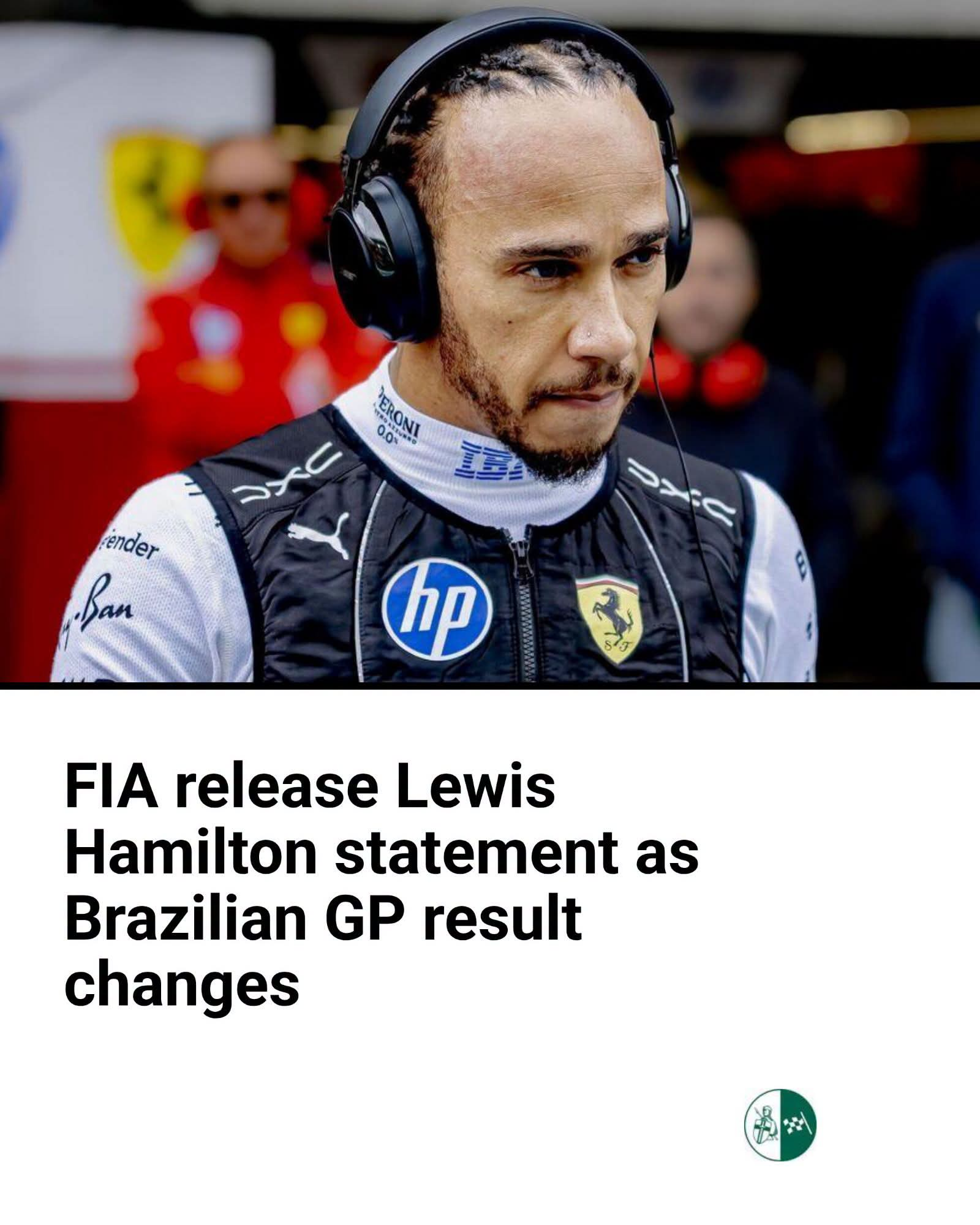
The FIA has released an official statement explaining why Lewis Hamilton escaped punishment following an investigation into an on-track incident at the 2026 São Paulo Grand Prix. The Ferrari driver had been investigated for leaving the track while attempting to overtake fellow Briton Oliver Bearman, but the stewards concluded that he gained no advantage and therefore took no further action.
The decision came during a post-race period that also saw the Brazilian Grand Prix classification adjusted following three separate five-second penalties. Charles Leclerc lost seventh place to Liam Lawson after being found responsible for a collision, while Kimi Antonelli and Bearman were punished for unsafe releases in the pit lane.
Although Hamilton avoided another penalty, his difficult afternoon at Interlagos continued to attract attention. The seven-time world champion started from 20th after an engine-related grid penalty and fought his way into the points, eventually finishing ninth.
Meanwhile, Lando Norris secured victory for McLaren, Max Verstappen produced an extraordinary recovery from 21st to finish second, and Isack Hadjar completed the podium. Mercedes also celebrated securing the Constructors’ Championship, making the Brazilian weekend a major moment in the 2026 season.
FIA EXPLAINS WHY LEWIS HAMILTON ESCAPED A BRAZILIAN GP PENALTY
Hamilton’s investigation centred on an overtaking attempt against Haas driver Oliver Bearman at Turn 5.
During the battle, Bearman moved to the right while defending his position, forcing Hamilton off the track as the Ferrari driver attempted to complete the move. The incident attracted the attention of the stewards, who reviewed the available in-car video evidence before reaching their decision.
In its official explanation, the FIA stated that Hamilton had the momentum to complete the overtake and was pushed off the circuit while avoiding a collision.
The stewards also highlighted an important detail: Hamilton subsequently gave the position back to Bearman. Their investigation found that the Ferrari driver had not gained an advantage by leaving the track.
The FIA therefore decided that no further action was necessary.
This distinction is important because Formula 1 regulations do not automatically require a penalty every time a driver leaves the circuit during an overtaking attempt. The circumstances matter, including whether the driver was forced off the track, whether an advantage was gained and whether the position was returned.
In Hamilton’s case, the stewards concluded that he had been forced wide and had not benefited unfairly from the incident.
CHARLES LECLERC LOSES POSITION AFTER COLLISION WITH LIAM LAWSON
While Hamilton escaped punishment, his Ferrari teammate Charles Leclerc was not as fortunate.
Leclerc finished seventh on the road after a late battle with Lawson, but the FIA subsequently handed him a five-second time penalty for causing a collision with the Racing Bulls driver.
The incident occurred as the pair fought for position during the closing stages of the 71-lap race. Leclerc made contact with Lawson while attempting an overtake, although the New Zealander initially managed to maintain his position.
The Ferrari driver eventually passed Lawson several corners later and appeared to have secured seventh place.
However, the stewards concluded that the contact had disrupted Lawson and helped Leclerc close the gap before completing the overtake.
They also noted that Lawson had the right to the corner under the Driving Standard Guidelines, meaning Leclerc was responsible for avoiding the collision.
Although the contact was considered minor, the officials believed it had an obvious sporting consequence. They therefore imposed a five-second penalty, taking account of the wet conditions when deciding against a harsher sanction.
The revised classification promoted Lawson to seventh and dropped Leclerc to eighth.
For Ferrari, it was another frustrating development after a weekend in which both drivers struggled to maximise their opportunities.
KIMI ANTONELLI AND OLIVER BEARMAN ALSO RECEIVE FIA PENALTIES
Leclerc was not the only driver punished after the Brazilian Grand Prix.
Mercedes rookie Kimi Antonelli received a five-second penalty following an unsafe release in the pit lane. The stewards determined that the Mercedes driver had been released into the path of Alpine’s Franco Colapinto.
The incident raised concerns about pit lane safety, particularly because drivers must be released only when it is safe to rejoin the flow of traffic.
Haas driver Oliver Bearman also received a five-second sanction for a separate unsafe release.
However, neither penalty changed the drivers’ final positions. Both Antonelli and Bearman had enough time between themselves and the cars behind to absorb the additional five seconds without losing their places.
Antonelli therefore remained fifth in the final classification, while Bearman stayed 17th.
The decisions reinforced the importance of safe pit stop procedures, with teams expected to avoid releasing their drivers into dangerous situations regardless of the competitive circumstances.
LANDO NORRIS WINS AS MAX VERSTAPPEN RECOVERS FROM 21ST
Away from the post-race investigations, the biggest sporting story at Interlagos was another impressive performance from Verstappen.
The Red Bull driver started 21st following engine penalties but fought his way through the field to finish second behind Norris.
His recovery was one of the standout drives of the weekend and earned him Driver of the Day recognition. Verstappen demonstrated exceptional racecraft in difficult conditions, overtaking several competitors and putting himself in contention for another podium.
Norris, however, remained in control at the front.
The McLaren driver converted pole position into victory, securing his first win since the Dutch Grand Prix in August. The result was also another important reward for McLaren after introducing an upgrade package for the Brazilian round.
Hadjar completed the podium in third, giving Red Bull two drivers among the top three.
The result also continued the growing interest in the battle between Norris and Verstappen, with both drivers demonstrating that they remain capable of producing strong performances under very different circumstances.
MERCEDES SECURES THE 2026 CONSTRUCTORS’ CHAMPIONSHIP
Mercedes had another reason to celebrate at Interlagos after officially securing the 2026 Constructors’ Championship.
Russell and Antonelli did not finish on the podium, but their combined result provided enough points to confirm the title.
It was a major achievement for Toto Wolff and the entire Mercedes organisation, particularly after several seasons of attempting to return to the top of the constructors’ standings.
The team’s success also came despite a complicated Brazilian Grand Prix. Antonelli briefly led the race before losing positions after going off track, while Russell experienced a spin near the pit lane exit.
Nevertheless, their finishing positions were sufficient to deliver the championship.
The result demonstrated the importance of consistency across a full Formula 1 season. Winning individual races is valuable, but the Constructors’ Championship rewards teams that consistently collect points through both cars.
Mercedes achieved that objective in 2026, confirming its return to the top of the teams’ standings.
LEWIS HAMILTON’S FERRARI STRUGGLES CONTINUE AFTER BACK-OF-GRID START
Although Hamilton avoided punishment from the FIA, his Brazilian Grand Prix was far from straightforward.
The Ferrari driver started 20th after an engine-related grid penalty and faced the difficult task of recovering through the field.
He made progress during the opening stages, but Ferrari struggled to find consistent performance in both wet and dry conditions.
The situation became more complicated when rain arrived during the closing stages. Hamilton misunderstood the team’s communication and remained on slick tyres as the track became wet.
The mistake cost him valuable time and contributed to his eventual ninth-place finish.
His recovery from the back of the grid was still an achievement, but Ferrari will be disappointed that another opportunity to collect stronger points was affected by strategic difficulties.
The team also needs to examine the contrast between its drivers’ performances and the progress made by McLaren, Mercedes and Red Bull.
For Hamilton, the immediate challenge is finding greater consistency with Ferrari as the season approaches its final stages.
WHAT THE FIA DECISIONS MEAN FOR THE FINAL BRAZILIAN GP RESULTS
The three post-race penalties changed the classification in different ways, but Hamilton’s investigation did not result in a sanction.
The final top 10 remained:
1. Lando Norris – McLaren
2. Max Verstappen – Red Bull
3. Isack Hadjar – Red Bull
4. George Russell – Mercedes
5. Kimi Antonelli – Mercedes*
6. Oscar Piastri – McLaren
7. Liam Lawson – Racing Bulls
8. Charles Leclerc – Ferrari*
9. Lewis Hamilton – Ferrari
10. Nico Hulkenberg – Audi
Five-second penalty applied.
Hamilton’s clearance means his ninth-place result remained unchanged, while Leclerc’s penalty allowed Lawson to move ahead of him.
The FIA’s explanations also underline an important difference between the incidents. Hamilton was found to have been forced off the track without gaining an advantage, whereas Leclerc was judged to have benefited from contact that disrupted another driver.
FERRARI LEFT WITH MORE QUESTIONS AFTER INTERLAGOS
The Brazilian Grand Prix has provided Ferrari with several issues to address before the next race.
Hamilton’s radio confusion, Leclerc’s collision penalty and the team’s overall lack of consistency prevented the Scuderia from achieving the result it would have wanted.
The FIA’s decision to clear Hamilton will come as a relief, but it does little to change the wider picture. Ferrari needs to improve its race execution if it hopes to challenge its rivals more consistently.
For Mercedes, the weekend ended with a championship celebration. McLaren secured another victory through Norris, while Red Bull enjoyed a double podium thanks to Verstappen and Hadjar.
The post-race investigations added another layer of drama, but the most important outcome for Hamilton was that the FIA found no reason to punish him.
At Interlagos, one Ferrari driver escaped the stewards’ attention without a penalty, while the other lost a position after an expensive late-race incident. That contrast perfectly captured another complicated weekend for the Scuderia.