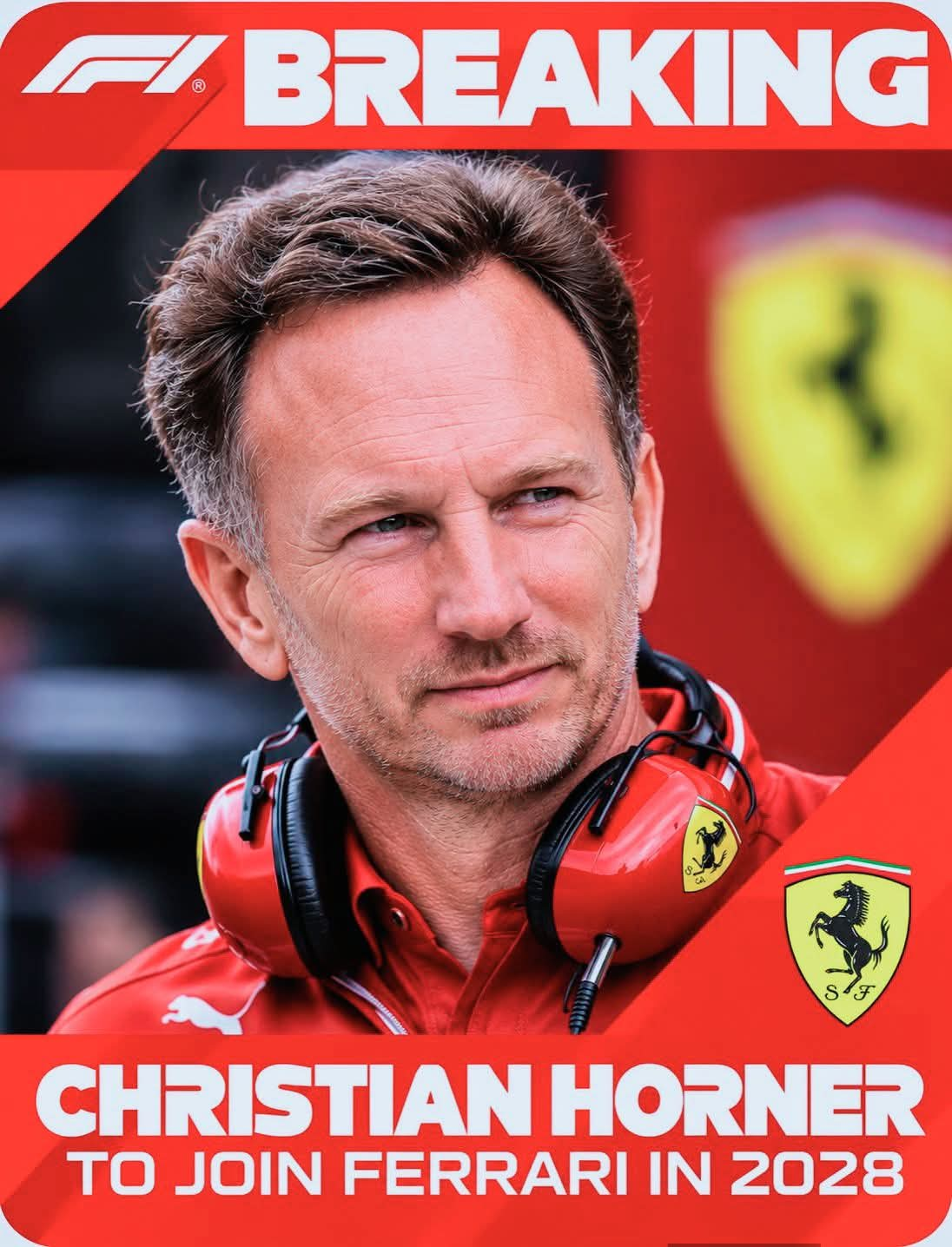
Christian Horner remains one of Formula 1’s most successful and polarising figures. After two decades building Red Bull into a powerhouse that delivered eight drivers’ titles and six constructors’ crowns, his abrupt departure in July 2025 left a vacuum that the paddock still discusses. Recent comments linking him to Ferrari as a “dream” destination ignited fresh speculation, only for Horner himself to cool the temperature. No deal exists. His future in the sport is undecided. Yet the mere idea of the former Red Bull boss walking into Maranello continues to fascinate because it touches deeper questions about leadership, ownership, culture, and what it takes to unlock Ferrari’s latent potential.
WHAT HORNER ACTUALLY SAID AND WHY IT MATTERED
In interviews promoting his book, Horner described Ferrari as the biggest brand in Formula 1, a historic sleeping giant, and the one team for which he would consider a pure management role without an ownership stake. Those words, especially the “dream” framing, landed at a moment when Fred Vasseur’s position faced the usual intense scrutiny that comes with Ferrari’s high expectations and uneven results. The reaction was predictable: Italian media ran hard with succession talk, and the paddock connected dots that were never formally joined.
Horner later clarified that the remarks were taken out of context. He said he was being respectful about Ferrari’s unique status rather than campaigning for the job. He has expressed sympathy for the pressure placed on Vasseur and emphasised that any return to Formula 1 would ideally involve equity. Ferrari, as a listed company and national icon, is not structured to hand out ownership shares in the racing team. That practical barrier, combined with Ferrari’s public backing of its current leadership, makes an imminent move highly unlikely. Still, the episode revealed how quickly Horner’s name generates oxygen around any underperforming or high-stakes team.
WHY THE FERRARI QUESTION REFUSES TO FADE
Ferrari has not won a constructors’ championship since 2008. The drivers’ title drought stretches even longer. The arrival of Lewis Hamilton added star power and commercial weight, yet the results have not matched the resources or the mythology. In that environment, any high-profile name with a proven record of building winning cultures becomes catnip for speculation.
Horner’s track record is hard to dismiss. He took a midfield Jaguar operation and, with the right people and resources, turned it into a dominant force across two distinct eras—first with Sebastian Vettel, then with Max Verstappen. He understood political navigation, driver management, technical recruitment, and the relentless demands of the modern calendar. At Ferrari those same skills would meet a different test: the intense internal politics, the media glare of Italian motorsport, the expectations of the tifosi, and a corporate structure that answers to shareholders and the wider Ferrari brand rather than a single energetic owner like the late Dietrich Mateschitz.
The cultural fit is the real unknown. Red Bull under Horner operated with notable autonomy and a results-first ruthlessness. Ferrari operates as both a racing team and a national institution. Success there requires navigating layers of history, pride, and politics that have tripped up many capable outsiders. Some argue Horner’s outsider status and proven ability to impose clarity could be exactly what is needed. Others believe the same intensity that delivered titles at Red Bull could clash with Maranello’s established ways.
THE OWNERSHIP REALITY AND THE BROADER INDUSTRY SHIFT
Horner has been clear that he does not need to return simply to sit on a pit wall again. After a lucrative exit settlement, he has the luxury of time and capital. He has spoken about seeking opportunities that include equity and like-minded partners focused on winning rather than merely participating. In an era when Formula 1 team valuations have soared into the billions, ownership has become the new prize for ambitious executives. Pure hired leadership roles, even at iconic teams, look less attractive when the alternative is a meaningful stake in the next wave of growth.
This changes the equation for every team. Midfield and lower outfits face pressure to attract or retain talent who now demand skin in the game. Established giants must decide how much control they are willing to share. Ferrari’s structure makes it an outlier, which is precisely why Horner’s earlier exception for the Scuderia generated such attention. The fact that he later reaffirmed the ownership priority only reinforces how the economics of the sport have shifted.
IMPACT ON THE KEY PLAYERS AND THE CHAMPIONSHIP LANDSCAPE
For Ferrari, sustained speculation around the team principal role creates distraction even when the organisation publicly stands behind its leadership. Drivers feel it. Engineers feel it. Sponsors notice the noise. Stability has value, yet Ferrari’s history shows that results ultimately dictate tenure more than almost anywhere else on the grid.
For Red Bull, Horner’s continued presence in the conversation serves as a reminder of the high bar he set and the different path the team is now charting under new leadership. Recent results have shown resilience, but the comparison is inevitable.
For the wider championship, the possibility—however remote—of Horner returning at a top team injects uncertainty into the power structure. A revitalised Ferrari under strong leadership would alter the competitive balance, the commercial landscape, and the narrative around who can truly challenge the current order. Even without a move, the speculation keeps Ferrari in the headlines and forces every rival to consider contingency scenarios.
PREDICTIONS AND THE REALISTIC PATH FORWARD
The most probable near-term outcome is that Horner remains outside the day-to-day fray, evaluating ownership opportunities while Ferrari continues with its current structure. A direct appointment as team principal without equity looks improbable given his stated priorities and Ferrari’s corporate reality. Longer term, if performance at Maranello continues to lag expectations and leadership change becomes unavoidable, the conversation could reopen. Culture, chemistry with the driver pairing, and willingness on both sides to adapt would then decide whether the “dream” framing ever becomes more than rhetoric.
Horner has said he would be at peace if he never returned. That may be genuine. Yet Formula 1 has a habit of pulling its most successful figures back when the right project appears. For now the Scuderia remains a hypothetical rather than a destination. The story matters less because of any imminent deal and more because it crystallises the modern Formula 1 dilemma: the tension between iconic brands, proven operators, ownership ambitions, and the relentless demand for results. Whether Christian Horner ever wears red, the questions his name raises will keep shaping how teams think about leadership for years to come.