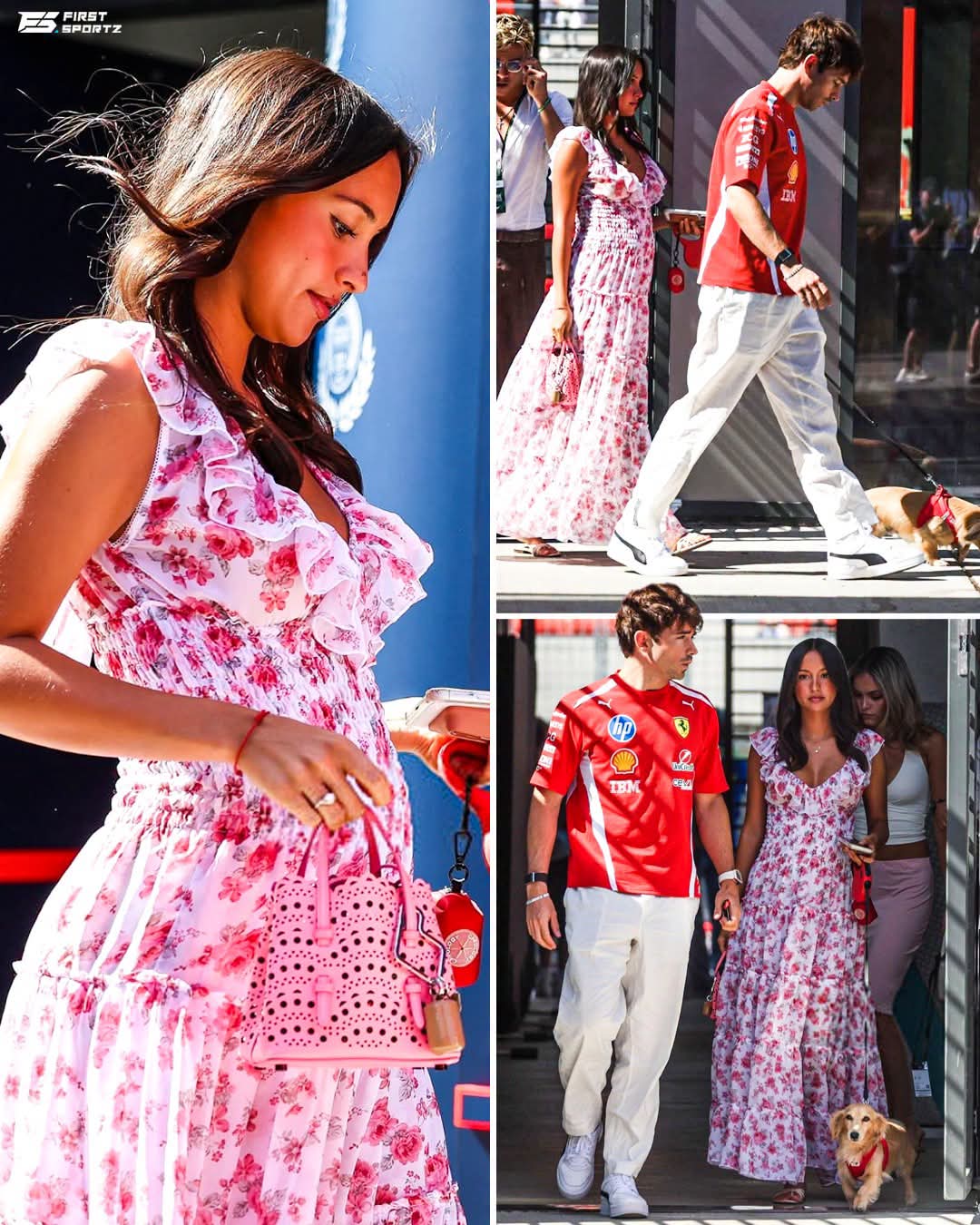
Charles Leclerc and Alexandra Saint Mleux at the Hungarian Grand Prix Qualifying The Hungarian Grand Prix weekend once again brought together the excitement of Formula 1 racing and the glamour that surrounds the sport, with Ferrari driver Charles Leclerc drawing attention both on and off the track. Among the familiar faces supporting the Monegasque driver was Alexandra Saint Mleux, who was seen at the Hungaroring during the qualifying weekend. Qualifying is one of the most closely watched sessions of a Formula 1 weekend. With drivers fighting for the best possible starting positions, every lap carries enormous importance. For Leclerc, the session represented another opportunity to extract maximum performance from his Ferrari and put himself in a strong position for the Grand Prix. Away from the intense action on the circuit, Saint Mleux’s presence added another layer of interest for fans following Leclerc’s weekend. The couple have attracted considerable attention from Formula 1 followers, with their appearances at races frequently becoming a talking point among fans and motorsport media. The Hungaroring, located near Budapest, provides a distinctive challenge for Formula 1 drivers. Often described as a technical and twisty circuit, the track leaves little room for error. Unlike some of the sport’s faster venues, overtaking can be difficult, making qualifying particularly significant. Starting position can have a major influence on a driver’s prospects during the race. For Leclerc, the pressure of qualifying is familiar. As one of Ferrari’s leading drivers, expectations are high whenever he takes to the track. His ability to produce fast laps under pressure has been one of the defining features of his Formula 1 career. The narrow margins between competitors mean that even small improvements in braking, cornering or tyre management can make a difference. While Leclerc concentrated on his preparations and performance, Saint Mleux was among the people providing support away from the cockpit. Her appearances at Formula 1 events have generated interest beyond the traditional motorsport audience, particularly among fans who follow the personal lives of drivers alongside their racing careers. The attention surrounding Formula 1 has expanded considerably in recent years. Social media has played a major role in bringing fans closer to the personalities behind the sport, while drivers’ partners, families and friends have increasingly become part of the wider Formula 1 conversation. Leclerc himself has developed a substantial international following throughout his career. His success with Ferrari, combined with his competitive performances and public profile, has made him one of the most recognisable figures on the current Formula 1 grid. Consequently, moments away from the racetrack can attract almost as much interest online as the racing itself. At the Hungarian Grand Prix, however, the primary focus remained on the battle for grid position. Qualifying at the Hungaroring requires precision throughout the lap. Drivers must balance aerodynamic performance with mechanical grip while attempting to maintain tyre performance over a short but demanding circuit. The final sector is particularly important because mistakes in one corner can affect the following sections of the lap. With the field often separated by fractions of a second, a small loss of time can translate into several positions on the grid. For Ferrari, qualifying at a circuit such as the Hungaroring also provides an important test of the car’s overall package. The team must find the right setup while working within the limited practice time available during a Grand Prix weekend. Engineers and drivers analyse data from every session to determine how to maximise performance when it matters most. Leclerc’s qualifying approach has traditionally involved pushing the limits while maintaining the precision required to complete a clean lap. The challenge is particularly demanding on a circuit where the corners arrive in quick succession, leaving little opportunity to recover from an error. As the qualifying session unfolded, fans around the circuit and viewers watching around the world followed the Ferrari driver’s progress closely. Cameras also captured the atmosphere in the paddock, where guests, team personnel and members of drivers’ entourages prepared for one of the most important sessions of the weekend. Saint Mleux’s presence naturally became part of that paddock atmosphere. Her appearances alongside Leclerc have attracted a strong following, with fans frequently sharing photographs and clips from Grand Prix weekends across social media platforms. However, for Leclerc, the priority remained firmly on his Ferrari responsibilities. Once he climbed into the cockpit, attention shifted from the paddock to the stopwatch. Formula 1 qualifying is ultimately decided by lap time, and every driver on the grid is focused on achieving the same objective: completing the fastest possible lap. The Hungarian Grand Prix has historically offered a distinctive atmosphere compared with many other European races. The proximity of Budapest, the enthusiastic crowds and the compact nature of the Hungaroring combine to create a memorable setting for the Formula 1 paddock. For spectators, seeing high-profile drivers such as Leclerc at the circuit is part of the attraction. For the drivers themselves, however, the weekend represents another demanding sporting challenge in a championship where every point and every position can matter. Leclerc’s qualifying performance therefore remained the central sporting storyline, while his relationship with Saint Mleux provided an additional point of interest for fans following the Ferrari driver’s weekend. The combination of high-speed competition and the personalities surrounding the sport has become an important part of Formula 1’s modern appeal. Race weekends now attract audiences interested not only in lap times and championship standings but also in the lives and experiences of the people who make up the paddock. At the Hungaroring, those two sides of Formula 1 came together once again. Leclerc faced the pressure of qualifying with Ferrari, while Saint Mleux was present among the supporters watching the weekend unfold. As the Hungarian Grand Prix weekend moved toward race day, the attention inevitably returned to the track. The starting grid would set the stage for another demanding race, with strategy, tyre management and overtaking opportunities all expected to influence the outcome. For Leclerc, qualifying was another chapter in his continuing Ferrari story. For fans, his presence alongside Saint Mleux offered a glimpse of the personal side of a driver whose professional life is played out under intense global scrutiny. Ultimately, the Hungarian Grand Prix weekend demonstrated once again why Formula 1 extends far beyond the two hours of racing on Sunday. The paddock, the personalities, the atmosphere and the anticipation surrounding qualifying all contribute to the spectacle. With Leclerc preparing to represent Ferrari at one of Formula 1’s most technical circuits and Saint Mleux supporting him from the paddock, the Hungarian Grand Prix provided another memorable moment for fans both inside and outside the world of motorsport.
Charles Leclerc and Alexandra Saint Mleux at the Hungarian Grand Prix qualifying…Charles Leclerc and Alexandra Saint Mleux at the Hungarian Grand Prix Qualifying


The Hungarian Grand Prix weekend once again brought together the excitement of Formula 1 racing and the glamour that surrounds the sport, with Ferrari driver Charles Leclerc drawing attention both on and off the track. Among the familiar faces supporting the Monegasque driver was Alexandra Saint Mleux, who was seen at the Hungaroring during the qualifying weekend.


Qualifying is one of the most closely watched sessions of a Formula 1 weekend. With drivers fighting for the best possible starting positions, every lap carries enormous importance. For Leclerc, the session represented another opportunity to extract maximum performance from his Ferrari and put himself in a strong position for the Grand Prix.


Away from the intense action on the circuit, Saint Mleux’s presence added another layer of interest for fans following Leclerc’s weekend. The couple have attracted considerable attention from Formula 1 followers, with their appearances at races frequently becoming a talking point among fans and motorsport media.


The Hungaroring, located near Budapest, provides a distinctive challenge for Formula 1 drivers. Often described as a technical and twisty circuit, the track leaves little room for error. Unlike some of the sport’s faster venues, overtaking can be difficult, making qualifying particularly significant. Starting position can have a major influence on a driver’s prospects during the race.


For Leclerc, the pressure of qualifying is familiar. As one of Ferrari’s leading drivers, expectations are high whenever he takes to the track. His ability to produce fast laps under pressure has been one of the defining features of his Formula 1 career. The narrow margins between competitors mean that even small improvements in braking, cornering or tyre management can make a difference.


While Leclerc concentrated on his preparations and performance, Saint Mleux was among the people providing support away from the cockpit. Her appearances at Formula 1 events have generated interest beyond the traditional motorsport audience, particularly among fans who follow the personal lives of drivers alongside their racing careers.


The attention surrounding Formula 1 has expanded considerably in recent years. Social media has played a major role in bringing fans closer to the personalities behind the sport, while drivers’ partners, families and friends have increasingly become part of the wider Formula 1 conversation.


Leclerc himself has developed a substantial international following throughout his career. His success with Ferrari, combined with his competitive performances and public profile, has made him one of the most recognisable figures on the current Formula 1 grid. Consequently, moments away from the racetrack can attract almost as much interest online as the racing itself.


At the Hungarian Grand Prix, however, the primary focus remained on the battle for grid position. Qualifying at the Hungaroring requires precision throughout the lap. Drivers must balance aerodynamic performance with mechanical grip while attempting to maintain tyre performance over a short but demanding circuit.


The final sector is particularly important because mistakes in one corner can affect the following sections of the lap. With the field often separated by fractions of a second, a small loss of time can translate into several positions on the grid.


For Ferrari, qualifying at a circuit such as the Hungaroring also provides an important test of the car’s overall package. The team must find the right setup while working within the limited practice time available during a Grand Prix weekend. Engineers and drivers analyse data from every session to determine how to maximise performance when it matters most.


Leclerc’s qualifying approach has traditionally involved pushing the limits while maintaining the precision required to complete a clean lap. The challenge is particularly demanding on a circuit where the corners arrive in quick succession, leaving little opportunity to recover from an error.


As the qualifying session unfolded, fans around the circuit and viewers watching around the world followed the Ferrari driver’s progress closely. Cameras also captured the atmosphere in the paddock, where guests, team personnel and members of drivers’ entourages prepared for one of the most important sessions of the weekend.


Saint Mleux’s presence naturally became part of that paddock atmosphere. Her appearances alongside Leclerc have attracted a strong following, with fans frequently sharing photographs and clips from Grand Prix weekends across social media platforms.


However, for Leclerc, the priority remained firmly on his Ferrari responsibilities. Once he climbed into the cockpit, attention shifted from the paddock to the stopwatch. Formula 1 qualifying is ultimately decided by lap time, and every driver on the grid is focused on achieving the same objective: completing the fastest possible lap.


The Hungarian Grand Prix has historically offered a distinctive atmosphere compared with many other European races. The proximity of Budapest, the enthusiastic crowds and the compact nature of the Hungaroring combine to create a memorable setting for the Formula 1 paddock.


For spectators, seeing high-profile drivers such as Leclerc at the circuit is part of the attraction. For the drivers themselves, however, the weekend represents another demanding sporting challenge in a championship where every point and every position can matter.


Leclerc’s qualifying performance therefore remained the central sporting storyline, while his relationship with Saint Mleux provided an additional point of interest for fans following the Ferrari driver’s weekend.


The combination of high-speed competition and the personalities surrounding the sport has become an important part of Formula 1’s modern appeal. Race weekends now attract audiences interested not only in lap times and championship standings but also in the lives and experiences of the people who make up the paddock.


At the Hungaroring, those two sides of Formula 1 came together once again. Leclerc faced the pressure of qualifying with Ferrari, while Saint Mleux was present among the supporters watching the weekend unfold.


As the Hungarian Grand Prix weekend moved toward race day, the attention inevitably returned to the track. The starting grid would set the stage for another demanding race, with strategy, tyre management and overtaking opportunities all expected to influence the outcome.


For Leclerc, qualifying was another chapter in his continuing Ferrari story. For fans, his presence alongside Saint Mleux offered a glimpse of the personal side of a driver whose professional life is played out under intense global scrutiny.


Ultimately, the Hungarian Grand Prix weekend demonstrated once again why Formula 1 extends far beyond the two hours of racing on Sunday. The paddock, the personalities, the atmosphere and the anticipation surrounding qualifying all contribute to the spectacle.


With Leclerc preparing to represent Ferrari at one of Formula 1’s most technical circuits and Saint Mleux supporting him from the paddock, the Hungarian Grand Prix provided another memorable moment for fans both inside and outside the world of motorsport.
Leave a Reply

Your email address will not be published. Required fields are marked *