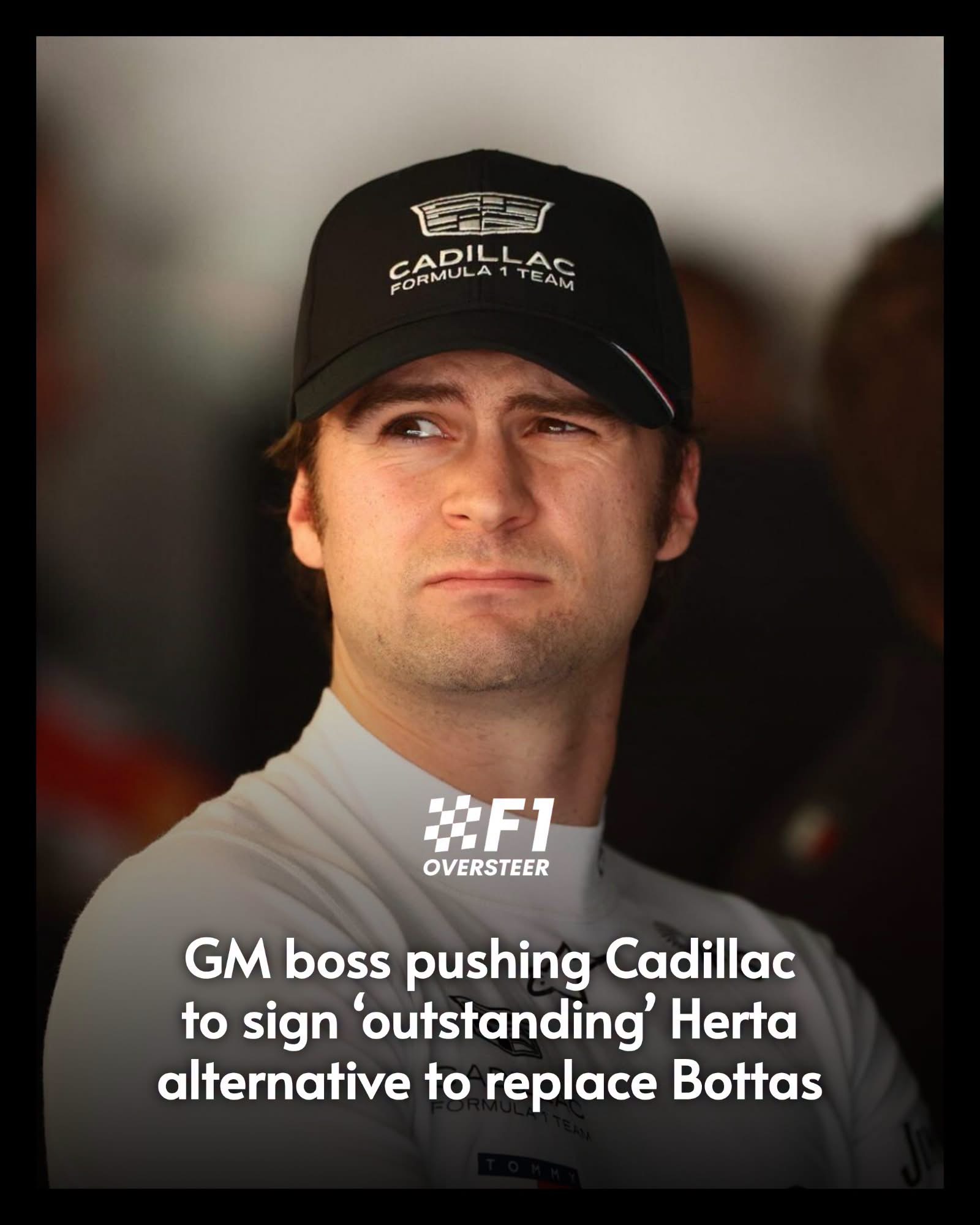
Valtteri Bottas could face an unexpected challenge to his Formula 1 future as Cadillac’s ownership reportedly pushes for an alternative driver ahead of the 2027 season.
The American manufacturer entered Formula 1 in 2026 with Bottas and Sergio Perez as its experienced driver pairing, hoping their knowledge would help establish the new team in the highly competitive championship.
However, Bottas’ position is becoming increasingly uncertain, with reports suggesting General Motors and TWG Global are not entirely convinced about retaining the Finnish driver beyond his debut campaign.
Colton Herta has emerged as one of the potential alternatives, although support for the American IndyCar star is reportedly divided among Cadillac’s ownership group.
The situation creates another major storyline surrounding the team’s driver development plans, particularly as Cadillac attempts to balance immediate competitiveness with its long-term ambitions.
GENERAL MOTORS PUSHES FOR ALTERNATIVE TO VALTTERI BOTTAS
Cadillac’s decision to enter Formula 1 represented one of the biggest developments in the sport’s recent history.
The team selected Bottas and Perez because their experience offered an important advantage for a new operation attempting to establish itself against established manufacturers.
However, Bottas’ performances have reportedly failed to convince every decision-maker that he should automatically retain his seat for 2027.
Although the Finnish driver has demonstrated his experience in qualifying, his race results have reportedly been less convincing when compared with Perez.
According to the report, Bottas has finished behind his teammate in 14 of the 18 races they have both completed.
That statistic could become particularly important when Cadillac evaluates whether its existing driver partnership is delivering the results expected from two experienced competitors.
COLTON HERTA EMERGES AS A SERIOUS CANDIDATE
Herta has become one of the most interesting names connected with Cadillac’s potential driver changes.
The American has built a strong reputation in IndyCar, demonstrating the speed and racing ability that attracted Formula 1 attention.
His potential arrival would also carry significant commercial advantages for Cadillac, which could benefit from having an American driver representing its American-backed operation.
However, securing an F1 opportunity has never been straightforward for Herta.
His previous difficulties obtaining enough FIA Super Licence points prevented him from making an immediate transition into Formula 1.
Cadillac has consequently been working towards helping him meet the requirements needed to become eligible for an F1 race seat.
The opportunity to compete in practice sessions has provided Herta with valuable experience while bringing him closer to fulfilling those requirements.
HERTA’S SUPER LICENCE PURSUIT COULD CHANGE CADILLAC’S PLANS
Herta’s participation in Formula 1 practice sessions has been an important part of his preparation.
He appeared during FP1 at the Mexico City Grand Prix and the São Paulo Grand Prix, with those outings helping him accumulate the experience and eligibility points required for a potential F1 move.
His participation also allowed Cadillac to assess his adaptability to Formula 1 machinery.
Nevertheless, a practice session is not the same as competing in a full Grand Prix.
The demands of a race weekend include tyre management, race strategy, traffic, physical endurance and the ability to deliver consistent results under pressure.
Cadillac would need to carefully evaluate whether Herta is ready to take on those responsibilities immediately.
BOTΤAS STILL HAS A STRONG CASE TO KEEP HIS SEAT
Despite the uncertainty, Bottas should not be dismissed as an automatic casualty.
The Finnish driver brings considerable experience from Mercedes, Williams and Sauber, having spent years competing against some of Formula 1’s strongest operations.
That experience can be particularly valuable to Cadillac, which is still developing its technical infrastructure and understanding how to extract maximum performance from its package.
Bottas also has an established working relationship with the team’s engineers and management.
Replacing him would mean introducing another driver into an environment that is still establishing its competitive identity.
Cadillac must therefore determine whether a potential change would genuinely improve its long-term prospects or simply create additional disruption.
SERGIO PEREZ’S CONTRACT MAKES THE SECOND SEAT MORE IMPORTANT
Perez appears to have a considerably stronger position within Cadillac’s future plans.
The Mexican driver has reportedly secured a contract extension through 2029, giving the team a stable foundation for its upcoming campaigns.
That leaves Bottas facing a more complicated situation as Cadillac considers the identity of its second driver.
If the team believes Herta represents a worthwhile long-term investment, the American could become an attractive option.
However, Cadillac must also consider whether pairing a relatively inexperienced Formula 1 driver with Perez would create the right balance.
Perez’s experience could provide Herta with valuable guidance, but the team would need to ensure that its development ambitions do not come at the expense of immediate competitiveness.
WHY CADILLAC’S OWNERSHIP IS DIVIDED OVER HERTA
The reported disagreement among Cadillac’s ownership group highlights the competing priorities involved in building a successful Formula 1 team.
General Motors has enormous ambitions for its entry into the championship, while TWG Global is also heavily invested in the project’s long-term development.
A driver selection decision therefore carries consequences beyond sporting performance.
Herta could offer commercial appeal, American representation and a potentially exciting long-term development opportunity.
However, those advantages must be weighed against the risks associated with giving an inexperienced Formula 1 driver a seat in a team still attempting to establish itself.
An alternative candidate could offer greater immediate experience or a more predictable route towards competitive results.
That explains why Bottas’ replacement decision could become one of Cadillac’s most important strategic choices.
CADILLAC’S 2027 DRIVER DECISION COULD DEFINE ITS FUTURE
The American team is entering a critical stage of its development.
Its first season has provided valuable information about the challenges of competing in Formula 1, but the next campaign will bring increased expectations.
Cadillac will need to demonstrate that it can improve its competitiveness while building a sustainable long-term structure.
The driver pairing will be central to that process.
Keeping Bottas would provide continuity and experience, while promoting Herta could offer a different development direction and potentially strengthen Cadillac’s American identity.
Neither option is without risk.
The final decision will ultimately depend on whether Cadillac believes its immediate needs are best served by experience or by investing in a promising driver whose Formula 1 potential remains largely untested.
For Bottas, the coming months could determine whether his Cadillac adventure becomes a long-term project or another temporary chapter in his Formula 1 career.
For Herta, the opportunity represents a potentially life-changing breakthrough.
And for Cadillac, the decision could shape its competitive identity for years to come.