Ferrari has never been a Formula 1 team unfamiliar with pressure, internal disagreements or fierce competition between its drivers. However, some rivalries leave scars that remain long after the drivers involved have left the cockpit.
As Ferrari struggles to manage the growing tension between Lewis Hamilton and Charles Leclerc in 2026, memories of the infamous 1982 conflict between Gilles Villeneuve and Didier Pironi have returned.
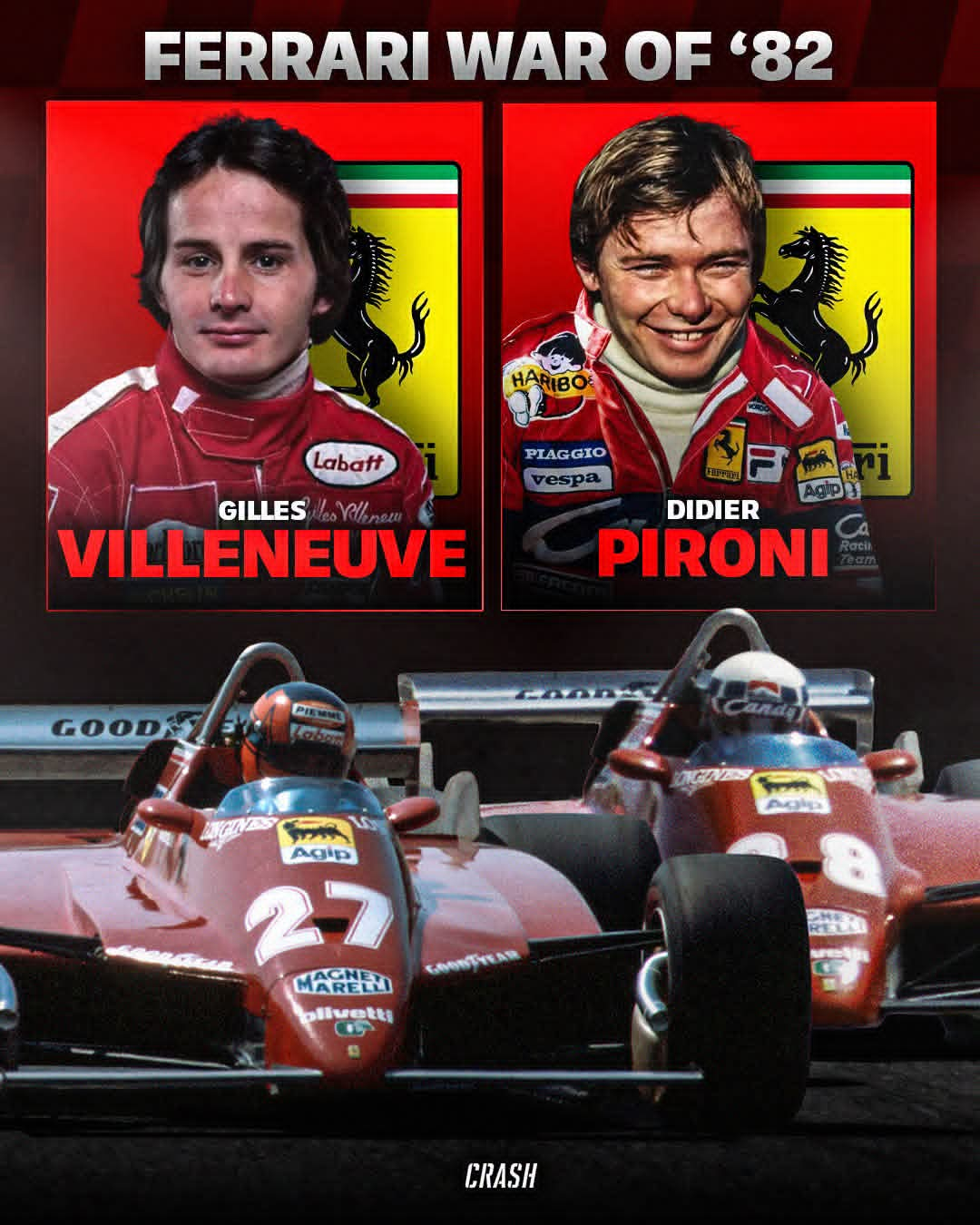
More than four decades ago, Ferrari experienced one of the most painful teammate disputes in Formula 1 history. What initially appeared to be a straightforward opportunity for a dominant one-two finish at the San Marino Grand Prix eventually developed into a personal conflict that changed the relationship between two of the sport’s biggest stars.
The controversy also exposed a difficult reality about Ferrari: having two exceptionally talented drivers does not automatically guarantee success.
Sometimes, the biggest threat to a team’s championship ambitions comes from inside its own garage.
THE 1982 SAN MARINO GRAND PRIX: WHERE EVERYTHING WENT WRONG
The 1982 San Marino Grand Prix at Imola became one of the defining moments in Ferrari’s complicated history.
Gilles Villeneuve and Didier Pironi were teammates at a time when Ferrari possessed a competitive advantage. With several major rivals absent because of the ongoing political conflict between Formula 1’s governing authorities and teams, Ferrari had a valuable opportunity to secure a memorable result.
As the race progressed, Villeneuve and Pironi found themselves fighting for victory.
Ferrari’s pit wall displayed the famous ‘SLOW’ signal, which was intended to encourage the drivers to reduce their pace and preserve the team’s advantage.
Villeneuve interpreted the situation as an instruction to maintain their positions. Having already moved ahead of Pironi, he expected his teammate to respect the apparent arrangement.
However, Pironi continued attacking.
The two Ferrari drivers exchanged the lead several times, turning what should have been a controlled team victory into an increasingly aggressive contest.
On the final lap, Pironi made another decisive move at the Tosa corner and took the lead.
He crossed the finish line first, winning the race ahead of Villeneuve.
Although Ferrari celebrated a one-two finish, the atmosphere between its drivers was anything but celebratory.
WHY GILLES VILLENEUVE FELT BETRAYED
For Villeneuve, the issue went beyond losing a Grand Prix.
He believed Pironi had ignored an understanding between teammates and disregarded the interests of the team by continuing to fight after Ferrari had communicated its desire for a controlled finish.
Pironi, however, disputed the interpretation that he had violated an explicit agreement to surrender victory.
That disagreement became the foundation of their bitter rivalry.
Villeneuve felt deeply betrayed by someone he had considered a trusted teammate. Their relationship deteriorated rapidly, and the Canadian made little attempt to hide his disappointment.
The incident demonstrated how dangerous unclear team instructions could become when two highly competitive drivers were fighting for the same prize.
Ferrari had secured the result it wanted on paper, but the damage inside the garage was already considerable.
THE TRAGEDY THAT MADE THE FEUD EVEN MORE PAINFUL
The Villeneuve-Pironi rivalry became even more tragic just two weeks after Imola.
During qualifying for the Belgian Grand Prix at Zolder, Villeneuve suffered a devastating accident that claimed his life at the age of 32.
His death shocked the Formula 1 community and left Ferrari without one of its most beloved drivers.
The circumstances surrounding his final weeks ensured that the disagreement at Imola remained an important part of his legacy.
Pironi continued racing, but his own Formula 1 career was eventually cut short by a serious accident during practice for the 1982 German Grand Prix.
He survived, although his injuries prevented him from returning to Formula 1 competition.
The 1982 season consequently became one of the most emotionally complicated periods in Ferrari’s history.
It was a reminder that sporting rivalries can have consequences extending far beyond the championship standings.
FERRARI’S 2026 PROBLEMS BRING BACK UNCOMFORTABLE MEMORIES
Fast-forward to 2026, and Ferrari once again finds itself dealing with an increasingly difficult relationship between its two drivers.
The arrival of seven-time world champion Lewis Hamilton was expected to strengthen Ferrari’s championship ambitions. Pairing him with Charles Leclerc created one of the most exciting driver combinations on the grid.
However, the partnership has also produced considerable tension.
Their disagreements have become increasingly visible following several contentious on-track encounters, including incidents at Monza and Mexico.
The situation escalated further at the Las Vegas Grand Prix, where the two drivers collided while fighting for position.
Leclerc received a 10-second penalty following the incident, while Hamilton recovered to finish seventh.
Ferrari team principal Fred Vasseur expressed considerable frustration, describing the incident as unacceptable and questioning the level of respect being shown towards the team.
The most concerning aspect is that the incident happened despite previous discussions intended to prevent another confrontation.
Ferrari had already attempted to address the situation following the Mexican Grand Prix, with Hamilton, Leclerc and Vasseur meeting in São Paulo.
Yet the Las Vegas incident demonstrated that conversations alone might not be enough.
HAMILTON AND LECLERC FACE A DIFFERENT KIND OF FERRARI PRESSURE
Although comparisons with Villeneuve and Pironi are understandable, there are important differences between the two situations.
Villeneuve’s disagreement with Pironi centred on an apparent understanding about maintaining positions during a race.
Hamilton and Leclerc’s disagreements have developed through repeated wheel-to-wheel battles, competing expectations and questions about how much freedom each driver should have when fighting for position.
Hamilton brings enormous experience from his championship-winning years with McLaren and Mercedes.
He understands what it takes to operate within a championship-winning organisation and has previously experienced clearly defined rules governing teammate competition.
Leclerc, meanwhile, has spent much of his Ferrari career carrying the expectations of the team and its passionate supporters.
He knows the organisation, understands its internal culture and has ambitions of becoming a world champion with the Scuderia.
Neither driver wants to become the subordinate partner.
That is precisely why Ferrari must establish clear expectations before another disagreement damages its competitive ambitions.
FERRARI’S BIGGEST ENEMY COULD BE ITS OWN GARAGE
The biggest problem for Ferrari is not necessarily a lack of speed.
When both drivers are competitive, the team has the potential to collect valuable championship points and challenge its rivals.
However, unnecessary teammate battles can undermine those advantages.
Every collision, penalty or lost position creates opportunities for competing teams to benefit.
McLaren, Mercedes and Red Bull do not need Ferrari to surrender points through internal disagreements, but they will gladly take advantage when it happens.
There is also a wider organisational issue.
Ferrari employs thousands of people whose work contributes to the performance of its Formula 1 cars. Engineers, mechanics, strategists and factory personnel invest enormous effort into producing competitive machinery.
When two drivers compromise that work through avoidable confrontations, frustration naturally spreads beyond the cockpit.
This is why Vasseur’s repeated emphasis on respect for the team is particularly important.
Ferrari needs its drivers to understand that individual success and collective success must work together.
WHAT FERRARI MUST LEARN FROM THE 1982 DISASTER
The lesson from 1982 is not that Ferrari should prevent its drivers from competing.
Formula 1 is a competitive sport, and elite drivers are naturally expected to fight for victories.
However, competition requires boundaries.
Ferrari must communicate its expectations clearly, establish consistent procedures and ensure that both drivers understand the consequences of compromising the team’s interests.
It must also avoid creating a situation where one driver believes the other receives preferential treatment.
Consistency will be particularly important because Hamilton and Leclerc have different personalities, experiences and expectations.
Treating both drivers fairly does not necessarily mean treating every situation identically. It means applying the same fundamental principles of professionalism and accountability.
COULD HISTORY REPEAT ITSELF AT MARANELLO?
Ferrari’s current situation is not identical to the 1982 disaster, and there is no reason to assume that Hamilton and Leclerc will experience the same fate as Villeneuve and Pironi.
Nevertheless, the historical comparison provides an important warning.
A successful Formula 1 team requires more than a fast car and talented drivers. It needs trust, communication, discipline and leadership capable of managing competing personalities.
The Las Vegas Grand Prix demonstrated that Ferrari’s previous attempts to settle the Hamilton-Leclerc disagreements have not completely resolved the problem.
With the season approaching its conclusion, the team’s ability to manage its driver relationship could become just as important as its technical performance.
Ferrari cannot afford to allow another season of championship opportunities to be undermined by internal conflict.
The 1982 story remains a painful reminder of what happens when trust disappears between teammates.
More than 40 years later, Ferrari once again faces a familiar question: can two fiercely competitive drivers work together without allowing their personal ambitions to damage the team?
For the Scuderia, finding the right answer could determine whether its current partnership becomes a championship-winning combination or another chapter in its complicated history of internal rivalries.EDITORIAL NOTE: The 1982 Imola controversy is often described as Pironi deliberately disobeying team orders. However, the precise understanding between the drivers and the meaning of Ferrari’s ‘SLOW’ signal remain disputed historical details. The article preserves that distinction.
Historical reference:
2026 Ferrari developments: