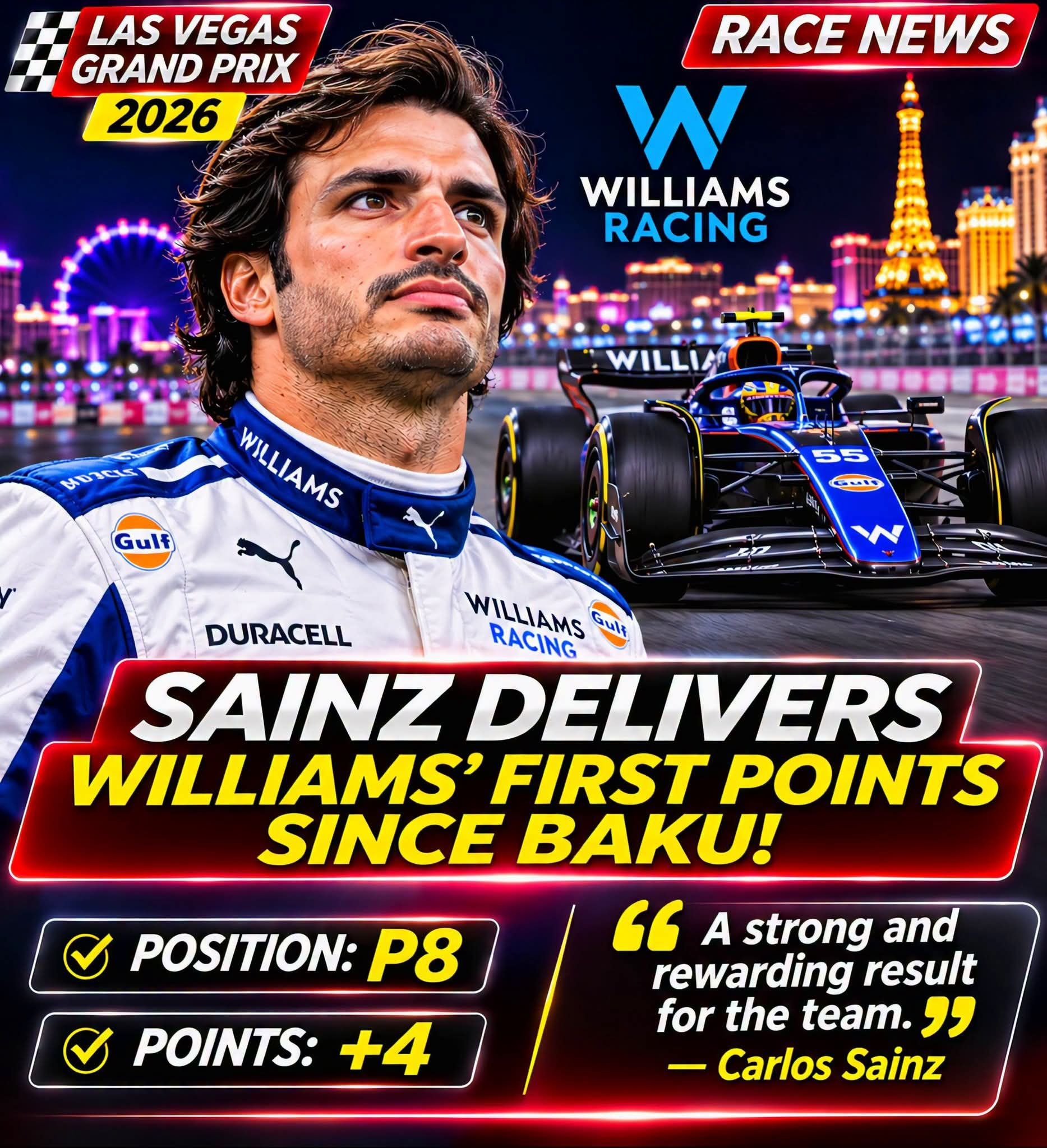
Carlos Sainz crossed the line in eighth place at the Las Vegas Grand Prix, collecting four hard-earned points for Williams Racing and snapping a points drought that had stretched back to the Azerbaijan Grand Prix. In a season where every position counts, the result offered more than just a scoreboard boost. It provided tangible proof that Williams can still extract results when the car, strategy, and driver alignment click.
WHY THESE FOUR POINTS MATTER MORE THAN THEY LOOK
Formula 1 rarely hands out moral victories. Points are currency, and Williams had been running low since Baku. Finishing P8 in Las Vegas may not generate podium champagne, but it changes the internal narrative inside the garage. For a team that has spent recent seasons fighting for relevance in the midfield, converting a solid qualifying or race-day execution into actual championship points rebuilds confidence and justifies the long nights of development work.
Sainz’s result also carries weight in the constructors’ standings. Even a handful of points can separate teams when the battle for seventh, eighth, or ninth becomes a season-long war of attrition. Williams has made progress with its current package, yet consistency has remained elusive. Ending the drought in a high-profile night race under the Vegas lights gives the team something concrete to build on as the 2026 campaign heads into its final stretch.
SAINZ ADAPTING TO LIFE IN THE MIDFIELD FIGHT
Carlos Sainz arrived at Williams with a reputation for extracting the maximum from imperfect machinery. Las Vegas offered another data point in that ongoing process. The Strip circuit rewards precise energy management, clean air, and the ability to look after tyres while still attacking. Sainz delivered a measured drive that kept him in the points conversation from the opening stint through the closing laps.
His performance also highlights the dual challenge facing the team. On one hand, the car has shown flashes of competitiveness. On the other, turning those flashes into regular points requires everything to align—strategy calls, pit-stop execution, and race-day reliability. Sainz’s eighth place suggests the combination is capable of delivering when the variables fall into place.
THE BIGGER PICTURE FOR WILLIAMS IN 2026
Williams has been open about its longer-term ambitions. The team is no longer content to simply make up the numbers. Incremental gains in aero efficiency, mechanical grip, and operational consistency are the stated path forward. A points finish in Las Vegas does not rewrite the season, but it validates the direction of travel.
For the drivers, results like this ease the pressure that builds during a points drought. For the engineers and strategists, it provides real-world confirmation that recent upgrades or setup directions are working. And for the commercial side of the operation, visible progress helps maintain sponsor confidence and fan engagement at a time when the midfield battle remains fiercely competitive.
WHAT COMES NEXT AFTER LAS VEGAS
The calendar does not pause for reflection. Williams will take the data from the Las Vegas weekend and feed it straight into preparations for the remaining races. The car’s performance characteristics on the unique Vegas surface—smooth asphalt, long straights, and heavy braking zones—offer useful clues for tracks that share similar traits.
Sainz will continue refining his understanding of the Williams package. The team will keep hunting for the small operational edges that turn occasional points into more regular ones. And the rest of the midfield will take note: Williams is still capable of punching through when the opportunity appears.
Four points will not define a season. But in a year where Williams has had to fight for every result, they represent something more valuable than their face value. They prove the team can still score when it matters, and that Sainz remains a driver capable of delivering under pressure. For a squad building toward bigger ambitions, that is a message worth carrying into the final races of 2026.