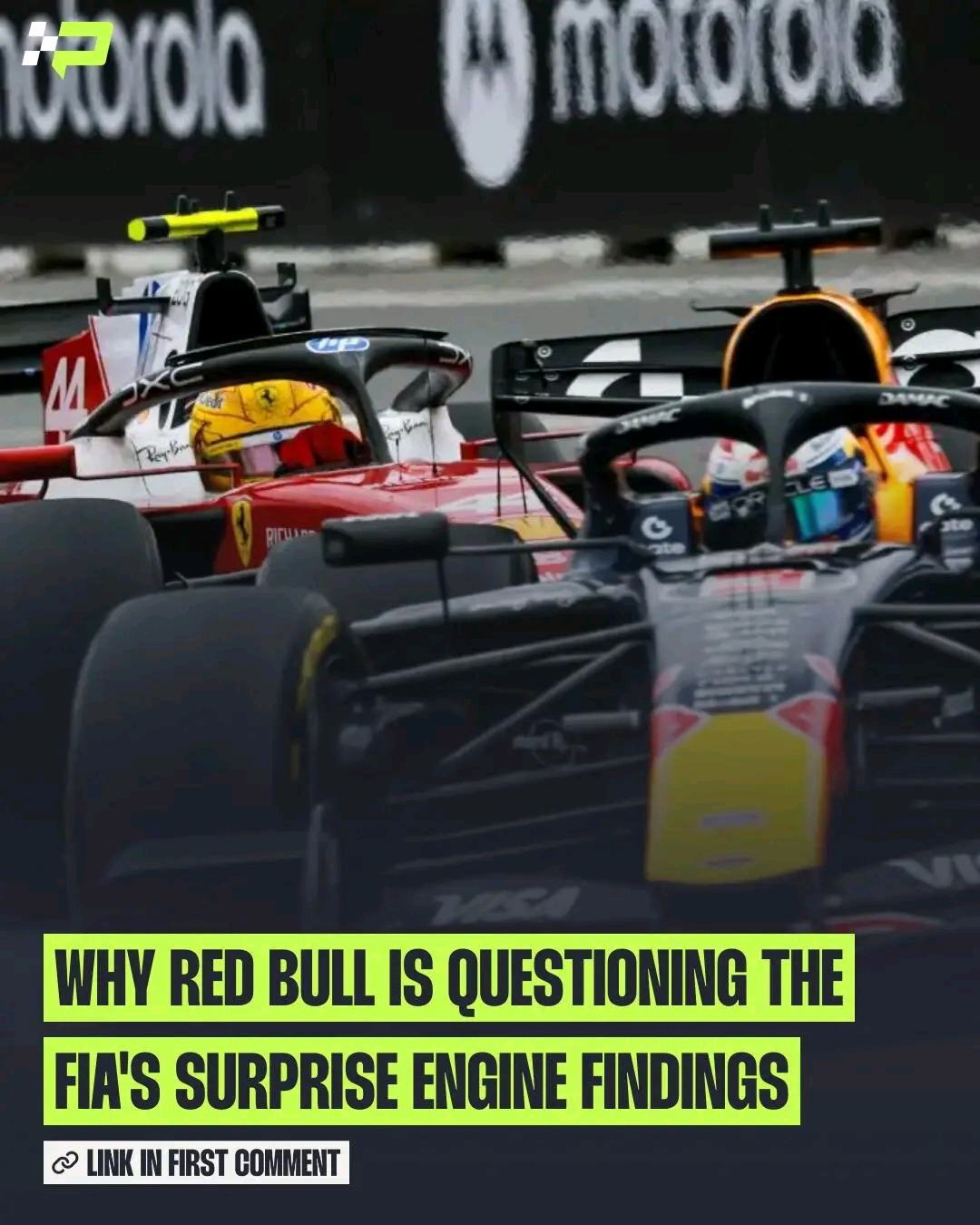
A fresh technical debate has emerged in Formula 1 after reports suggested that Red Bull Racing believed Mercedes-AMG Petronas Formula One Team held the fastest overall package, only for FIA findings to indicate a very different competitive picture.
This contrast between team perception and regulatory analysis has reignited discussions about how performance is measured in modern F1, and why what teams “feel” on track does not always match what the data shows.
In a sport where margins are measured in thousandths of a second, even a slight misread of the competitive order can shape development direction, race strategy, and even championship momentum.
WHAT THE FIA FINDINGS REVEAL ABOUT PERFORMANCE PERCEPTION
According to the report circulating in the Formula 1 paddock, Red Bull Racing had internally assessed that Mercedes-AMG Petronas Formula One Team possessed the strongest all-round package at certain stages.
However, the Fédération Internationale de l’Automobile (FIA) analysis reportedly painted a different picture, suggesting that the performance hierarchy was not as straightforward as assumed.
Rather than a clear “Mercedes advantage,” the findings reportedly indicated a far more complex spread of competitiveness across multiple teams, with performance varying significantly depending on circuit characteristics, tyre behavior, and aerodynamic efficiency windows.
This is a key point in modern Formula 1: there is rarely a single “fastest car” across all conditions.
WHY RED BULL’S ASSESSMENT MATTERS
Red Bull Racing has been the dominant force in recent seasons of the Formula 1 World Championship, largely due to its ability to consistently optimize race pace, tyre management, and aerodynamic efficiency across a wide range of circuits.
If a team as dominant as Red Bull is misjudging who holds the performance edge, it highlights just how difficult it has become to accurately benchmark competitors under today’s regulations.
It also raises an important strategic issue:
If Red Bull overestimates Mercedes’ pace, it may over-develop in the wrong areas
If Mercedes is underestimated or overestimated, it affects how aggressively they approach upgrades
Rival teams like Ferrari and McLaren Racing can exploit any uncertainty in development direction
In modern F1, development wars are often decided not just by speed, but by perception.
MERCEDES’ TRUE POSITION IN THE PECKING ORDER
For Mercedes-AMG Petronas Formula One Team, the narrative is particularly important. Since the end of their long hybrid-era dominance, the team has been working to return to consistent championship-winning form.
If FIA findings suggest that Mercedes is not consistently the benchmark across all conditions, it reinforces a reality the team has openly acknowledged in recent seasons: inconsistency remains a major challenge.
While Mercedes has shown flashes of strong qualifying and race pace, especially in cooler conditions or specific aerodynamic setups, they have struggled to match Red Bull’s operational consistency over a full race weekend.
This reinforces the idea that Mercedes’ performance is highly track-dependent, rather than universally dominant.
WHY FIA DATA AND TEAM PERCEPTION OFTEN DIFFER
One of the most interesting aspects of modern Formula 1 is the gap between what teams believe and what regulatory or analytical bodies observe.
Teams like Red Bull Racing and Mercedes-AMG Petronas Formula One Team rely heavily on:
GPS data comparison
Tyre degradation models
Wind tunnel and simulator projections
Sector-by-sector race analysis
However, the FIA uses a broader dataset across the entire grid, often smoothing out anomalies caused by strategy, traffic, or unique race circumstances.
This can lead to very different conclusions.
For example: A team might appear slower on race day due to poor strategy, even if their raw car pace is stronger. Conversely, a well-executed strategy can make a slightly slower car look competitive.
IMPACT ON THE FORMULA 1 CHAMPIONSHIP BATTLE
While this story may not directly change race results, it has significant implications for how the championship fight evolves.
If Red Bull Racing recalibrates its understanding of rivals, it may:
Adjust upgrade priorities more aggressively
Focus on specific weaknesses rather than broad performance gains
Prepare differently for circuits where Mercedes is expected to peak
For Mercedes-AMG Petronas Formula One Team, the findings may be used internally as motivation, especially if they believe their true potential is higher than external assessments suggest.
Meanwhile, teams like Ferrari and McLaren Racing are likely watching closely, because any misjudgment between the top two forces creates opportunities in the midfield battle and occasional podium contention.
DRIVER IMPACT: VERSTAPPEN AND HAMILTON IN FOCUS
On the driver side, this kind of performance uncertainty filters directly into race preparation and expectations.
For Max Verstappen of Red Bull Racing, understanding whether Mercedes is genuinely the main threat affects how aggressively he can manage races versus pushing flat-out from the start.
For Lewis Hamilton at Mercedes-AMG Petronas Formula One Team, perception battles matter just as much as on-track performance. If the team is being underestimated, it can fuel motivation internally and externally as they push for further upgrades and consistency improvements.
In Formula 1, drivers often operate with incomplete information, but these technical insights shape their confidence going into each weekend.
WHAT THIS MEANS GOING FORWARD
The key takeaway from this situation is not just about who is faster, but about how difficult it is to define “fastest” in modern Formula 1.
With current regulations emphasizing aerodynamics, tyre management, and operational precision, the competitive order is fluid and highly track-specific.
Going forward, expect:
More variation in race winners across different circuits
Increased importance of upgrade timing
Greater reliance on data interpretation over raw pace assumptions
Continued unpredictability in the Red Bull Racing vs Mercedes-AMG Petronas Formula One Team rivalry
FINAL THOUGHTS
This FIA-backed contrast in performance perception highlights a deeper truth in Formula 1: dominance is rarely as clear as it appears from the outside.
Even teams at the top of the grid can misread the competitive landscape, and in a sport where fractions of a second define success, those misreads can shape entire seasons.
As the Formula 1 World Championship continues, the real battle may not just be on the track, but in how accurately each team understands its own position in the pecking order.