More than two months after the Italian Grand Prix, a controversial decision involving Yuki Tsunoda is threatening to reopen one of the most unusual sporting disputes of the 2026 Formula 1 season.
Audi has refused to accept the stewards’ decision that allowed the Racing Bulls driver to keep his 10th-place finish at Monza, and the team’s appeal is now heading to the FIA International Court of Appeal.
The case will be heard in Paris on November 25, with the potential to change the final points classification from a race that took place on September 6.
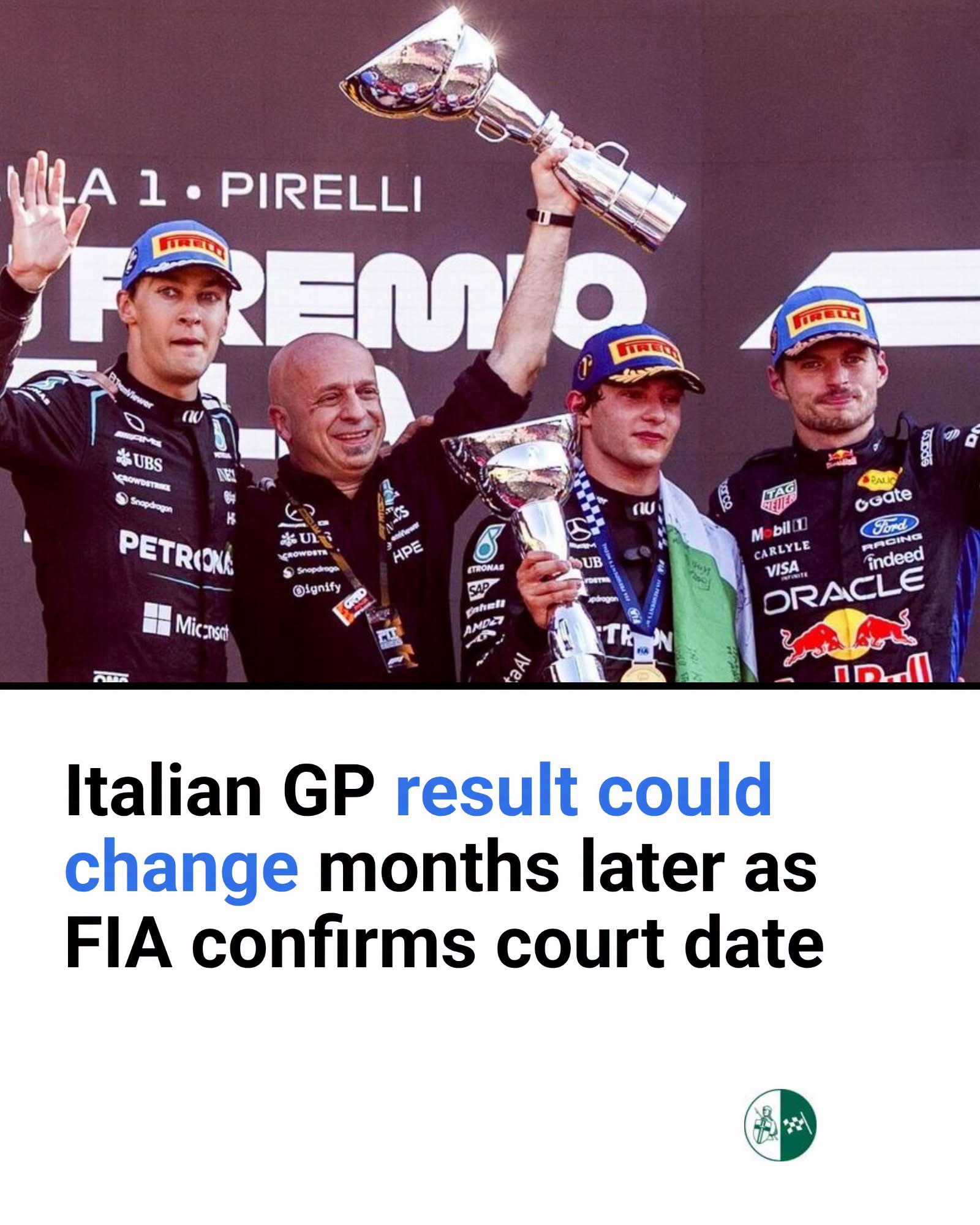
Although Kimi Antonelli’s historic victory and the podium positions of George Russell and Max Verstappen are not under threat, the dispute could have serious consequences for Tsunoda and Audi’s Gabriel Bortoleto.
FIA CONFIRMS DATE FOR AUDI’S MONZA APPEAL
The FIA has confirmed that the International Court of Appeal will hear Audi’s challenge on Wednesday, November 25.
The hearing will take place between the Las Vegas and Qatar Grands Prix, meaning the controversy will return to the spotlight during the closing stages of the championship.
Audi is challenging the original stewards’ decision not to penalise Tsunoda following an incident on the starting grid.
The German manufacturer believes the regulations were not correctly applied and wants the decision reconsidered.
This is no longer simply a disagreement between two teams. It is now a formal legal challenge that could influence how similar situations are handled in future Formula 1 races.
WHAT REALLY HAPPENED TO YUKI TSUNODA AT MONZA?
The controversy began before the Italian Grand Prix had officially started.
Tsunoda was scheduled to begin the race from 14th position, but he initially approached the wrong side of the grid while attempting to reach his starting position.
Realising his mistake at the last moment, the Japanese driver corrected his direction and moved towards the correct grid slot.
However, his car ended up positioned at an unusual angle.
Race director Rui Marques noticed the situation and decided to order another formation lap as a precaution.
Tsunoda subsequently lined up correctly for the restart and completed the race in 10th position, collecting one championship point.
The problem was that the additional formation lap triggered a specific requirement within the sporting regulations, which Audi believes should have resulted in a penalty.
THE REGULATION AT THE CENTRE OF THE CONTROVERSY
Audi’s argument centres on Article B5.9.5 of the 2026 Formula 1 Sporting Regulations.
The provision states that a driver who causes an additional formation lap and is able to start that extra lap must enter the pit lane at the end of the lap and begin the race from the end of the pit lane.
Failure to comply can result in a stop-and-go penalty.
Audi believes Tsunoda should have been required to follow that procedure.
However, the original stewards decided against imposing a penalty after considering Racing Bulls’ explanation.
The team argued that Tsunoda was not responsible for the additional formation lap because the decision to order it was ultimately made by the race director.
That distinction became the central issue in the original investigation.
WHY THE STEWARDS REFUSED TO PUNISH TSUNODA
The stewards’ explanation revealed an important complication within the wording of the regulations.
They considered whether Tsunoda could reasonably have known that he had caused an additional formation lap.
According to their reasoning, neither the driver nor Racing Bulls had received a message informing them that Tsunoda was considered responsible for the extra lap.
The stewards also suggested that the FIA should consider introducing a clearer communication procedure to prevent similar situations from happening again.
Their position was that imposing a penalty without properly establishing that the driver knew he had caused the additional formation lap would raise questions about fairness and the practical application of the rule.
Audi, however, believes the regulation should have been enforced regardless.
The appeal will now determine whether the original decision was correct.
GABRIEL BORTOLETO COULD BE THE BIGGEST BENEFICIARY
One championship point could become the biggest prize in this legal battle.
Tsunoda finished 10th at Monza, while Audi driver Gabriel Bortoleto crossed the line in 11th position.
That meant Racing Bulls secured the final available championship point, leaving Audi just outside the points-paying positions.
If the appeal succeeds and the appropriate penalty is applied, Tsunoda could lose his position in the final classification.
Bortoleto would then have an opportunity to move into 10th place and claim the point.
For Audi, that would represent a valuable reward for challenging a decision it believes was incorrectly handled.
However, the team cannot assume victory. The FIA’s appeals court must examine the regulations, the stewards’ reasoning and the circumstances surrounding the aborted start before reaching its verdict.
FIA COURT HAS ALREADY CHANGED A MAJOR 2026 RESULT
The Monza appeal is particularly interesting because the International Court of Appeal has already played a significant role in another controversial result this season.
At the Monaco Grand Prix, Pierre Gasly’s Alpine team successfully secured a Right of Review, resulting in penalties originally imposed on the Frenchman being rescinded.
However, the International Court of Appeal subsequently overturned that decision and reinstated the penalties.
That case demonstrated that an initial sporting decision is not necessarily the final word when a matter reaches the FIA’s highest appeals body.
Audi will hope the court takes a similarly detailed approach to the circumstances surrounding Tsunoda’s Monza incident.
The outcome could also provide useful guidance for teams and race officials when dealing with additional formation laps in future competitions.
WHY THIS CASE MATTERS BEYOND ONE CHAMPIONSHIP POINT
At first glance, the dispute might appear relatively minor because it concerns the final points-paying position rather than the race victory.
However, the wider implications are more significant.
Formula 1 depends on teams having confidence that sporting regulations are applied consistently.
If drivers can be penalised for causing additional formation laps, teams need clear instructions about when that responsibility has been established and what action they must take.
The Monza controversy exposed a potential communication problem between race control, teams and drivers.
A successful Audi appeal could reinforce the importance of applying the existing regulations, while a rejection could strengthen the argument that clearer procedures are needed.
Either outcome could influence how similar incidents are handled in the future.
NOVEMBER 25 COULD FINALLY END THE MONZA CONTROVERSY
The attention now turns to Paris, where Audi will attempt to convince the International Court of Appeal that the original stewards’ decision should be overturned.
For Racing Bulls, the priority will be defending Tsunoda’s result and maintaining the position secured on the circuit.
For Audi, the objective is straightforward: prove that the regulations were not properly applied and potentially secure an additional championship point for Bortoleto.
The outcome will not change Kimi Antonelli’s historic Monza victory, but it could rewrite the story surrounding the final points-paying position.
More than two months after the chequered flag, a single point remains at the centre of a major Formula 1 legal battle.