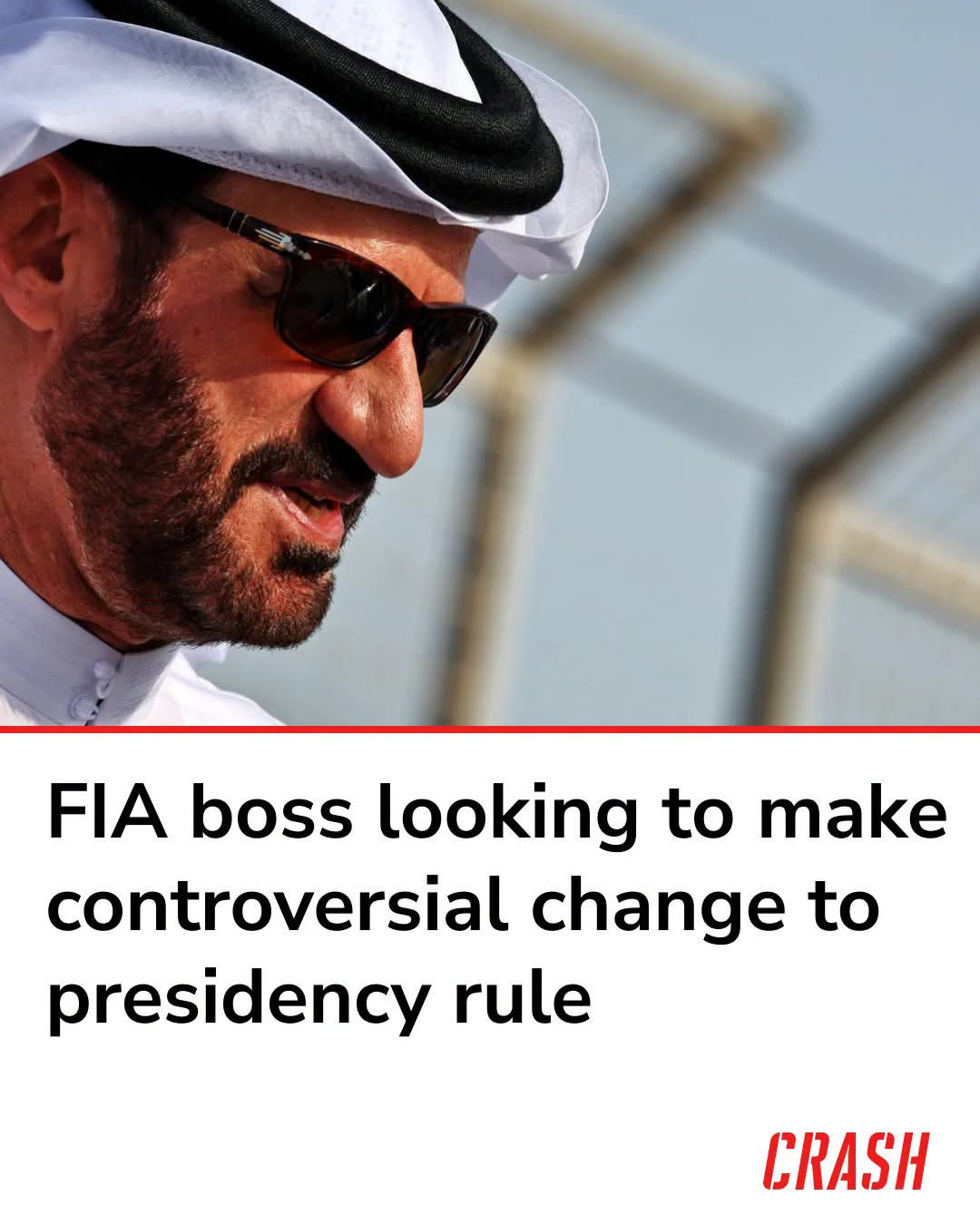
FIA President Mohammed Ben Sulayem is once again rewriting the rules that govern the very organisation he leads. The Emirati official is advancing a proposal to abolish the age limit that currently bars anyone over 75 from standing as part of a presidential ticket. The move, set for a vote at next month’s FIA General Assembly in Shanghai, arrives just six months after term limits were eliminated. Critics see a clear pattern: the steady dismantling of every structural check that might prevent Ben Sulayem from remaining in power indefinitely.
WHAT THE PROPOSAL ACTUALLY SAYS
Under current FIA statutes, no one aged 75 or older can form part of a presidential list. The proposal argues that age caps “could restrict the number of qualified candidates eligible for election… in particular individuals whose experience and expertise could be of benefit to the FIA.” An FIA spokesperson has framed the change as aligning the federation with other organisations, noting that the BBC’s chairman is 74 and that chronological age alone should not disqualify proven talent.
The same body that once introduced an age limit of 70 in 2023 (later raised to 75) now insists such restrictions are outdated. Ben Sulayem, who turns 65 this year and was re-elected unopposed for a second four-year term in December 2025, would theoretically face no hard stop if the measure passes.
A PATTERN OF CONSOLIDATING POWER
This is not an isolated adjustment. In June 2026, FIA member clubs voted to scrap the three-term (12-) limit that previous president Jean Todt had introduced. That change alone opened the door for Ben Sulayem to seek further terms beyond 2029. Earlier reforms tightened eligibility rules for challengers, concentrated more appointment power in the president’s office, and reduced the independent authority of the ethics and audit committees. Senior officials who raised governance concerns have departed. The cumulative effect is a governing structure increasingly shaped around one man’s continued leadership.
Supporters argue that experience matters and that democratic elections by member clubs remain the ultimate safeguard. Detractors counter that when the barriers to entry keep rising and the natural endpoints keep disappearing, the democracy starts to look more like managed continuity.
WHY THIS MATTERS BEYOND THE PRESIDENT’S OFFICE
The FIA is not a private club. It sets the technical and sporting regulations for Formula 1, Formula 2, Formula 3, the World Endurance Championship, the World Rally Championship, and dozens of other series. It oversees safety standards, homologates circuits, and acts as the final arbiter in disputes that can decide championships and careers. When the institution’s internal governance tilts toward long-term personal control, the ripple effects reach every team principal, driver, and manufacturer that must live under its rules.
Teams already navigate complex power-unit regulations, cost caps, and sporting codes that shift with political winds. Drivers have clashed with the federation over language rules, jewellery, and other behavioural codes. National motorsport authorities that once viewed the FIA as a neutral referee now watch its leadership structure become less transparent and more centralised. Confidence in the independence of the rule-maker is an invisible asset. Erode it, and every controversial decision—whether on a penalty, a technical directive, or a calendar change—carries heavier political baggage.
THE CASE FOR AND AGAINST THE CHANGE
There is a legitimate debate about arbitrary age cut-offs. Plenty of leaders in business, politics, and sport remain effective well past 75. Experience in global motorsport administration is rare, and discarding it solely because of a birthday can look wasteful. The FIA’s stated rationale—that talent and expertise should not be sidelined by a number—has surface appeal.
Yet the timing and context undercut the purity of that argument. The same president who once championed age limits as a governance improvement now seeks to abolish them after eliminating term limits. When institutional guardrails are removed one by one by the person those guardrails were meant to constrain, observers are entitled to question the motive. Good governance is not only about electing the right people; it is also about designing systems that remain healthy when the current leadership eventually leaves.
WHAT HAPPENS NEXT AND WHAT IT COULD MEAN
The proposal will be put to the FIA General Assembly in December. Previous major statute changes under Ben Sulayem have passed with comfortable majorities, suggesting the numbers may again favour the presidency. If approved, the practical effect is straightforward: Ben Sulayem, currently in his mid-60s, would face no statutory age barrier to seeking further terms as long as he retains the support of member clubs.
For Formula 1 and the wider motorsport ecosystem, the longer-term risk is institutional. A governing body perceived as the personal domain of one long-serving president can struggle to attract independent talent, retain critical internal voices, or command full trust when it adjudicates high-stakes disputes. Manufacturers investing billions in power units and chassis programmes, teams operating under tight cost controls, and drivers whose livelihoods depend on consistent rule application all benefit from a federation that is stable, transparent, and demonstrably independent.
Ben Sulayem has repeatedly emphasised fairness as the FIA’s core mission. The coming vote will test whether that principle extends to the rules that govern the governors themselves. In an era when Formula 1’s commercial success has never been higher, the sport’s regulatory guardian faces a quieter but equally important test: whether it can modernise without becoming the vehicle for permanent personal power. The Shanghai General Assembly will deliver the next chapter.