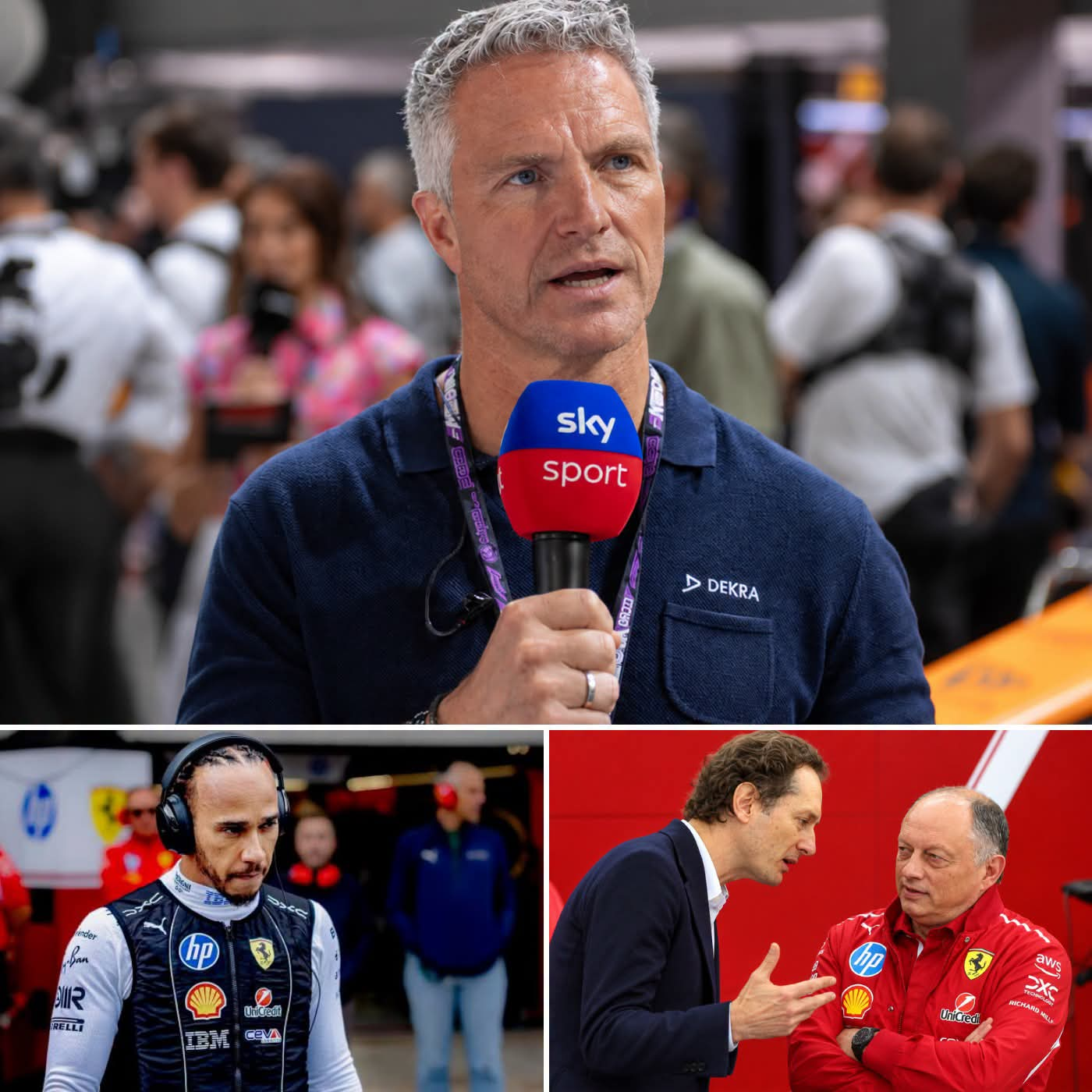
Lewis Hamilton’s difficult Ferrari journey has come under fresh scrutiny after former Formula 1 driver Ralf Schumacher questioned whether the seven-time world champion deserves his current position within the team. With Charles Leclerc continuing to demonstrate impressive speed, Schumacher’s assessment has reignited the debate over Ferrari’s driver hierarchy, internal leadership and long-term championship ambitions.
Hamilton’s arrival at Maranello was supposed to represent a defining moment for Ferrari. The partnership between the most successful driver in Formula 1 history and its most iconic team generated enormous excitement, with expectations that the British champion could finally help restore the Scuderia to championship glory.
However, the reality has proved considerably more complicated. Performance differences, adaptation challenges and growing tension between Ferrari’s drivers have placed Hamilton under increasing pressure, while Schumacher’s latest criticism has added another uncomfortable dimension to the situation.
RALF SCHUMACHER QUESTIONS HAMILTON’S POSITION AT FERRARI
Ralf Schumacher has never been reluctant to offer strong opinions about Formula 1, and his assessment of Hamilton’s Ferrari situation has been particularly direct.
The former Williams and Toyota driver reportedly questioned whether Hamilton’s position within the team was justified, arguing that the British champion had not demonstrated sufficient speed to consistently challenge Charles Leclerc.
His criticism centres on one of Formula 1’s most important performance indicators: the comparison between teammates.
When two drivers compete in identical machinery, their performances provide an important reference point for evaluating their abilities. Qualifying speed, race pace, tyre management and consistency all contribute to determining which driver is extracting more from the car.
Leclerc has repeatedly established himself as an exceptionally quick qualifier, making him a difficult benchmark for anyone joining Ferrari.
For Hamilton, the challenge is particularly demanding because he arrived with enormous expectations. His reputation guarantees attention, but Formula 1 ultimately judges drivers by what they deliver on the track.
Schumacher’s criticism therefore reflects a wider debate about whether Hamilton has sufficiently justified Ferrari’s decision to bring him into the team.
CHARLES LECLERC HAS BECOME A MAJOR PROBLEM FOR HAMILTON
One of Hamilton’s biggest challenges at Ferrari is the presence of Charles Leclerc.
The Monegasque has spent years developing his relationship with the team, understanding its technical environment and establishing himself as one of its leading drivers.
His qualifying performances have frequently demonstrated exceptional speed, while his familiarity with Ferrari’s machinery gives him an important advantage during difficult weekends.
Hamilton, meanwhile, has had to adapt to a completely different environment after spending the majority of his career with Mercedes.
That transition involves more than simply learning a new steering wheel or adjusting to a different engine. Drivers must understand how a car responds under braking, how its aerodynamic balance changes throughout a corner and how its tyres behave across different conditions.
Even a champion with Hamilton’s experience can require considerable time to establish the confidence necessary to extract maximum performance.
The problem is that Leclerc is not waiting for his teammate to complete that process. He continues competing at a high level, making every performance difference immediately visible.
If Hamilton cannot consistently close the gap, questions about Ferrari’s driver hierarchy are likely to become increasingly difficult to avoid.
FERRARI’S DRIVER RIVALRY COULD CREATE A MANAGEMENT HEADACHE
The relationship between Hamilton and Leclerc has become one of Ferrari’s most important storylines.
Both drivers possess the talent and ambition to compete for victories, but that creates an uncomfortable challenge for team management.
Ferrari must ensure that its drivers compete fairly without allowing their rivalry to damage the team’s results.
When teammates begin questioning each other’s performances or fighting aggressively on track, the consequences can extend beyond individual race outcomes.
Engineers may receive conflicting feedback, strategic decisions can become more complicated, and internal discussions may become increasingly focused on managing personalities rather than improving the car.
This is particularly concerning for Ferrari because the organisation has spent years attempting to rebuild its championship-winning foundations.
The Scuderia cannot afford another period in which internal disagreements overshadow its technical progress.
Hamilton and Leclerc must therefore find a way to maintain their competitive intensity while ensuring that Ferrari remains the priority.
SCHUMACHER’S CRITICISM RAISES QUESTIONS ABOUT FERRARI’S FUTURE
The debate surrounding Hamilton has also revived questions about whether Ferrari needs a broader organisational change.
Schumacher reportedly went beyond questioning Hamilton’s performance, suggesting that Ferrari should consider a significant personnel or structural adjustment to improve its championship prospects.
Such proposals are particularly sensitive because Ferrari’s difficulties cannot automatically be attributed to one driver or individual within its management structure.
Formula 1 performance depends on a complicated combination of aerodynamic development, mechanical engineering, strategy, driver feedback and organisational efficiency.
A team can have exceptionally talented drivers and still struggle if its technical direction is not producing the expected results.
That is why any potential restructuring would need to address the underlying causes of Ferrari’s competitiveness rather than simply responding to public criticism.
The most important question is whether Ferrari’s current approach can deliver the improvements required to challenge consistently for championships.
HAMILTON’S EXPERIENCE REMAINS A VALUABLE ASSET
Despite the criticism, Hamilton’s experience should not be underestimated.
The British champion has spent nearly two decades competing at the highest level of motorsport, winning seven world championships and establishing himself among Formula 1’s most successful drivers.
His knowledge of race strategy, tyre management and championship pressure remains valuable, particularly for a team attempting to return to sustained success.
Hamilton also brings a different perspective to Ferrari’s development process.
Having worked extensively with Mercedes during its dominant championship years, he understands how successful organisations approach performance improvement, communication and race execution.
That experience could prove particularly useful as Ferrari continues refining its technical direction.
However, experience alone cannot guarantee results. Hamilton must translate his knowledge into competitive performances while demonstrating that he can consistently challenge Leclerc.
The balance between reputation and present-day performance will remain central to his Ferrari future.
WHY FERRARI CANNOT AFFORD ANOTHER DISAPPOINTING SEASON
Ferrari’s championship ambitions make the current situation especially significant.
The team operates under enormous expectations, and its supporters demand more than occasional victories or isolated moments of brilliance.
They want sustained competitiveness, consistent development and a realistic opportunity to fight for the Drivers’ and Constructors’ Championships.
If Ferrari continues struggling, pressure on its leadership will inevitably increase.
That pressure could influence decisions regarding technical personnel, development priorities and the future composition of its driver lineup.
Hamilton’s position is therefore connected to a much larger organisational challenge.
Ferrari needs to determine whether its current drivers can deliver the results required for championship success and whether its existing structure provides the best environment for achieving that objective.
A successful response would strengthen the entire organisation. A disappointing response could trigger another period of uncertainty.
HAMILTON STILL HAS AN OPPORTUNITY TO SILENCE HIS CRITICS
For Hamilton, the most effective response to Schumacher’s assessment would be delivered on the circuit.
A consistent improvement in qualifying, stronger race performances and a smaller performance gap to Leclerc would immediately strengthen his position.
The British champion has experienced criticism throughout his career, including periods when his performances were questioned before he eventually returned to winning form.
His ability to respond under pressure has been one of the defining characteristics of his career.
Nevertheless, Ferrari presents a particularly difficult challenge because Hamilton must demonstrate that he can succeed in a new environment against a teammate who already understands the team exceptionally well.
The coming races and subsequent development decisions could therefore prove crucial in determining how Ferrari evaluates its partnership.
FERRARI’S BIGGEST DECISION MAY STILL BE AHEAD
Ralf Schumacher’s criticism has intensified the debate surrounding Hamilton, but it does not represent an official Ferrari decision.
There is no confirmed announcement that Ferrari intends to remove Hamilton or replace its current management structure because of Schumacher’s comments.
What remains clear is that the pressure surrounding the Scuderia is growing.
Leclerc continues to provide a demanding performance benchmark, Hamilton faces questions about his adaptation, and Ferrari must find a way to transform its enormous resources into championship-winning results.
The team cannot depend indefinitely on its history, reputation or the achievements of its drivers.
Ultimately, Ferrari must deliver on the track.
Hamilton still has the opportunity to prove that his move to Maranello can become a success, but the longer the performance questions remain unanswered, the louder the criticism will become.
For Ferrari, the challenge is no longer simply managing two talented drivers. It is determining whether its current approach can finally produce the championship success its supporters have been waiting for.