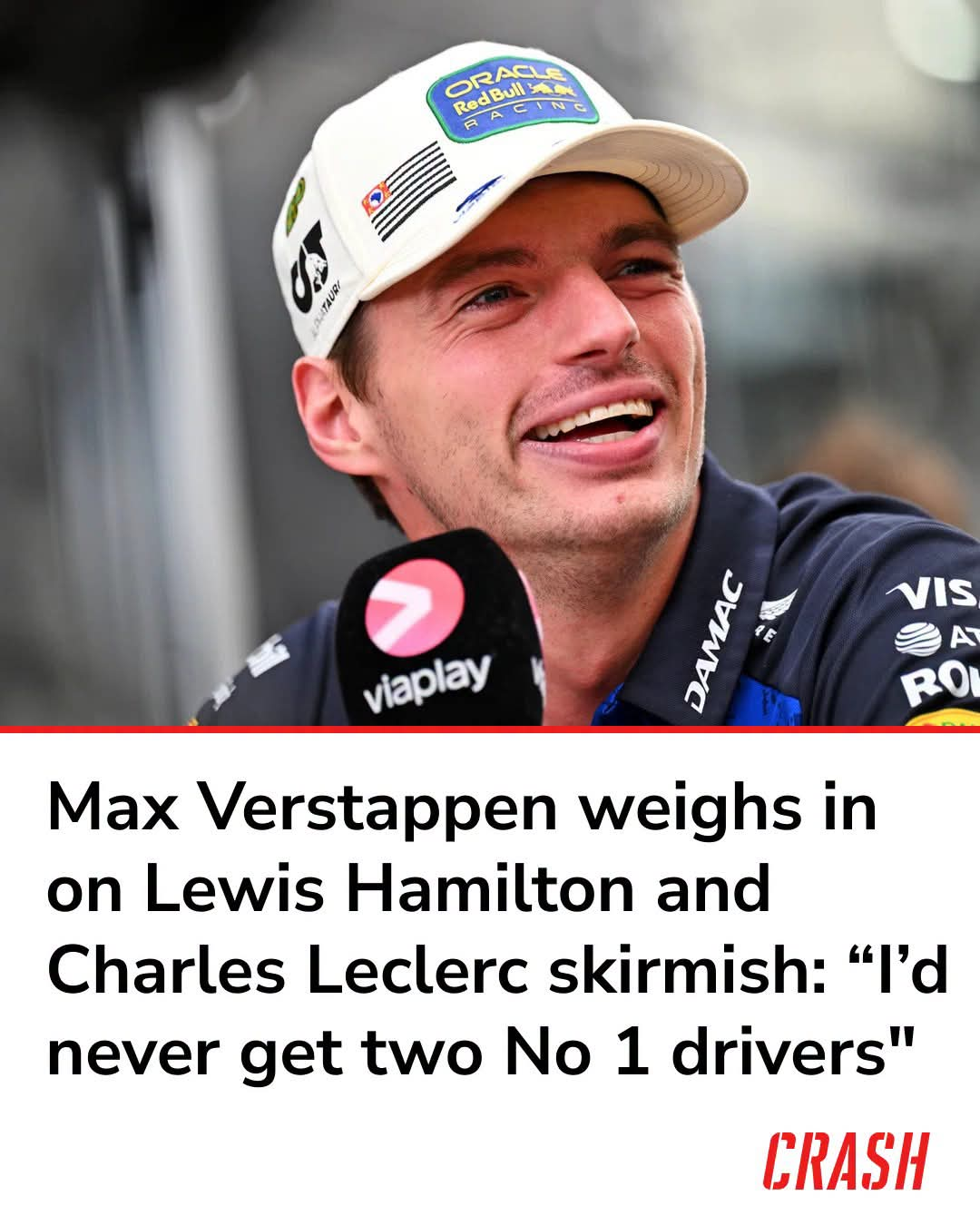
Max Verstappen has offered a revealing assessment of the relationship between Lewis Hamilton and Charles Leclerc at Ferrari, questioning whether putting two highly ambitious drivers in the same team is the right strategy for a Formula 1 constructor chasing championship glory.
The Red Bull superstar believes Ferrari’s decision to bring Hamilton and Leclerc together creates a difficult management challenge, particularly when both drivers consider themselves capable of leading the team and fighting for victories.
His comments come after another controversial episode between Ferrari’s two drivers at the Mexico City Grand Prix, where an opening-lap battle significantly damaged the Scuderia’s chances of securing a potentially dominant result.
For Verstappen, the situation highlights a fundamental problem in Formula 1: having two exceptional drivers does not necessarily guarantee the best outcome for a team.
VERSTAPPEN QUESTIONS FERRARI’S TWO-LEADER STRATEGY
Speaking to Viaplay, Verstappen explained that he would avoid putting two number-one drivers together if he were responsible for managing a Formula 1 team.
The Dutchman believes that when two drivers have equal ambitions and both expect to receive opportunities to win, disagreements become almost inevitable.
Verstappen explained:
“I’ve said it before, and a lot of people often don’t agree, but if I was a team principal, I’d never get two ‘No 1′ drivers because then you get things like this.”
He continued by explaining that neither driver would naturally want to give up a position when both believe they have the ability to win.
“One won’t yield for the other because they both think they can win, and that’s how I am too. And if I was a team principal, I’d change this.”
His comments provide an interesting insight into how Verstappen views team management and the importance of establishing a clear competitive hierarchy.
He suggested that having an established number-one and number-two driver could prevent unnecessary battles and help a team maximise its championship points.
However, his argument also raises an important question: should a team sacrifice individual competitiveness to guarantee greater collective stability?
THE MEXICO CITY GRAND PRIX EXPOSES FERRARI’S BIGGEST PROBLEM
The controversy surrounding Hamilton and Leclerc intensified following the Mexico City Grand Prix.
Hamilton started from pole position and appeared to be in an excellent position to challenge for victory. However, the opening-lap battle with Leclerc disrupted Ferrari’s race.
The two drivers fought aggressively for position, with Leclerc going off track during the exchange. He subsequently received a five-second penalty.
The incident allowed Verstappen to capitalise on Ferrari’s difficulties and ultimately take victory.
For Ferrari, the consequences extended beyond losing a potential race win.
The Scuderia had an opportunity to secure a major points haul, potentially finishing first and second. Instead, its drivers became involved in a battle that compromised the team’s overall result.
This is precisely the situation Verstappen believes teams should try to avoid.
In modern Formula 1, championship battles are frequently decided by small margins. Losing valuable points because teammates cannot manage their on-track competition can become extremely expensive over an entire season.
WHY HAMILTON AND LECLERC ARE A DIFFICULT COMBINATION
There is little doubt that Ferrari has assembled an exceptionally talented driver pairing.
Hamilton brings seven world championships, extraordinary experience and a proven ability to perform under pressure.
Leclerc, meanwhile, represents Ferrari’s long-term investment. He understands the organisation, has developed strong relationships within the team and possesses the speed to challenge for victories.
However, these strengths also create a potential management headache.
Hamilton did not join Ferrari simply to play a supporting role. The British driver wants another championship and expects to have the machinery and opportunities necessary to achieve that objective.
Leclerc has similarly spent years establishing himself as Ferrari’s leading driver. Naturally, he will not want to surrender his position without a fight.
The problem is therefore not necessarily a lack of respect between the two drivers.
It is the reality that both have ambitions that occasionally conflict with the team’s immediate interests.
When they compete against rival teams, their aggressive instincts are valuable. When they compete against each other, those same instincts can become Ferrari’s biggest weakness.
HAMILTON AND LECLERC HAVE ALREADY EXPERIENCED MULTIPLE FLASHPOINTS
The Mexico incident was not the first occasion on which Ferrari’s drivers found themselves at the centre of controversy.
Their battle at the Italian Grand Prix at Monza in September also raised questions about how Ferrari manages competition between its drivers.
Hamilton was forced onto the gravel during an early exchange with Leclerc, while the Monegasque later crashed out of the race.
Following the Mexico controversy, Hamilton made it clear that he believed Leclerc raced him harder than some of his other competitors.
He also called for discussions to establish clearer expectations about how Ferrari’s drivers should approach their battles.
These incidents demonstrate why Verstappen’s comments have attracted attention.
Ferrari cannot afford to repeatedly lose valuable opportunities because its drivers are unable to find the right balance between personal ambition and collective responsibility.
FERRARI’S RESPONSE: PROFESSIONALISM OVER FRIENDSHIP
Ferrari team principal Fred Vasseur has also addressed the situation.
Following the Mexico City Grand Prix, Vasseur confirmed that discussions had taken place with Hamilton and Leclerc in Brazil.
He made it clear that he was not demanding that the drivers become best friends.
Instead, his priority was ensuring that they respected each other and understood their responsibilities to Ferrari.
Vasseur explained that both drivers were competitive individuals who wanted to win, but the interests of the organisation had to come first.
Hamilton subsequently confirmed that he and Leclerc had spoken directly and resolved their disagreement.
The seven-time world champion indicated that there were no demands from either side and that both drivers had explained their perspectives.
Leclerc also described the disagreement as something that could be addressed through communication.
This is an encouraging development for Ferrari, although resolving one disagreement does not necessarily eliminate the possibility of future incidents.
As long as both drivers are fighting for victories, the pressure will remain.
DOES VERSTAPPEN HAVE A POINT ABOUT TEAM ORDERS?
Verstappen’s argument deserves serious consideration, particularly when examining some of Formula 1’s most successful driver partnerships.
Having two equally competitive drivers can create tremendous advantages.
They push each other to improve, provide valuable feedback and increase the team’s chances of scoring significant championship points.
However, the arrangement also creates risks.
The history of Formula 1 contains numerous examples of teammates becoming fierce rivals.
Lewis Hamilton’s relationship with Nico Rosberg at Mercedes remains one of the clearest examples. Both drivers were capable of winning championships, but their rivalry eventually became increasingly difficult for the team to manage.
There were moments when their competition threatened Mercedes’ dominance.
Similarly, Sebastian Vettel and Mark Webber experienced several disagreements during their time together at Red Bull.
These examples demonstrate that driver equality can become complicated when championship opportunities are involved.
Nevertheless, establishing a strict number-one and number-two arrangement is not necessarily a perfect solution.
A secondary driver who feels permanently restricted may lose motivation, while a team that favours one competitor too heavily could sacrifice valuable performance.
The challenge is finding a system that allows both drivers to compete without damaging the team’s objectives.
WHY FERRARI CANNOT AFFORD AN INTERNAL RIVALRY
Ferrari is one of the most recognisable organisations in motorsport, and expectations surrounding the team are always enormous.
Its supporters want victories, championships and performances that reflect the organisation’s history.
That pressure makes the Hamilton-Leclerc partnership particularly important.
Ferrari has invested heavily in building a competitive project, and having two drivers capable of fighting at the front should theoretically be a major advantage.
However, the team must ensure that its drivers do not turn every race into an internal championship battle.
The consequences of repeated disagreements could affect several areas:
– Championship points: Unnecessary battles can allow rival teams to collect points that Ferrari should have secured.
– Team development: Disagreements can create distractions and complicate communication between engineers and drivers.
– Driver confidence: Repeated controversies can damage trust and make future racing decisions more difficult.
– Team morale: Ferrari’s engineers and mechanics need both drivers working towards the same objectives.
– Championship ambitions: Even a fast car can struggle to deliver consistent results when internal competition becomes counterproductive.
Ultimately, Ferrari needs both drivers performing at their highest level, not competing against each other at the expense of the organisation.
WHAT HAPPENS NEXT BETWEEN HAMILTON AND LECLERC?
The immediate signs are encouraging.
Both Hamilton and Leclerc have indicated that their disagreement has been addressed following discussions in Brazil.
However, the real test will come when they find themselves fighting for the same corner, podium position or race victory again.
Neither driver is likely to abandon his ambitions simply because Ferrari has held a meeting.
Hamilton wants to demonstrate that he can bring championship success to Maranello, while Leclerc wants to establish himself as the driver capable of leading Ferrari into its next successful era.
Their competitive relationship could ultimately make Ferrari stronger, provided the team establishes clear and consistently applied racing guidelines.
There is also an important distinction between managing a disagreement and preventing another one.
Ferrari must make sure that both drivers understand where the boundaries lie before the next controversial incident occurs.
VERDICT: VERSTAPPEN HAS IDENTIFIED A GENUINE FERRARI DILEMMA
Max Verstappen’s comments might appear straightforward, but they highlight one of the biggest strategic challenges facing Ferrari.
Having Lewis Hamilton and Charles Leclerc in the same garage gives the Scuderia enormous competitive potential.
It also means Ferrari must manage two drivers with championship ambitions, strong personalities and very little interest in playing second fiddle.
Verstappen believes he would avoid that situation entirely by establishing a clear hierarchy.
Ferrari, however, appears determined to allow both drivers to compete while maintaining professional standards.
Neither approach guarantees success.
What matters most is whether the Scuderia can prevent individual battles from undermining its collective ambitions.
Hamilton and Leclerc have the talent to deliver extraordinary results together. But unless Ferrari manages their rivalry effectively, its biggest championship obstacle could eventually come from inside its own garage.
For Verstappen and Red Bull, that would undoubtedly be a welcome development.
And for Ferrari, it is a warning that two number-one drivers can become either its greatest strength or its most expensive weakness.SEO META DESCRIPTION: Max Verstappen questions Ferrari’s decision to pair Lewis Hamilton and Charles Leclerc, explaining why having two number-one drivers could create problems for the Scuderia.
FOCUS KEYWORDS: Max Verstappen, Lewis Hamilton, Charles Leclerc, Ferrari F1, Hamilton and Leclerc relationship, Ferrari team orders, Formula 1 news.
Suggested URL Slug: max-verstappen-hamilton-leclerc-ferrari-relationship
Editorial accuracy note: The article distinguishes Verstappen’s opinion from Ferrari’s actual management decisions. His comments are not an announcement that Ferrari intends to prioritise either driver.