Red Bull Racing found itself facing an uncomfortable team-orders debate at the 2026 São Paulo Grand Prix after Isack Hadjar surrendered second position to Max Verstappen, only for the promised opportunity to reclaim his place to disappear as the race unfolded.
What initially appeared to be a straightforward strategic decision became one of the most interesting talking points of the weekend. Hadjar was delivering an impressive performance at Interlagos, but Red Bull believed Verstappen had a better opportunity to challenge Lando Norris for victory after recovering from 21st on the starting grid.
The team therefore instructed the young Frenchman to move aside on Lap 38.
However, there was another important detail behind the decision: Red Bull had considered giving Hadjar his position back if Verstappen failed to make sufficient progress.
That reversal never happened.
With Verstappen finishing second and Hadjar settling for third, the incident has raised an important question about fairness, team hierarchy and how Formula 1 teams should manage their drivers when individual ambitions collide with collective objectives.
WHY RED BULL ASKED HADJAR TO GIVE VERSTAPPEN SECOND PLACE
Verstappen’s recovery drive was one of the biggest stories of the Brazilian Grand Prix.
Starting 21st following a power-unit penalty, the four-time world champion had an enormous challenge ahead of him. Nevertheless, his pace and ability to navigate the changing conditions allowed him to work his way through the field.
By Lap 38, Verstappen had caught Hadjar, who was occupying second position.
Red Bull recognised an opportunity.
With Norris leading the race, the team wanted its most experienced driver to have the clearest possible opportunity to attack the McLaren.
Hadjar was consequently instructed to surrender second place and allow Verstappen through.
From a strategic perspective, the decision was understandable. Verstappen has an exceptional record in difficult racing conditions, and Red Bull had little reason to ignore the possibility of turning an impressive recovery into a potential victory challenge.
However, the decision also placed Hadjar in a difficult position.
He had earned his position through his own performance, and surrendering it meant temporarily sacrificing an important individual result for the benefit of the team.
LAURENT MEKIES REVEALS RED BULL’S PLAN TO RESTORE HADJAR’S POSITION
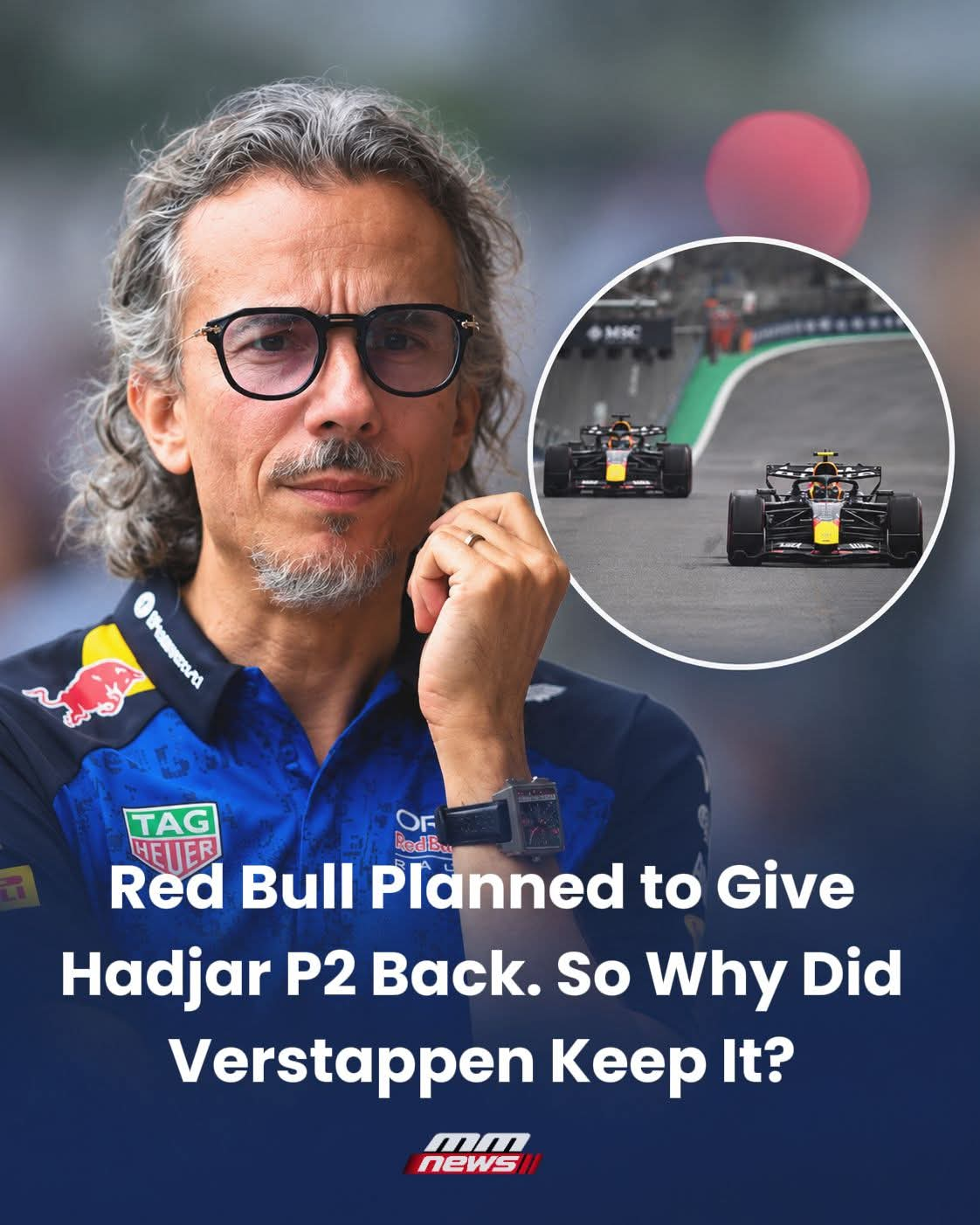
The most interesting revelation came after the race when Red Bull team principal Laurent Mekies explained that the team had genuinely considered reversing the original instruction.
According to Mekies, Hadjar would have received second place back if the two Red Bull drivers had remained sufficiently close together.
He also acknowledged that the Frenchman had demonstrated impressive pace and managed to stay with Verstappen following the position swap.
However, the situation changed as the race progressed.
Rain returned to Interlagos, the distance between the two Red Bull cars increased, and the team eventually concluded that reversing their positions would no longer make strategic sense.
Mekies explained that the increasing intensity of the rain made another switch even less practical.
He also praised the cooperation between both drivers, highlighting their contribution to Red Bull’s double podium.
His explanation provides an important insight into how quickly Formula 1 strategy can change.
A decision that appears reasonable at one stage of a Grand Prix can become unnecessary or even counterproductive several laps later.
Nevertheless, Red Bull’s explanation has not completely removed the debate surrounding the incident.
ISACK HADJAR DESERVED MORE THAN THIRD PLACE?
Perhaps the biggest winner from this controversy, beyond the two podium finishers, was Hadjar himself.
The young Frenchman demonstrated that he could compete at the front of the field and maintain a competitive pace alongside one of Formula 1’s most accomplished drivers.
His performance was particularly encouraging because he did not simply benefit from Verstappen’s recovery. He had established himself as a genuine contender for a strong result before the team intervened.
Remaining close to Verstappen after surrendering second position also strengthened the argument that Hadjar deserved an opportunity to recover his original place.
For a relatively young driver competing alongside a multiple world champion, performances like this are extremely important.
They help establish credibility within the team and demonstrate that the driver deserves to be evaluated on performance rather than reputation.
Hadjar’s third-place finish was still an excellent achievement, but there is a difference between celebrating a podium and knowing that an even better result might have been possible.
That distinction is central to this debate.
MAX VERSTAPPEN AND THE TEAM ORDERS QUESTION
Verstappen’s involvement inevitably makes the situation more interesting.
There is no question that Red Bull made the original decision because it believed the Dutchman had a better opportunity to challenge Norris.
His experience, racecraft and extraordinary recovery from 21st justified giving him an opportunity.
However, team orders work best when both drivers understand that the arrangement is fair.
Hadjar accepted the instruction to move aside, and the expectation was that the team could restore the original order if circumstances allowed.
This raises an important question: should Verstappen have voluntarily surrendered second place once it became increasingly unlikely that he would catch Norris?
There is a strong argument that he should have.
Hadjar had given up his position to support the team’s strategy. Returning it would have demonstrated that Red Bull values cooperation and rewards drivers who follow instructions.
On the other hand, Formula 1 is not simply about rewarding individual performances. Teams must consider tyre conditions, strategy, safety and the potential consequences of every decision.
Verstappen also had to manage his own race, particularly as the weather deteriorated.
The responsibility, therefore, was primarily Red Bull’s rather than Verstappen’s alone.
It was the team that introduced the position swap, and it was the team that ultimately decided against reversing it.
RED BULL MUST BE CAREFUL ABOUT HOW IT MANAGES ITS DRIVERS
This incident carries implications beyond the final result at Interlagos.
One of the biggest challenges for any Formula 1 team is maintaining harmony between two competitive drivers.
Both drivers want to win, collect points and establish themselves as the team’s leading performer.
When team orders become necessary, management must demonstrate that decisions are based on sporting and strategic considerations rather than simply favouring one driver.
For Red Bull, this is particularly important as Hadjar continues developing alongside Verstappen.
The Frenchman needs to understand that strong performances will earn him opportunities, while Verstappen must know that his status does not automatically make every team decision revolve around him.
If Red Bull wants to get the best out of both drivers, consistency will be essential.
A situation where one driver repeatedly sacrifices opportunities without receiving comparable support could eventually damage the relationship.
That is something Mekies and the wider Red Bull management structure will want to avoid.
THE 2022 SERGIO PEREZ INCIDENT ADDS ANOTHER LAYER TO THE DEBATE
Red Bull’s history with team orders also makes this discussion particularly interesting.
The 2022 São Paulo Grand Prix remains a memorable example.
During that race, Verstappen refused to surrender a position to Sergio Perez despite the team asking him to do so.
Perez was fighting for second place in the drivers’ championship, and the decision created considerable controversy.
Although the circumstances surrounding the two incidents are different, the comparison is difficult to ignore.
In Brazil in 2026, Hadjar willingly moved aside to accommodate Verstappen’s recovery drive.
The possibility of reversing the order was subsequently abandoned.
For some observers, this creates an uncomfortable perception that Red Bull’s willingness to use team orders can depend on which driver benefits.
However, it would be unfair to conclude that the two situations are identical.
The important lesson is that teams must establish clear expectations before asking one driver to sacrifice a position for another.
Without that clarity, even a successful double podium can produce uncomfortable questions.
WHY RED BULL’S DOUBLE PODIUM STILL MATTERS
Despite the controversy, Red Bull has plenty of reasons to celebrate its performance in Brazil.
Verstappen’s recovery from 21st to second demonstrated his extraordinary ability to extract results from difficult circumstances.
Hadjar’s third-place finish provided further evidence of his growing competitiveness.
Together, the drivers secured a double podium and delivered an important result for the team.
There is also a broader competitive benefit.
Having two drivers capable of fighting near the front gives Red Bull more strategic flexibility in future races.
It creates additional opportunities to influence race situations, challenge rival teams and collect valuable championship points.
For Hadjar, the result represents another important milestone in his development.
For Verstappen, it reinforces his reputation as one of the strongest comeback performers in modern Formula 1.
And for Mekies, it provides another opportunity to demonstrate that Red Bull can manage two highly competitive drivers without allowing internal disagreements to undermine the team’s objectives.
SHOULD VERSTAPPEN HAVE GIVEN SECOND PLACE BACK TO HADJAR?
This is where the debate becomes particularly interesting.
In my opinion, Red Bull should have made every reasonable effort to restore Hadjar’s second position once it became clear that Verstappen was unlikely to catch Norris.
Hadjar followed the instruction, surrendered a position he had earned and continued demonstrating competitive pace.
That cooperation deserved recognition.
However, the circumstances surrounding the closing stages cannot be ignored. The returning rain and increasing distance between the cars complicated the situation, and Red Bull ultimately had to consider whether another position swap would offer any meaningful sporting benefit.
The bigger issue is not necessarily that Verstappen kept second place.
It is that Red Bull created an expectation that the original order could be restored, leaving Hadjar in an uncertain position.
If a team asks one driver to sacrifice something, it must communicate clearly what that driver can expect in return.
Otherwise, team orders risk becoming a one-way arrangement.
And that is not a healthy foundation for a competitive driver partnership.
WHAT HAPPENS NEXT FOR VERSTAPPEN AND HADJAR?
The Brazilian Grand Prix could prove to be an important moment in the development of Red Bull’s internal driver relationship.
Hadjar has demonstrated that he possesses the pace to compete with Verstappen, even if the Dutchman remains the more experienced and established driver.
That should give the Frenchman considerable confidence heading into the remaining races.
It could also influence how Red Bull approaches future strategic decisions.
If Hadjar continues delivering strong performances, the team may increasingly find itself managing two drivers with legitimate expectations of fighting for podium positions.
Verstappen, meanwhile, will continue to be Red Bull’s biggest competitive asset, but his teammate’s growing confidence means the team cannot afford to take Hadjar’s cooperation for granted.
The most interesting development to watch will be whether Red Bull introduces clearer guidelines for future position swaps.
A transparent approach would benefit everyone involved.
It would protect the team’s competitive objectives while ensuring that neither driver feels disadvantaged by decisions made on the pit wall.
FINAL VERDICT: RED BULL WON THE PODIUM BATTLE, BUT THE TEAM ORDERS DEBATE IS FAR FROM OVER
Red Bull achieved an impressive double podium at the São Paulo Grand Prix, but the decision not to restore Isack Hadjar’s second position has created an interesting debate about fairness and driver management.
Verstappen’s recovery from 21st to second deserves enormous credit, while Hadjar also deserves recognition for his impressive performance and willingness to cooperate with the team.
Laurent Mekies has explained why the planned position reversal never happened, pointing to the returning rain and the growing distance between the two cars.
Nevertheless, the incident highlights an important principle in Formula 1: team orders should be based on clear agreements, mutual trust and consistent decision-making.
Hadjar did his part when Red Bull asked him to move aside.
The question is whether the team did enough to protect his interests afterwards.
Ultimately, Red Bull secured the result it wanted, but how it handles similar situations in the future could be just as important as the points collected in Brazil.
What do you think? Should Max Verstappen have given Isack Hadjar second place back, or was Red Bull right to maintain the finishing order?
#F1 #Formula1 #RedBullRacing #MaxVerstappen #IsackHadjar #BrazilGP #SaoPauloGP #LaurentMekies #F1News #F1TeamOrdersEditorial accuracy: The article reflects Mekies’ post-race explanation and the reported circumstances of the 2026 São Paulo Grand Prix.