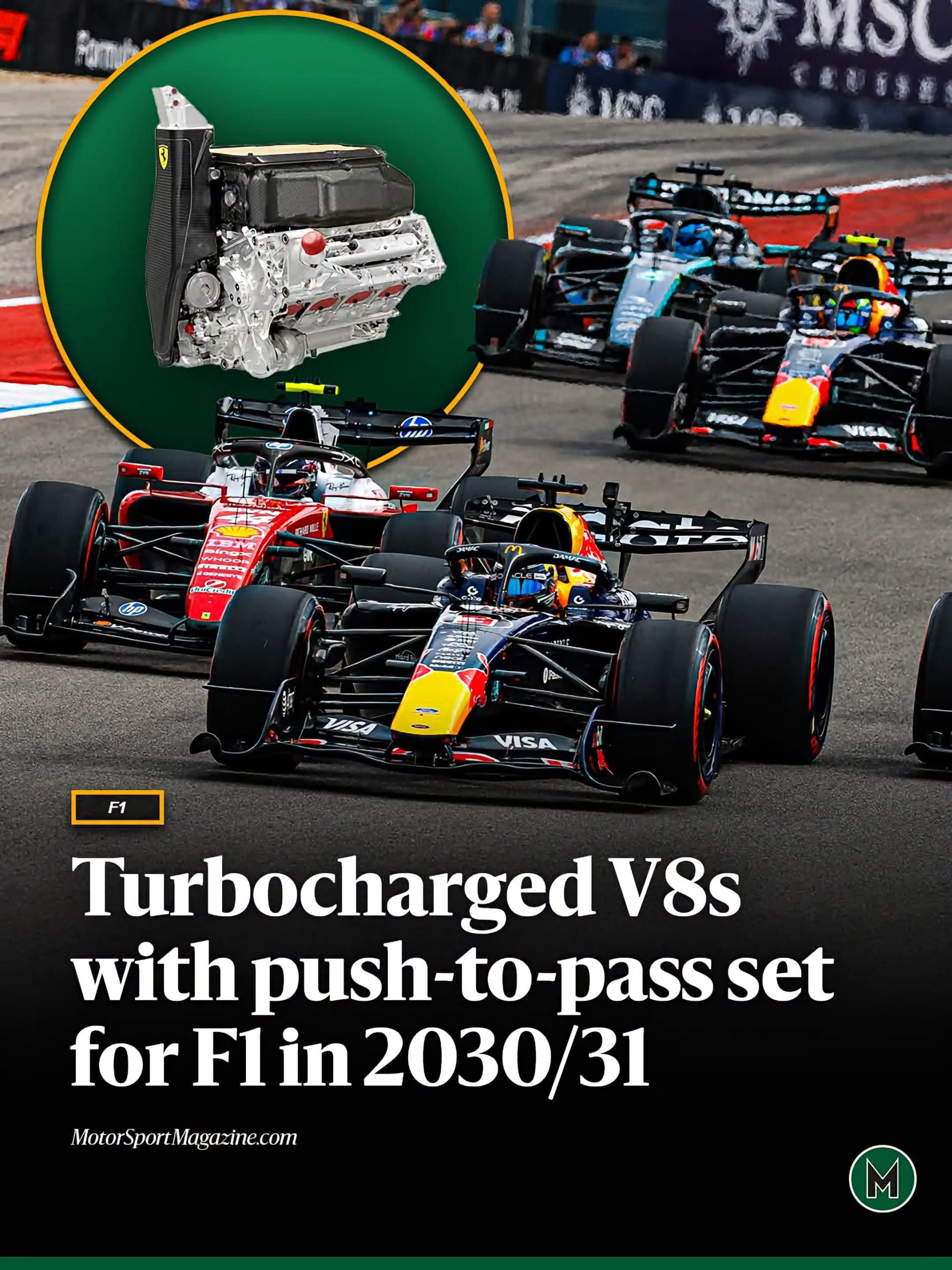
Formula 1 could be heading towards one of its biggest technical revolutions in the next decade, with the FIA reportedly proposing a dramatic return to V8 engines alongside a new push-to-pass system. The proposal, reported by the BBC, has reportedly been sent to Formula 1’s six current power unit manufacturers as discussions begin over what the championship’s future could look like beyond the controversial 2026 regulations.
The potential changes would represent a significant departure from the current 1.6-litre V6 turbocharged hybrid engines, which have attracted considerable criticism from drivers and fans. While the 2026 regulations were designed to increase electrical power and strengthen Formula 1’s commitment to sustainable technology, concerns about energy management, racing quality and driver experience have intensified the debate over the championship’s long-term direction.
FIA CONSIDERS BRINGING BACK V8 ENGINES
One of the most significant elements of the reported proposal is the return of turbocharged V8 engines. Formula 1 previously enjoyed naturally aspirated V8 power units between 2006 and 2013, an era remembered for their distinctive sound, high-revving characteristics and strong appeal among motorsport fans.
However, the proposed engines would not simply recreate the old V8 era. The FIA is reportedly considering turbocharged units with a larger capacity of approximately 2.0 to 2.3 litres, potentially offering a different combination of performance, efficiency and technological relevance.
The move could also address concerns that modern Formula 1 power units have become excessively complicated. Manufacturers currently operate sophisticated hybrid systems involving internal combustion engines, electrical energy recovery and battery management, making development and operation increasingly demanding.
A simpler V8-based architecture could offer a more attractive technical direction without completely abandoning hybrid technology.
F1 COULD REDUCE ELECTRIC POWER AND INTRODUCE PUSH-TO-PASS
Another major feature of the proposal is a reduction in electrical power from the current 350kW level to approximately 200kW.
Rather than relying as heavily on electrical energy deployment, the proposed system would introduce a new 100kW push-to-pass mechanism. Such a feature could provide drivers with an additional power boost when attempting overtakes or defending positions.
The concept could significantly change how drivers approach battles on track.
Under the current regulations, energy management has become a central part of race strategy, with drivers sometimes required to compromise their speed to recharge batteries or conserve electrical energy. A push-to-pass system could provide a more straightforward method of delivering additional performance during important moments.
However, the exact activation rules, duration and availability of the proposed system would still need to be determined.
900 HORSEPOWER AND LIGHTER F1 CARS COULD TRANSFORM RACING
The reported proposal also targets approximately 900 horsepower, alongside a potential reduction of 80 kilograms in car weight.
That combination could prove particularly important for the quality of racing.
Modern Formula 1 cars have become increasingly heavy, contributing to concerns about agility, responsiveness and the difficulty of following competitors closely through corners. Reducing weight could improve braking performance, direction changes and overall driving characteristics.
A lighter car with a more powerful internal combustion engine could also create a different racing experience from the current generation.
For drivers, the potential benefits could extend beyond lap times. More responsive cars could make qualifying more challenging and potentially reward driver skill more directly.
Nevertheless, achieving an 80kg reduction would require significant changes beyond the engine itself, meaning the FIA would need to reconsider several aspects of the wider technical regulations.
FIA TARGETS A 50% REDUCTION IN POWER UNIT COSTS
Cost remains another major factor behind the reported proposal.
The FIA is reportedly targeting a 50% reduction in power unit budgets, potentially making Formula 1 more accessible to manufacturers and reducing the financial burden associated with developing competitive engines.
This could become particularly important as the championship continues attracting automotive manufacturers interested in balancing technological investment with commercial returns.
A simpler engine architecture could reduce development complexity, although the actual financial savings would depend on the final regulations and implementation costs.
For smaller manufacturers, lower engine expenditure could also improve the sustainability of their participation in Formula 1.
WHY THE 2026 ENGINE REGULATIONS HAVE BECOME CONTROVERSIAL
The reported proposal arrives against the backdrop of growing debate surrounding Formula 1’s 2026 power units.
The current regulations significantly increased electrical power while reducing dependence on the internal combustion engine. Although the changes were intended to support electrification and sustainability, they have also raised concerns about the demands placed on drivers during racing.
Energy deployment, battery management and power conservation have become major talking points, with critics questioning whether the regulations place too much emphasis on managing technology rather than maximising racing performance.
The proposed V8 direction could represent an attempt to respond to those concerns while maintaining some level of hybrid assistance.
Importantly, the proposal does not mean Formula 1 has officially decided to abandon its current engine direction. It remains a reported concept under discussion rather than an approved regulation.
MANUFACTURERS FACE A MAJOR DECISION
The six current power unit manufacturers would play a crucial role in determining whether the proposed direction becomes reality.
Any major engine regulation change requires manufacturers to assess investment costs, technical feasibility, competitive advantages and the commercial value of participating in Formula 1.
A return to V8 engines could appeal to fans and potentially simplify certain engineering challenges, but manufacturers would also need to determine whether the technology aligns with their wider automotive strategies.
The timing of the change would be equally important.
Introducing a new engine generation in 2030 would mean another substantial technical transition relatively soon after the 2026 regulations. A 2031 introduction, meanwhile, could provide additional time for manufacturers and the FIA to develop a more comprehensive framework.
COULD V8 ENGINES BECOME F1’S BIGGEST ATTRACTION AGAIN?
The possibility of turbocharged V8 engines returning has already created an intriguing discussion about Formula 1’s identity in the 2030s.
For many supporters, engine sound remains an important part of the championship’s appeal. The V8 era delivered an unmistakable soundtrack that helped define Formula 1 during the late 2000s and early 2010s.
A modern turbocharged V8 would not necessarily sound identical to those naturally aspirated engines, but the prospect of a different engine character could still represent a major attraction.
The potential combination of lighter cars, approximately 900 horsepower and a new overtaking system could also create a more aggressive racing environment.
If the FIA can successfully balance performance, sustainability, affordability and competitive racing, the next engine generation could become an important opportunity to strengthen Formula 1’s appeal.
2030 OR 2031 COULD MARK A NEW ERA FOR FORMULA 1
The proposed timeline leaves Formula 1 with two potential introduction windows: 2030 or 2031.
Neither date should currently be treated as confirmed, and considerable discussions are likely to take place before a final decision is reached.
The challenge for the FIA will be ensuring that the next regulations avoid the difficulties associated with introducing a complicated technical package while delivering improvements that drivers, teams and fans can genuinely appreciate.
Formula 1 has repeatedly reinvented itself through engine regulation changes, from naturally aspirated V8s to turbocharged V6 hybrids and increasingly electrified power units.
The reported V8 proposal could represent another major turning point.
If the plans progress, Formula 1’s future could feature a combination of traditional combustion-engine appeal, modern hybrid technology and a simplified approach to performance delivery.
For fans who have spent years calling for lighter cars, stronger engines and less complicated racing, the possibility of a 900-horsepower V8-powered Formula 1 machine could be one of the most exciting developments of the decade.