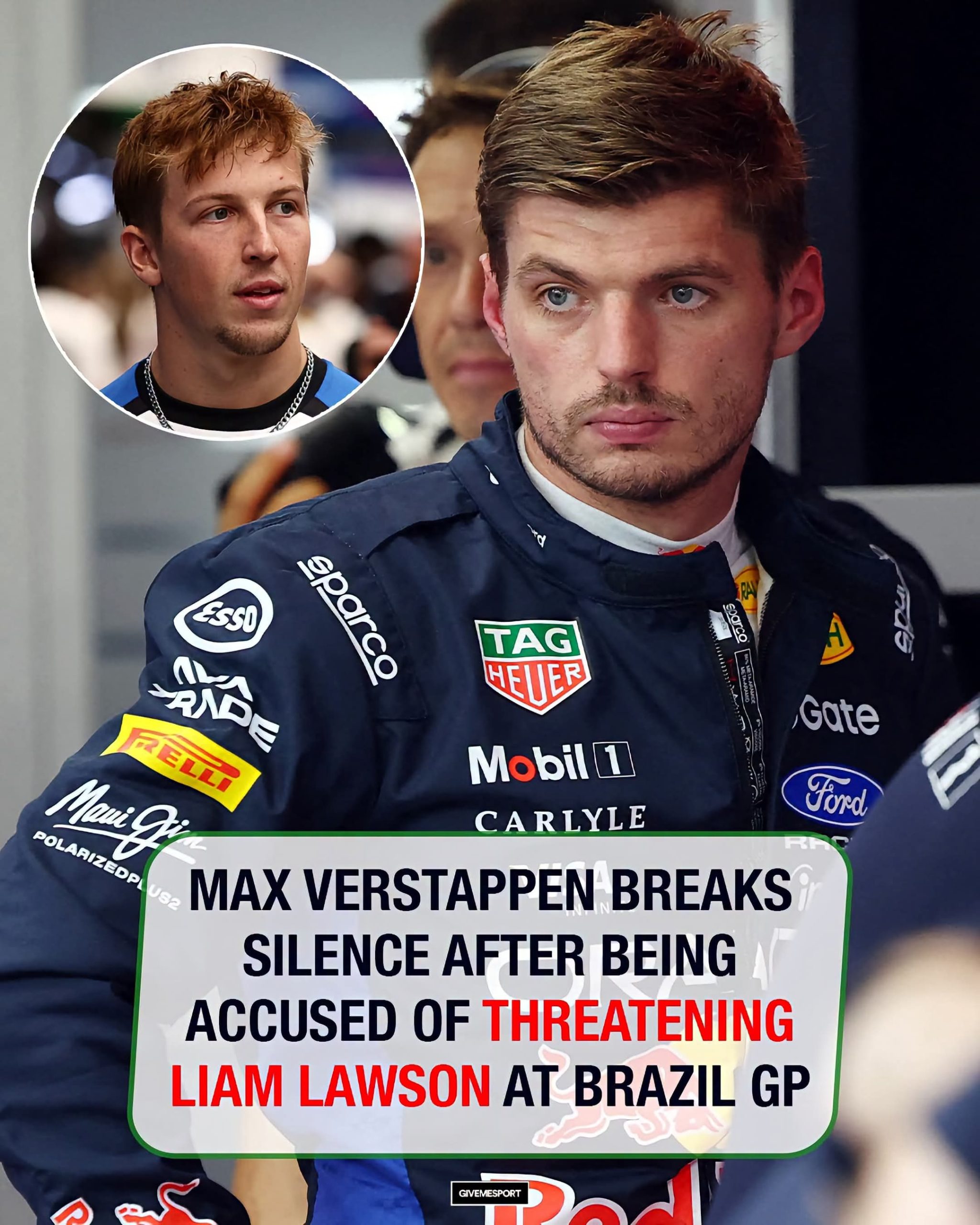
Max Verstappen has broken his silence after former Formula 1 driver and steward Johnny Herbert accused him of making an inappropriate threat towards Liam Lawson following their controversial collision at the Mexico City Grand Prix. The four-time world champion has dismissed the criticism, insisting that the disagreement has already been addressed privately with Lawson and that there is no reason to continue discussing it publicly.
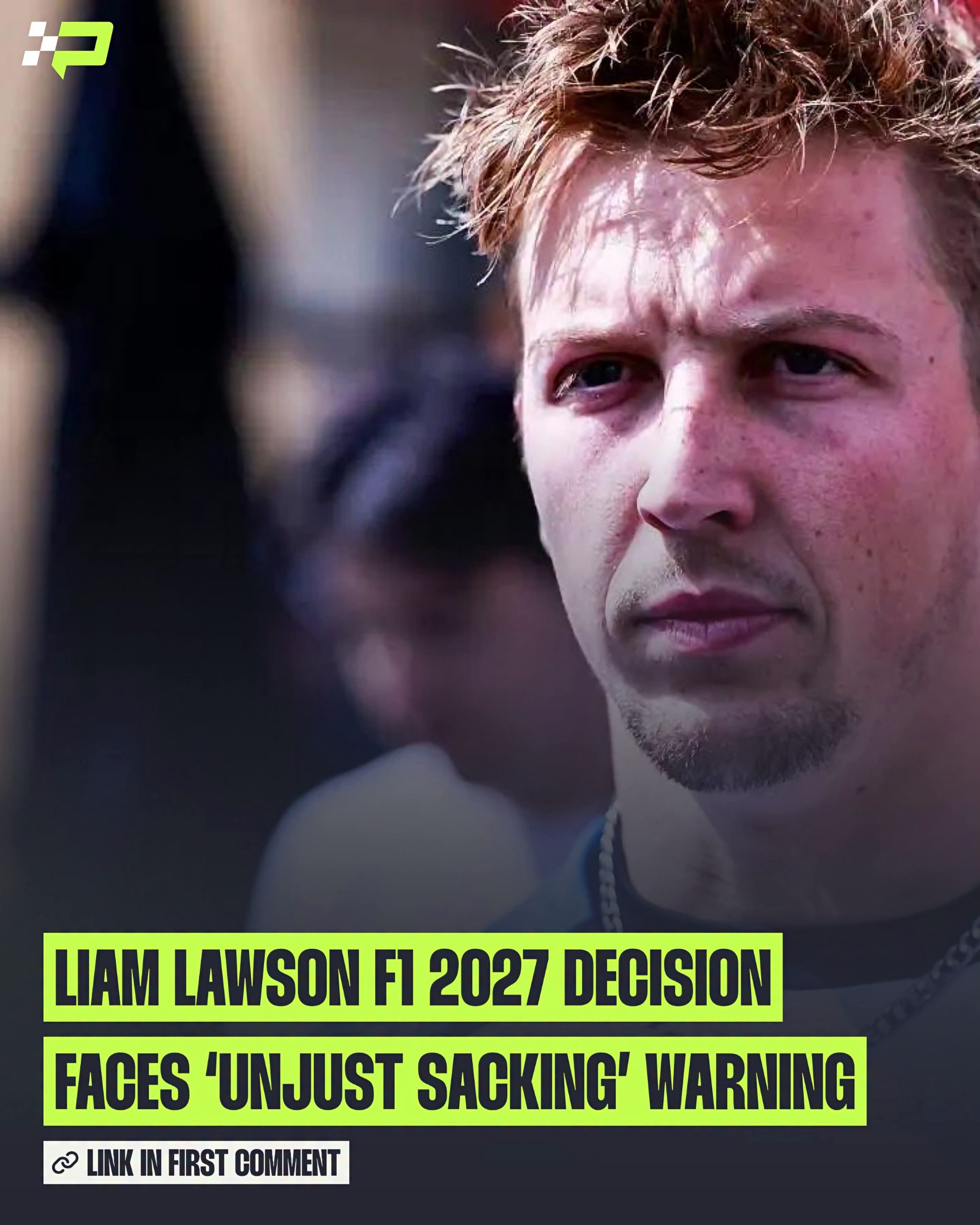
The controversy began during second practice at the Mexican Grand Prix, when Verstappen attempted to overtake Lawson at Turn 12 near the old baseball stadium. The Racing Bulls driver refused to give up his position, with both cars running alongside each other through the following corners before making contact at Turn 14. The incident damaged Verstappen’s Red Bull and resulted in debris being scattered across the circuit, forcing race control to bring out the red flags.
Although the collision happened during a practice session rather than a competitive race, the disagreement quickly developed into a major talking point because of Verstappen’s reaction afterwards. The Dutchman was particularly unhappy with Lawson’s approach, believing the New Zealander could have handled the situation differently.
VERSTAPPEN’S COMMENTS ABOUT LAWSON SPARKED CONTROVERSY
Following the incident, Verstappen publicly questioned Lawson’s judgement and made a pointed reference to the uncertainty surrounding his Formula 1 future.
“If I were him I would act a little smarter, and when you’re fighting for your seat it’s not very smart behaviour,” Verstappen said.
Those comments attracted considerable attention because Lawson’s position at Racing Bulls has been a subject of speculation ahead of the 2027 season. The New Zealander has been working to establish himself as a reliable Formula 1 driver, and any suggestion that his future could be affected by an incident involving a leading driver naturally carries additional significance.
Verstappen’s remarks were interpreted by some observers as an attempt to remind Lawson of his vulnerable position in the sport. Others viewed them as an emotional response from a driver who believed his rival had taken an unnecessary risk during practice.
The disagreement also raised a broader question about how experienced drivers should approach younger competitors who are still trying to secure their long-term positions in Formula 1.
JOHNNY HERBERT ACCUSES VERSTAPPEN OF CROSSING THE LINE
Johnny Herbert was among the most outspoken critics of Verstappen’s comments. The former Formula 1 driver described the Dutchman’s remarks as a threat and argued that Lawson should not be subjected to that kind of pressure, particularly when he is already fighting to maintain his place on the grid.
Herbert acknowledged Verstappen’s extraordinary performance during the Mexican Grand Prix but insisted that his driving ability did not excuse the way he spoke about Lawson.
He described the practice collision as ridiculous and questioned why Verstappen had chosen to make such personal comments after an incident that could have been resolved without escalating tensions.
Herbert also defended Lawson’s progress, suggesting that the New Zealander had become a stronger and more confident competitor over recent seasons.
His criticism was significant because Verstappen’s comments went beyond the usual complaints drivers make about aggressive defending. By mentioning Lawson’s uncertain future, the Red Bull star brought the wider pressure surrounding the younger driver’s career into the disagreement.
However, Herbert’s interpretation was not necessarily shared by everyone. In Formula 1, drivers frequently use strong language when discussing incidents, and Verstappen has never been particularly interested in softening his opinions when he believes another competitor has made a mistake.
MAX VERSTAPPEN RESPONDS TO HERBERT’S CRITICISM
Verstappen was questioned about Herbert’s comments during the Brazilian Grand Prix weekend, and his response suggested that he had little interest in allowing the controversy to grow.
Asked whether he understood why Herbert had described his remarks as a threat, Verstappen dismissed the criticism.
“Do I understand why he says that? I don’t know. Actually, it doesn’t bother me at all. What do I care?” he said, speaking to Formule1.nl.
The Dutchman then explained that he had already spoken to Lawson about what happened in Mexico and believed the matter had been properly addressed.
“Everything [with Lawson] has simply been discussed properly. So I’ll leave it at that. I think that, in general, it is reasonably clear where things stand and what the rules are. Ultimately, I think it is also good for him to realise it.
“I understand that he wants to make a strong impression, but do that with someone else.”
Verstappen’s response indicates that he does not believe the disagreement requires further public discussion. Rather than apologising for his original remarks or accepting Herbert’s interpretation, he appears satisfied that the conversation with Lawson has settled the matter between the two drivers.
His comments also suggest that he believes Lawson’s aggressive approach was unnecessary, although the exact details of their private conversation have not been made public.
LAWSON’S POSITION MAKES THE DISAGREEMENT MORE SENSITIVE
One reason the controversy attracted so much attention is the uncertainty surrounding Lawson’s Formula 1 future.
The 24-year-old has experienced a challenging journey through the sport, including the pressure of competing at Red Bull before returning to Racing Bulls. Every strong performance is an opportunity to strengthen his position, while incidents involving other drivers can quickly become part of the wider discussion about his consistency and judgement.
For a driver in Lawson’s situation, showing determination is important. Formula 1 teams want competitors who are willing to defend their positions and challenge established names. However, there is also a difference between demonstrating confidence and taking unnecessary risks.
The Mexico incident placed Lawson in an uncomfortable position because he was defending against one of the most successful drivers on the grid. Giving Verstappen too much space could have invited criticism, but refusing to back down created the possibility of contact.
That is the difficult balance young drivers must manage. They need to prove they belong in Formula 1 without allowing every battle to become a career-defining controversy.
Verstappen’s comments may have been intended as a warning about racing judgement rather than a genuine attempt to influence Lawson’s future. Nevertheless, the reference to his seat situation ensured that the discussion extended beyond the collision itself.
VERSTAPPEN’S BRAZILIAN GRAND PRIX PERFORMANCE CHANGED THE CONVERSATION
Despite the controversy surrounding his comments, Verstappen delivered another remarkable performance at the Brazilian Grand Prix.
The Red Bull driver faced an extremely difficult weekend after taking a grid penalty for exceeding his permitted allocation of internal combustion engines, turbochargers and exhaust components. He also carried an additional penalty connected to the Mexico incident, leaving him starting the race from 21st position.
A starting position that far down the grid would normally make a podium finish extremely difficult, particularly at a circuit where track position and tyre strategy can have a major influence on the outcome.
However, Verstappen produced an impressive recovery drive to finish second behind Lando Norris. He also received the Driver of the Day recognition from fans, underlining the scale of his performance.
Isack Hadjar completed the podium in third place, giving Red Bull a double podium finish.
The result once again demonstrated why Verstappen remains one of the most formidable competitors in Formula 1. Even when his weekend begins with significant disadvantages, he has the ability to turn a difficult situation into a major championship result.
His performance also helped shift attention away from the Mexico disagreement, although Herbert’s criticism ensured that the issue remained part of the conversation throughout the Brazilian Grand Prix weekend.
THE INCIDENT REVEALS THE PRESSURE YOUNG DRIVERS FACE IN FORMULA 1
The disagreement between Verstappen and Lawson highlights one of the less comfortable realities of Formula 1: drivers are judged not only by their results but also by how they handle the sport’s political and competitive environment.
Lawson is trying to establish himself in a championship where opportunities are limited and competition for seats is intense. Every race, qualifying session and practice incident can influence how teams evaluate a driver’s performance.
At the same time, established champions such as Verstappen operate under enormous expectations. They are expected to fight for victories, protect their teams’ interests and challenge competitors who make mistakes.
This creates an environment where disagreements can quickly become personal, particularly when a collision involves drivers with very different levels of experience and career security.
Herbert’s intervention also reflects a wider debate about the responsibility experienced drivers have when speaking about younger competitors. Public criticism from a four-time world champion can attract considerable attention, especially when it touches on a driver’s employment situation.
However, Lawson cannot afford to become overly cautious simply because he is competing against a world champion. If he wants to establish himself as a long-term Formula 1 driver, he must be prepared to defend his position while recognising when a battle is no longer worth the risk.
WILL VERSTAPPEN AND LAWSON’S RELATIONSHIP REMAIN UNCHANGED?
For now, Verstappen appears determined to move on from the controversy. His insistence that he and Lawson have already discussed the incident suggests that he does not expect the disagreement to become a lasting problem between them.
However, the comments from Herbert have added another dimension to the story. The former driver believes Verstappen crossed a line by bringing Lawson’s career uncertainty into the discussion, while the Red Bull star clearly does not accept that interpretation.
The next time the two drivers find themselves fighting for track position, their approach could attract additional attention. Any aggressive defence or close racing between them is likely to be examined more closely because of what happened in Mexico.
Ultimately, the most important development for Lawson will be what happens on the circuit. Strong performances, consistent results and intelligent racecraft will do far more to strengthen his future than any public disagreement with Verstappen.
For Verstappen, the matter appears settled. He has made his position clear, dismissed Herbert’s criticism and pointed to a private conversation with Lawson as evidence that the issue has been addressed.
But the controversy has exposed a familiar feature of modern Formula 1: even an incident during free practice can become a major story when it involves a world champion, a driver fighting for his future and a public exchange that divides opinion across the paddock.