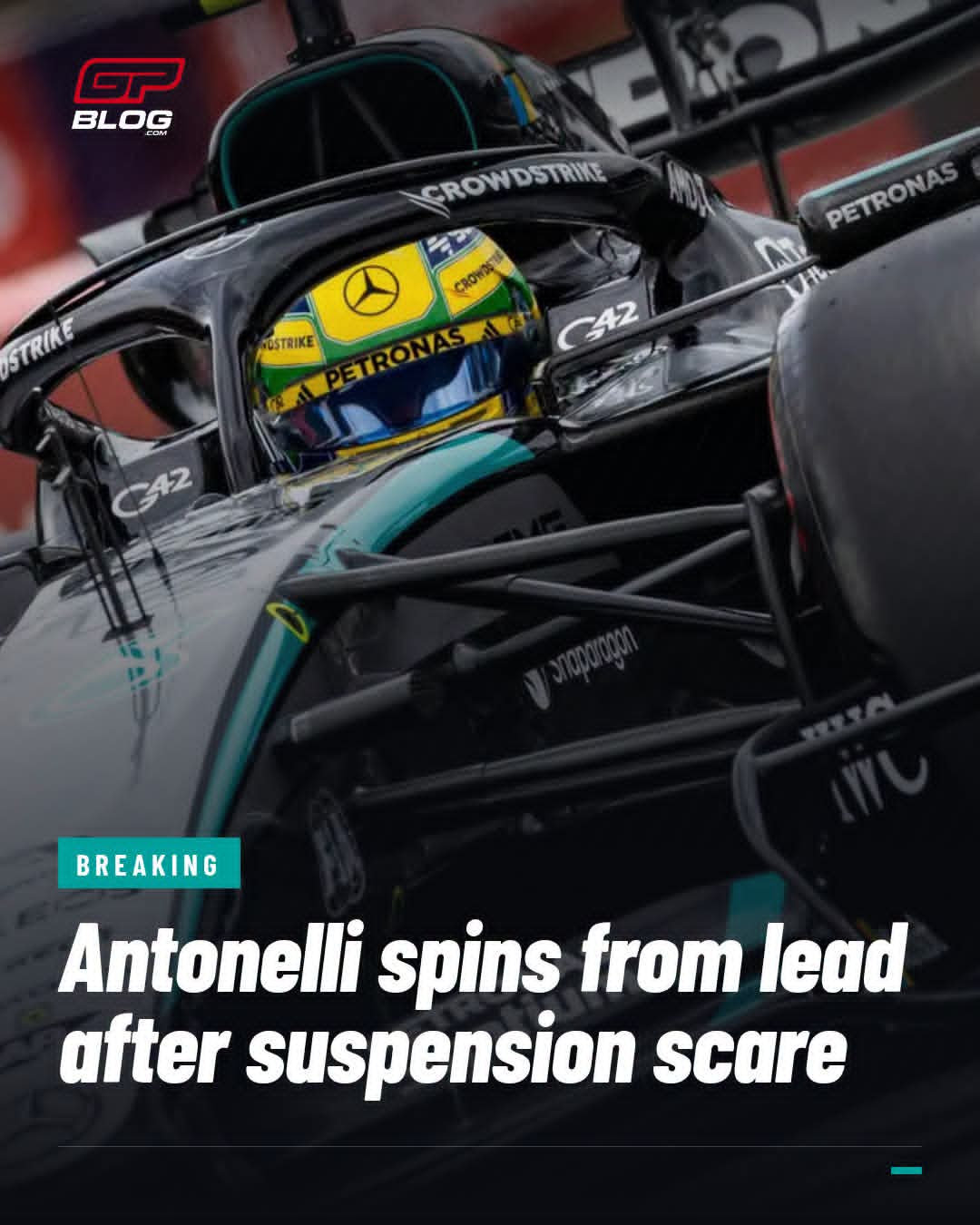
The 2026 Sao Paulo Grand Prix delivered pure Formula 1 chaos at Interlagos, and the biggest moment belonged to the sport’s newest world champion. Kimi Antonelli was leading the race when he radioed his engineer about a clear problem with the car. Moments later the Mercedes snapped sideways at Turn 1 and the lead was gone.
What looked like a simple cold-tyre spin quickly became something more intriguing — and more revealing about the fine line between control and disaster in modern F1.
ANTONELLI SOUNDED THE ALARM BEFORE THE SPIN
Antonelli had started from the front row after teammate George Russell took a grid penalty. He made a strong getaway and seized the lead early. For a stretch of the race the young Italian looked comfortable out front while the field behind him shuffled through the changing conditions.
Then the radio messages started. Antonelli reported that something felt wrong. He told the team the car was behaving strangely, particularly in left-hand corners. In one exchange he insisted it was not simply tyre temperature — the team’s initial diagnosis — but a suspension issue. The car, he said, felt like it was steering itself.
Peter Bonnington, the veteran race engineer known simply as “Bono,” urged him to focus and keep pushing. Within a short space of time the Mercedes rotated at the first corner. Lando Norris swept through into the lead. Antonelli recovered and rejoined, but the damage was done. Further moments followed, including another off, and he slipped down the order as Isack Hadjar and Max Verstappen both found ways past.
The timing made the radio traffic especially striking. Drivers often complain about grip or balance. Few call out a mechanical concern so clearly and then lose the lead in the very next sequence of corners.
WHY THE SPIN MATTERS BEYOND ONE CORNER
This was not just another Interlagos moment. Antonelli is the newly crowned world champion, the youngest in the sport’s history after sealing the title in Mexico. The Brazilian weekend was supposed to be a victory lap of sorts — a chance to race free of championship pressure on a circuit steeped in history.
Instead it became a reminder that even the best cars and drivers remain vulnerable when the surface is tricky and temperatures are changing. The track had been wet earlier. Teams were switching compounds and managing heat in the tyres. Interlagos rewards precision and punishes the smallest imbalance.
Mercedes needed strong points. The constructors’ championship battle with Ferrari remained alive, and every position counted. Watching their lead car lose places through a combination of reported mechanical concern and subsequent errors was costly in the moment and potentially significant for the longer campaign.
For Antonelli personally the incident carries extra weight. Young champions are still building their public image. Handling adversity on track, communicating clearly under pressure, and recovering without panic all form part of that process. The radio messages showed a driver who trusted his feel for the car enough to push back against the team’s initial explanation. That instinct is valuable — even when the result is painful.
THE BIGGER PICTURE AT INTERLAGOS
The race itself was already full of storylines. Norris started on pole and drove with the composure expected of a consistent frontrunner. Verstappen, starting near the back after penalties, produced another of his trademark recovery drives. Hadjar continued to show the kind of race craft that has marked him as one of the more interesting talents in the midfield-to-front group. Russell had his own drama with a spin in the pit lane.
Yet the Antonelli episode stood out because it combined three classic F1 elements: a mechanical suspicion, a high-stakes lead change, and the raw emotion of team radio. Fans heard the concern in real time. The pictures showed the spin. The timing connected the two.
Suspension issues in modern Formula 1 cars are rarely dramatic failures. More often they appear as subtle changes in feel — a pull under braking, an unexpected response in one direction, or a general sense that the platform is no longer neutral. Drivers spend countless hours calibrating their sense of the car. When that sense is disturbed, confidence erodes quickly, especially on a track as demanding as Interlagos.
Whether the problem was genuine suspension damage, a temporary effect of cold tyres and changing grip, or a combination of both may only become clear after the team examines the data and the car itself. What matters in the moment is that Antonelli felt something was wrong and said so before the spin occurred.
WHAT THIS MEANS GOING FORWARD
For Mercedes the incident raises practical questions about reliability under variable conditions and the communication loop between driver and pit wall. For Antonelli it becomes another data point in a season that has already rewritten records. Champions are measured not only by the races they dominate but by how they respond when control slips away.
The Sao Paulo Grand Prix has a long history of delivering unexpected turns. This latest chapter fits the tradition. A young world champion leading the race, a clear warning over the radio, and a sudden spin that changed the order in a single corner.
Formula 1 rarely offers cleaner drama than that. The rest of the afternoon would continue to unfold with its own twists, but the image of Antonelli’s Mercedes rotating at Turn 1 — right after he had told the team the car was not right — will be one of the lasting memories of the 2026 Brazilian Grand Prix.